A.M.I.T. Treatment in Draper, UT
Chiropractic Adjustments in Draper, UT
A chiropractic adjustment is a controlled, manual movement that restores motion to a joint that has lost it. At AMIT Clinics in Draper (12371 S 900 E Unit 101), we use adjustments alongside the AMIT Method, so the joint stays mobile after you leave instead of slipping back to its old pattern within hours. This page covers what an adjustment actually does, when it's the right call, and how a visit looks at our Draper office for patients across Salt Lake County.
What an Adjustment Actually Does
Joints in the spine and extremities lose motion. Sometimes it's traumatic — a fall, a collision, lifting a child the wrong way. More often it's gradual: long hours sitting, repetitive movement, side-sleeping habits, an old injury that never fully resolved. When a joint can't move through its normal range, the surrounding muscles tighten to protect it. That protective tone is where most of the felt pain comes from.
An adjustment delivers a specific, low-amplitude force into the restricted joint. The audible "pop" — when it happens — is gas releasing from the joint capsule and isn't a measure of effectiveness. What matters is the result: the joint moves, the protective muscle tone drops, and the nervous system gets accurate information about where the body is in space.
Why We Pair Adjustments With Muscle Reactivation
Adjustments by themselves often hold for a day or two before the same restriction returns. That happens when an inhibited muscle — one that has lost its nerve signal — is letting the joint drift back into the old pattern. At our Draper clinic, we test the muscles around the restricted joint before we adjust. If we find inhibited muscles, we reactivate them in the same visit. Once the muscle holds, the adjustment has something to anchor against, and patients stop relying on weekly cracks to feel functional.
This is the structural difference between an adjustment-only approach and the AMIT Method protocol. We see patients across Draper, Sandy, Riverton, Herriman, South Jordan, and the surrounding Salt Lake County area who've been to other chiropractors for years and tell us this is the first time the changes are sticking.
Conditions Adjustments Help With at AMIT Draper
Adjustments are most effective when the underlying issue is restricted joint motion. We use them most often for:
Acute and chronic low back pain
Neck pain, including post-whiplash and strain from prolonged screen and laptop work
Tension and cervicogenic headaches
Mid-back stiffness from prolonged sitting and driving
Sacroiliac (SI) joint dysfunction
Rib restrictions that make deep breathing or rotation painful
Restricted hip and shoulder motion limiting sport, lifting, or daily function
If imaging has already ruled out fracture, recent surgical hardware, or instability, adjustments are typically safe. We screen at the first visit either way.
How a Visit Works
History and screening. We walk through the injury or symptom, your activity level, prior care, and any imaging. Red flags — fracture, recent surgery, severe radiating symptoms — are caught here.
Movement and orthopedic exam. We watch how you move and where motion is missing. We test the joints above and below the painful one, because the cause is rarely in one isolated joint.
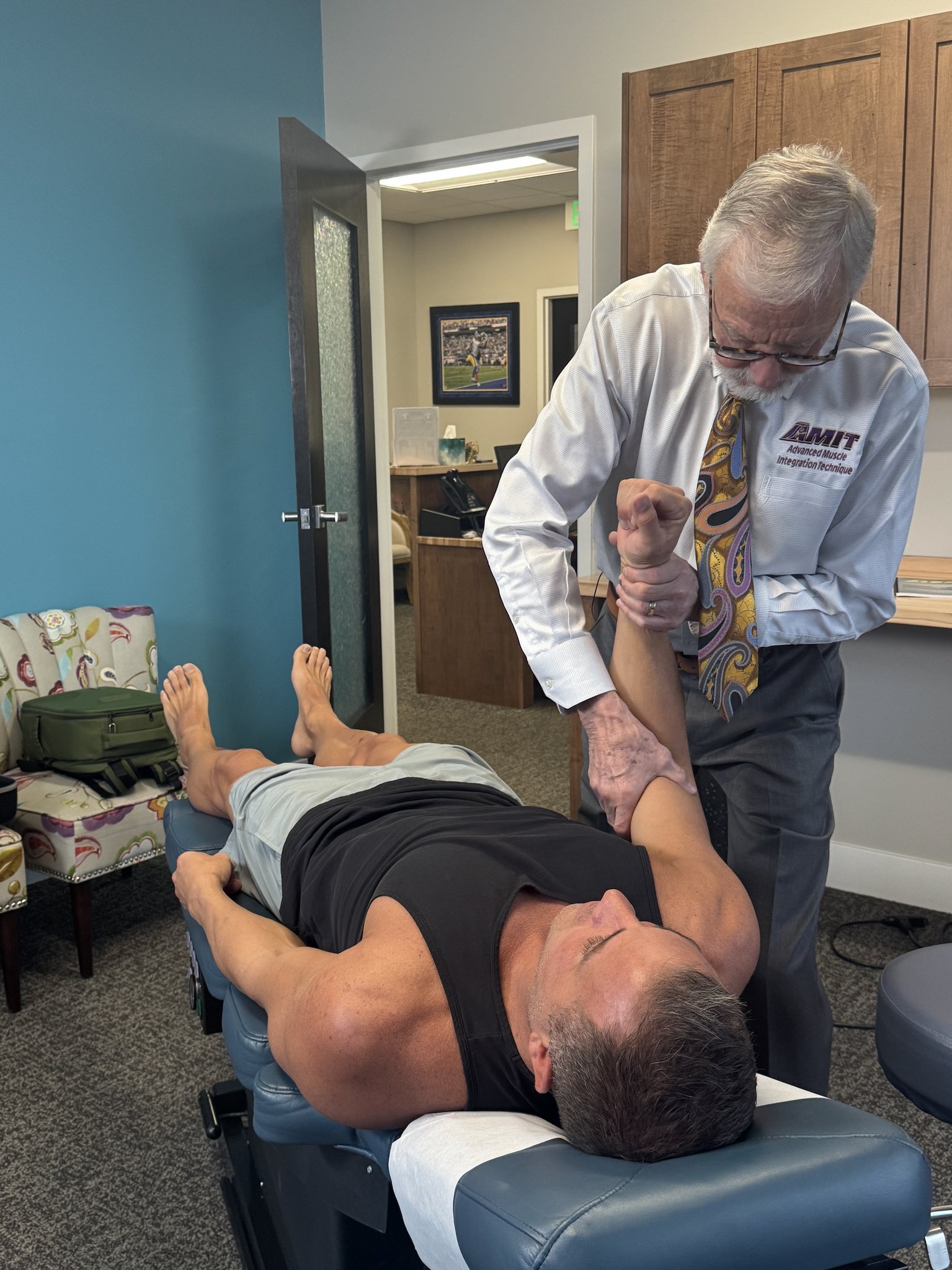
Muscle testing. Per the AMIT protocol, we identify inhibited muscles around the restricted joint.
Adjustment. The actual adjustment is fast — a few seconds per joint. We use the technique that fits the joint and the patient: manual diversified, drop-table, instrument-assisted, or lower-force methods depending on the case.
Reactivation and re-test. We reactivate any inhibited muscles so the joint stays in its corrected position, and we re-test before moving on.
Plan. Acute cases usually start with two or three visits in week one and taper as symptoms resolve. Maintenance schedules vary by lifestyle and history — we don't apply blanket long-term packages.
Visiting Our Draper Office
AMIT Clinics — Draper is at 12371 S 900 E Unit 101, Draper, UT 84020. Parking is on-site. We see patients from across Salt Lake County, including Draper, Sandy, Riverton, Herriman, and South Jordan.
Hours at the Draper office:
Monday: 7:30 AM – 4:00 PM
Tuesday: 6:30 AM – 4:00 PM
Wednesday: 7:30 AM – 4:00 PM
Thursday: 7:30 AM – 4:00 PM
Friday, Saturday & Sunday: Closed
New patients call 801.544.2355. Existing patients can reschedule through the patient portal. Spanish-speaking patients can request Dr. Alec Russell, who is fluent in Spanish.
Who We See for Adjustments at AMIT Draper
Adjustments fit a wide range of bodies and complaints, and our Draper patient base reflects that:
Active adults dealing with back stiffness from sitting, driving, or repetitive lifting
Recreational and competitive athletes working through overuse and sport-specific patterns
Pregnant patients (Dr. Tolman is Webster Certified) and post-partum mothers
Older adults wanting to maintain mobility without surgery or long-term medication
Patients in post-collision care after motor-vehicle incidents
If you're not sure whether an adjustment is the right approach for your situation, the first visit exists to answer that, not to enroll you in a treatment plan.
Read more about how our chiropractic adjustments work as part of the AMIT Method.
Schedule an Adjustment in Draper
Call 801.544.2355 to book a new-patient exam at the Draper office. Most weeks we have same-week openings, including a 6:30 AM Tuesday slot for before-work appointments. New-patient intake forms are sent ahead so the visit goes to examining and treating, not paperwork.
Frequently Asked Questions
Are chiropractic adjustments safe?
Adjustments are safe for most patients when performed after a screening exam. At AMIT Draper we check for fracture risk, recent surgical hardware, severe disc pathology, and other contraindications before adjusting. For sensitive areas like the upper neck, we use lower-force or instrument-assisted techniques when appropriate.
How many visits will I need?
Most acute neck or back cases at AMIT Draper resolve in 2 to 6 visits across a few weeks. Long-standing patterns or post-injury cases may need more, with frequency tapering from 1–2 per week down to once a month or less. We don't sell pre-set packages — frequency follows the exam.
What is the cracking sound during an adjustment?
It's called a cavitation — gas releasing from the joint capsule when joint pressure changes during the adjustment. It is harmless and not an indicator of whether the adjustment was effective. Some adjustments, including low-force and instrument-assisted ones, produce no sound at all and still restore joint motion.
Are adjustments safe during pregnancy?
Yes, with appropriately trained providers. At AMIT Draper, Dr. Daphne Tolman is Webster Certified — a credential issued by the International Chiropractic Pediatric Association indicating advanced training in chiropractic care for pregnant patients. We use side-lying tables and modified contacts that fit each trimester.
Will I have to keep coming back forever once I start?
No, that's a common misconception. Many of our Draper patients return only when symptoms recur or for periodic check-ins. Pairing adjustments with the AMIT Method addresses the muscle inhibition that drives recurring restrictions, which is why patients here usually need fewer visits over time, not more.
Do you accept insurance?
We accept several major insurance plans and will bill on your behalf when applicable. Coverage varies by plan, so we recommend calling 801.544.2355 with your member ID and we'll verify benefits for your specific policy before your visit. Self-pay rates are also available.
A chiropractic adjustment is a controlled, manual movement that restores motion to a joint that has lost it. At AMIT Clinics in Draper (12371 S 900 E Unit 101), we use adjustments alongside the AMIT Method, so the joint stays mobile after you leave instead of slipping back to its old pattern within hours. This page covers what an adjustment actually does, when it's the right call, and how a visit looks at our Draper office for patients across Salt Lake County.
What an Adjustment Actually Does
Joints in the spine and extremities lose motion. Sometimes it's traumatic — a fall, a collision, lifting a child the wrong way. More often it's gradual: long hours sitting, repetitive movement, side-sleeping habits, an old injury that never fully resolved. When a joint can't move through its normal range, the surrounding muscles tighten to protect it. That protective tone is where most of the felt pain comes from.
An adjustment delivers a specific, low-amplitude force into the restricted joint. The audible "pop" — when it happens — is gas releasing from the joint capsule and isn't a measure of effectiveness. What matters is the result: the joint moves, the protective muscle tone drops, and the nervous system gets accurate information about where the body is in space.
Why We Pair Adjustments With Muscle Reactivation
Adjustments by themselves often hold for a day or two before the same restriction returns. That happens when an inhibited muscle — one that has lost its nerve signal — is letting the joint drift back into the old pattern. At our Draper clinic, we test the muscles around the restricted joint before we adjust. If we find inhibited muscles, we reactivate them in the same visit. Once the muscle holds, the adjustment has something to anchor against, and patients stop relying on weekly cracks to feel functional.
This is the structural difference between an adjustment-only approach and the AMIT Method protocol. We see patients across Draper, Sandy, Riverton, Herriman, South Jordan, and the surrounding Salt Lake County area who've been to other chiropractors for years and tell us this is the first time the changes are sticking.
Conditions Adjustments Help With at AMIT Draper
Adjustments are most effective when the underlying issue is restricted joint motion. We use them most often for:
Acute and chronic low back pain
Neck pain, including post-whiplash and strain from prolonged screen and laptop work
Tension and cervicogenic headaches
Mid-back stiffness from prolonged sitting and driving
Sacroiliac (SI) joint dysfunction
Rib restrictions that make deep breathing or rotation painful
Restricted hip and shoulder motion limiting sport, lifting, or daily function
If imaging has already ruled out fracture, recent surgical hardware, or instability, adjustments are typically safe. We screen at the first visit either way.
How a Visit Works
History and screening. We walk through the injury or symptom, your activity level, prior care, and any imaging. Red flags — fracture, recent surgery, severe radiating symptoms — are caught here.
Movement and orthopedic exam. We watch how you move and where motion is missing. We test the joints above and below the painful one, because the cause is rarely in one isolated joint.
Muscle testing. Per the AMIT protocol, we identify inhibited muscles around the restricted joint.
Adjustment. The actual adjustment is fast — a few seconds per joint. We use the technique that fits the joint and the patient: manual diversified, drop-table, instrument-assisted, or lower-force methods depending on the case.
Reactivation and re-test. We reactivate any inhibited muscles so the joint stays in its corrected position, and we re-test before moving on.
Plan. Acute cases usually start with two or three visits in week one and taper as symptoms resolve. Maintenance schedules vary by lifestyle and history — we don't apply blanket long-term packages.
Visiting Our Draper Office
AMIT Clinics — Draper is at 12371 S 900 E Unit 101, Draper, UT 84020. Parking is on-site. We see patients from across Salt Lake County, including Draper, Sandy, Riverton, Herriman, and South Jordan.
Hours at the Draper office:
Monday: 7:30 AM – 4:00 PM
Tuesday: 6:30 AM – 4:00 PM
Wednesday: 7:30 AM – 4:00 PM
Thursday: 7:30 AM – 4:00 PM
Friday, Saturday & Sunday: Closed
New patients call 801.544.2355. Existing patients can reschedule through the patient portal. Spanish-speaking patients can request Dr. Alec Russell, who is fluent in Spanish.
Who We See for Adjustments at AMIT Draper
Adjustments fit a wide range of bodies and complaints, and our Draper patient base reflects that:
Active adults dealing with back stiffness from sitting, driving, or repetitive lifting
Recreational and competitive athletes working through overuse and sport-specific patterns
Pregnant patients (Dr. Tolman is Webster Certified) and post-partum mothers
Older adults wanting to maintain mobility without surgery or long-term medication
Patients in post-collision care after motor-vehicle incidents
If you're not sure whether an adjustment is the right approach for your situation, the first visit exists to answer that, not to enroll you in a treatment plan.
Read more about how our chiropractic adjustments work as part of the AMIT Method.
Schedule an Adjustment in Draper
Call 801.544.2355 to book a new-patient exam at the Draper office. Most weeks we have same-week openings, including a 6:30 AM Tuesday slot for before-work appointments. New-patient intake forms are sent ahead so the visit goes to examining and treating, not paperwork.
Frequently Asked Questions
Are chiropractic adjustments safe?
Adjustments are safe for most patients when performed after a screening exam. At AMIT Draper we check for fracture risk, recent surgical hardware, severe disc pathology, and other contraindications before adjusting. For sensitive areas like the upper neck, we use lower-force or instrument-assisted techniques when appropriate.
How many visits will I need?
Most acute neck or back cases at AMIT Draper resolve in 2 to 6 visits across a few weeks. Long-standing patterns or post-injury cases may need more, with frequency tapering from 1–2 per week down to once a month or less. We don't sell pre-set packages — frequency follows the exam.
What is the cracking sound during an adjustment?
It's called a cavitation — gas releasing from the joint capsule when joint pressure changes during the adjustment. It is harmless and not an indicator of whether the adjustment was effective. Some adjustments, including low-force and instrument-assisted ones, produce no sound at all and still restore joint motion.
Are adjustments safe during pregnancy?
Yes, with appropriately trained providers. At AMIT Draper, Dr. Daphne Tolman is Webster Certified — a credential issued by the International Chiropractic Pediatric Association indicating advanced training in chiropractic care for pregnant patients. We use side-lying tables and modified contacts that fit each trimester.
Will I have to keep coming back forever once I start?
No, that's a common misconception. Many of our Draper patients return only when symptoms recur or for periodic check-ins. Pairing adjustments with the AMIT Method addresses the muscle inhibition that drives recurring restrictions, which is why patients here usually need fewer visits over time, not more.
Do you accept insurance?
We accept several major insurance plans and will bill on your behalf when applicable. Coverage varies by plan, so we recommend calling 801.544.2355 with your member ID and we'll verify benefits for your specific policy before your visit. Self-pay rates are also available.
A chiropractic adjustment is a controlled, manual movement that restores motion to a joint that has lost it. At AMIT Clinics in Draper (12371 S 900 E Unit 101), we use adjustments alongside the AMIT Method, so the joint stays mobile after you leave instead of slipping back to its old pattern within hours. This page covers what an adjustment actually does, when it's the right call, and how a visit looks at our Draper office for patients across Salt Lake County.
What an Adjustment Actually Does
Joints in the spine and extremities lose motion. Sometimes it's traumatic — a fall, a collision, lifting a child the wrong way. More often it's gradual: long hours sitting, repetitive movement, side-sleeping habits, an old injury that never fully resolved. When a joint can't move through its normal range, the surrounding muscles tighten to protect it. That protective tone is where most of the felt pain comes from.
An adjustment delivers a specific, low-amplitude force into the restricted joint. The audible "pop" — when it happens — is gas releasing from the joint capsule and isn't a measure of effectiveness. What matters is the result: the joint moves, the protective muscle tone drops, and the nervous system gets accurate information about where the body is in space.
Why We Pair Adjustments With Muscle Reactivation
Adjustments by themselves often hold for a day or two before the same restriction returns. That happens when an inhibited muscle — one that has lost its nerve signal — is letting the joint drift back into the old pattern. At our Draper clinic, we test the muscles around the restricted joint before we adjust. If we find inhibited muscles, we reactivate them in the same visit. Once the muscle holds, the adjustment has something to anchor against, and patients stop relying on weekly cracks to feel functional.
This is the structural difference between an adjustment-only approach and the AMIT Method protocol. We see patients across Draper, Sandy, Riverton, Herriman, South Jordan, and the surrounding Salt Lake County area who've been to other chiropractors for years and tell us this is the first time the changes are sticking.
Conditions Adjustments Help With at AMIT Draper
Adjustments are most effective when the underlying issue is restricted joint motion. We use them most often for:
Acute and chronic low back pain
Neck pain, including post-whiplash and strain from prolonged screen and laptop work
Tension and cervicogenic headaches
Mid-back stiffness from prolonged sitting and driving
Sacroiliac (SI) joint dysfunction
Rib restrictions that make deep breathing or rotation painful
Restricted hip and shoulder motion limiting sport, lifting, or daily function
If imaging has already ruled out fracture, recent surgical hardware, or instability, adjustments are typically safe. We screen at the first visit either way.
How a Visit Works
History and screening. We walk through the injury or symptom, your activity level, prior care, and any imaging. Red flags — fracture, recent surgery, severe radiating symptoms — are caught here.
Movement and orthopedic exam. We watch how you move and where motion is missing. We test the joints above and below the painful one, because the cause is rarely in one isolated joint.
Muscle testing. Per the AMIT protocol, we identify inhibited muscles around the restricted joint.
Adjustment. The actual adjustment is fast — a few seconds per joint. We use the technique that fits the joint and the patient: manual diversified, drop-table, instrument-assisted, or lower-force methods depending on the case.
Reactivation and re-test. We reactivate any inhibited muscles so the joint stays in its corrected position, and we re-test before moving on.
Plan. Acute cases usually start with two or three visits in week one and taper as symptoms resolve. Maintenance schedules vary by lifestyle and history — we don't apply blanket long-term packages.
Visiting Our Draper Office
AMIT Clinics — Draper is at 12371 S 900 E Unit 101, Draper, UT 84020. Parking is on-site. We see patients from across Salt Lake County, including Draper, Sandy, Riverton, Herriman, and South Jordan.
Hours at the Draper office:
Monday: 7:30 AM – 4:00 PM
Tuesday: 6:30 AM – 4:00 PM
Wednesday: 7:30 AM – 4:00 PM
Thursday: 7:30 AM – 4:00 PM
Friday, Saturday & Sunday: Closed
New patients call 801.544.2355. Existing patients can reschedule through the patient portal. Spanish-speaking patients can request Dr. Alec Russell, who is fluent in Spanish.
Who We See for Adjustments at AMIT Draper
Adjustments fit a wide range of bodies and complaints, and our Draper patient base reflects that:
Active adults dealing with back stiffness from sitting, driving, or repetitive lifting
Recreational and competitive athletes working through overuse and sport-specific patterns
Pregnant patients (Dr. Tolman is Webster Certified) and post-partum mothers
Older adults wanting to maintain mobility without surgery or long-term medication
Patients in post-collision care after motor-vehicle incidents
If you're not sure whether an adjustment is the right approach for your situation, the first visit exists to answer that, not to enroll you in a treatment plan.
Read more about how our chiropractic adjustments work as part of the AMIT Method.
Schedule an Adjustment in Draper
Call 801.544.2355 to book a new-patient exam at the Draper office. Most weeks we have same-week openings, including a 6:30 AM Tuesday slot for before-work appointments. New-patient intake forms are sent ahead so the visit goes to examining and treating, not paperwork.
Frequently Asked Questions
Are chiropractic adjustments safe?
Adjustments are safe for most patients when performed after a screening exam. At AMIT Draper we check for fracture risk, recent surgical hardware, severe disc pathology, and other contraindications before adjusting. For sensitive areas like the upper neck, we use lower-force or instrument-assisted techniques when appropriate.
How many visits will I need?
Most acute neck or back cases at AMIT Draper resolve in 2 to 6 visits across a few weeks. Long-standing patterns or post-injury cases may need more, with frequency tapering from 1–2 per week down to once a month or less. We don't sell pre-set packages — frequency follows the exam.
What is the cracking sound during an adjustment?
It's called a cavitation — gas releasing from the joint capsule when joint pressure changes during the adjustment. It is harmless and not an indicator of whether the adjustment was effective. Some adjustments, including low-force and instrument-assisted ones, produce no sound at all and still restore joint motion.
Are adjustments safe during pregnancy?
Yes, with appropriately trained providers. At AMIT Draper, Dr. Daphne Tolman is Webster Certified — a credential issued by the International Chiropractic Pediatric Association indicating advanced training in chiropractic care for pregnant patients. We use side-lying tables and modified contacts that fit each trimester.
Will I have to keep coming back forever once I start?
No, that's a common misconception. Many of our Draper patients return only when symptoms recur or for periodic check-ins. Pairing adjustments with the AMIT Method addresses the muscle inhibition that drives recurring restrictions, which is why patients here usually need fewer visits over time, not more.
Do you accept insurance?
We accept several major insurance plans and will bill on your behalf when applicable. Coverage varies by plan, so we recommend calling 801.544.2355 with your member ID and we'll verify benefits for your specific policy before your visit. Self-pay rates are also available.