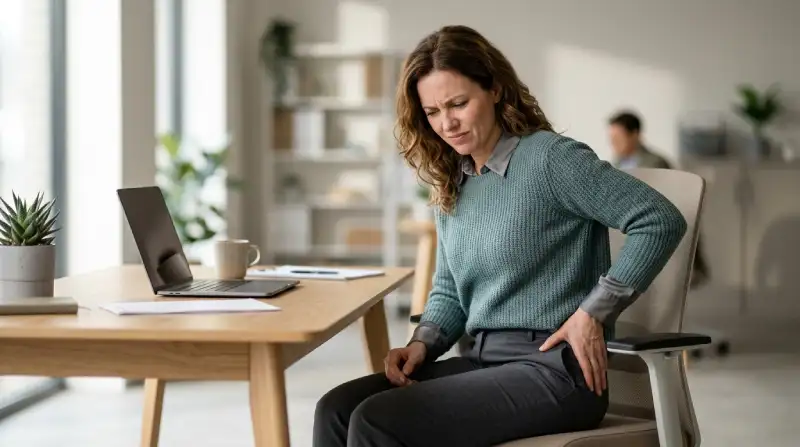
Hip pain from sitting too long is usually a soft tissue and activation problem, not joint damage.
Outer hip means bursitis, deep buttock means piriformis, front-of-hip pinching means tight hip flexors.
Greater trochanteric pain syndrome affects roughly 15 percent of women and 8 percent of men.
Stretching alone fails when the stabilizers have gone dormant and need reactivating, not lengthening.
Most cases improve with conservative care. Surgery is rarely the first or second conversation.
Hip pain from sitting too long is usually caused by soft tissue compression and muscle shutdown, not joint damage. When you sit, your hip flexors shorten, your glutes stop firing, and body weight presses through the bursa on the outside of the hip and the piriformis deep in the buttock. The result is a dull ache that sharpens the second you stand, then eases after a few steps. Standing all day does it from the other direction: the stabilizers fatigue, and the joint absorbs load alone.
Why Sitting Bothers Hips More Than People Expect
A chair holds your hip at about 90 degrees of flexion for hours. Muscles adapt to the position they live in, so the hip flexors shorten while the glutes get almost no work, and the brain stops recruiting them efficiently. That is muscle inhibition, and it matters more than flexibility: a hip without gluteal support stabilizes using smaller tissues never meant for the job.
Sitting also compresses tissue mechanically. Body weight loads the ischial tuberosity, where the sciatic nerve runs close to the piriformis, and prolonged sitting is a documented risk factor for piriformis syndrome. On the side of the hip, the bursa gets squeezed between bone and a tight iliotibial band, especially when you cross your legs.
In our Draper clinic the pattern is consistent. Patients who commute on I-15, sit a full workday, then drive home rarely show anything structural on imaging. They have a hip that forgot how to share load.
Five Common Causes of Hip Pain From Sitting Too Long
1. Greater Trochanteric Pain Syndrome (Hip Bursitis)
Greater trochanteric pain syndrome is irritation of the tissues over the bony point on the outside of your hip, including the bursa and gluteal tendons. It affects roughly 15 percent of women and 8 percent of men, most often middle-aged women. You cannot lie on that side at night, one finger finds the sore spot, and it flares after driving. Because tendons are usually involved, effective hip bursitis treatment needs to reduce the compression and then rebuild gluteal strength, not just calm the inflammation.
2. Piriformis Syndrome
Piriformis syndrome happens when the sciatic nerve is irritated by the piriformis muscle deep in the buttock. It accounts for an estimated 0.3 to 6 percent of low back pain cases, roughly 2.4 million people a year in the United States, and appears about six times more often in women. The pain sits deep in one buttock and can shoot down the back of the thigh, worst after sitting and on getting out of bed. Most patients improve within one to three weeks of a targeted program, so piriformis syndrome relief usually does not require anything invasive.
3. Shortened Hip Flexors With Dormant Glutes
This is the pattern behind most stubborn desk-job hip pain. The psoas and rectus femoris shorten, the pelvis tips forward, and the gluteus medius stops contributing. Patients stretch faithfully for months and get a few hours of relief each time, because lengthening a muscle does nothing to restore a firing pattern. Muscle reactivation for hip pain works the other direction: it re-establishes the neurological signal to the muscles that quit, so the hip has real support the moment you stand up.
4. Hip Impingement and Labral Irritation
Deep pinching in the front or groin when your knee comes toward your chest can point to femoroacetabular impingement or labral irritation. Low chairs and bucket seats aggravate it because the position closes the joint down. Stretching into the pinch makes it worse, so this group needs careful assessment.
5. Sacroiliac Joint Dysfunction
Pain just below the belt line on one side, often described as a bruise over the dimple of the low back, usually comes from the sacroiliac joint rather than the hip. Asymmetrical sitting is the common trigger.
Pain Location Map: A Quick Way to Narrow It Down
Where it hurts | Most likely cause | Telling detail |
Bony point on the outside of the hip | Greater trochanteric pain syndrome | Cannot sleep on that side |
Deep in the buttock, sometimes down the leg | Piriformis syndrome | Worse after sitting, eases when walking |
Front of the hip or crease, feels tight | Shortened hip flexors, dormant glutes | First few steps after standing are the worst |
Deep groin, pinching sensation | Impingement or labral irritation | Low chairs and car seats aggravate it |
Just below the belt line, one side | Sacroiliac joint dysfunction | Asymmetrical sitting triggers it |
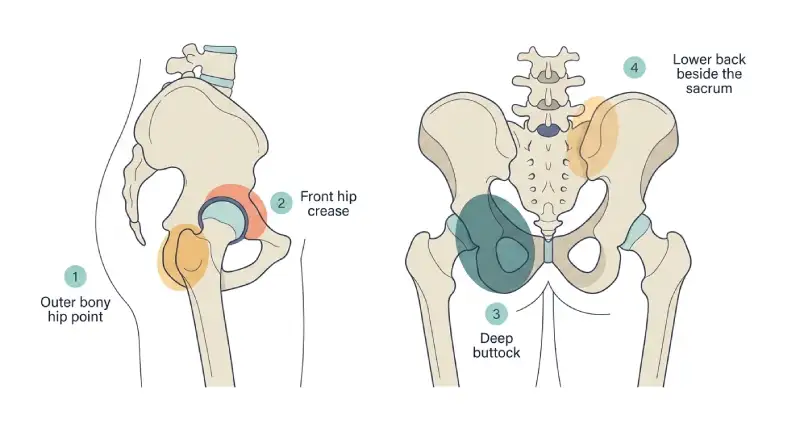
Self-check: stand up and walk ten steps. Pain that fades within 30 seconds points to soft tissue and activation problems. Pain that stays or worsens deserves a hands-on evaluation.
When Standing Too Long Is the Trigger Instead
Nurses, teachers, stylists, and retail staff describe the opposite: fine in the morning, aching by hour six. The mechanism is fatigue, not compression. Once the gluteus medius tires, the pelvis drops slightly with each step and the outer hip tissues absorb the extra load thousands of times per shift. Hard floors and worn shoes speed that up.
The fix is not more standing tolerance. It is enough single-leg strength to hold position under fatigue, plus changing position on a schedule.
Non-Surgical Solutions That Address the Cause
Restore the firing pattern before you chase flexibility
If a muscle is inhibited, stretching its opposite will not wake it up. Testing which muscles are actually recruiting, then reactivating them in order, changes how the hip loads within a few sessions. This is the step self-directed programs skip, and usually why a patient says they have tried everything.
Decompress the irritated tissue, then load it
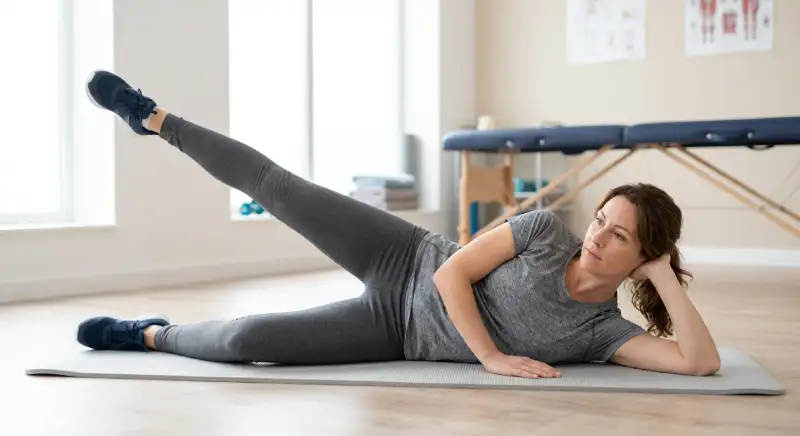
Soft tissue work on the iliotibial band, tensor fasciae latae, and piriformis reduces the squeeze so the area calms down. Use that window for progressive loading: side-lying abduction, bridges, step-downs, then single-leg work. Rest alone fails, because deconditioned tissue re-irritates once normal life resumes.
Interrupt the sitting, not just the symptom
Break the position. Stand and take ten steps every 30 minutes. Frequency beats duration.
Set the chair. Hips slightly above knees, feet flat, weight even, legs uncrossed.
Hit the activity floor. The CDC recommends 150 minutes of moderate activity weekly plus strength work on at least two days. Those strength days build hip stability.
Load the glutes daily. Two minutes of hip extension after a long drive prevents the evening flare.
Clinically, patients who combine reactivation with graded loading notice a change in those first few steps within two to three weeks, well before the hip feels normal. When that early shift does not happen, reassess rather than repeat the program for another month.
Red Flags: When to Stop Self-Treating
Pain after a fall, or you cannot bear weight.
Night pain that wakes you regardless of position.
Fever, unexplained weight loss, or a cancer history.
Numbness, progressive weakness, or bowel or bladder changes.
No improvement after six weeks of consistent conservative care.
Frequently Asked Questions
Why does my hip hurt after sitting for a long time?
Prolonged sitting shortens the hip flexors, lets the glutes go dormant, and compresses the bursa on the outside of the hip and the piriformis in the buttock. When you stand, those tissues load suddenly with little muscular support, which produces the first-few-steps ache.
How do I know if my hip pain is bursitis or something else?
Bursitis and gluteal tendon pain sit over the bony point on the outside of the hip, are tender to one-finger pressure, and make lying on that side painful. Deep buttock pain travelling down the leg points to the piriformis. Groin pinching points to the joint and needs an exam.
Can sitting too long cause permanent hip damage?
Sitting itself does not destroy the hip joint. It creates tightness, muscle inhibition, and tissue irritation that turn chronic if ignored for years. Chronic tendon irritation resolves more slowly than a recent flare, so address it early.
What is the best sitting position for hip pain?
Hips level or slightly higher than your knees, both feet flat, weight even, legs uncrossed. A small lumbar support keeps the pelvis neutral. No position is good for three straight hours, so the schedule matters more than the chair.
How long does hip bursitis take to heal?
Most cases settle over six to twelve weeks with consistent conservative care, though tendon involvement can extend that. Cases treated early resolve faster than those recurring for a year or more.
Hip pain after sitting or standing too long is almost always about how the hip loads, not a joint that needs replacing. Identify the irritated tissue, restore the muscles that stopped working, then load the hip progressively. That sequence resolves most cases without surgery or injections.
If your hip pain has outlasted stretching and rest, a hands-on assessment will tell you which of the five causes you have. Request an evaluation at our Draper, UT clinic and we will map the pattern before recommending anything.