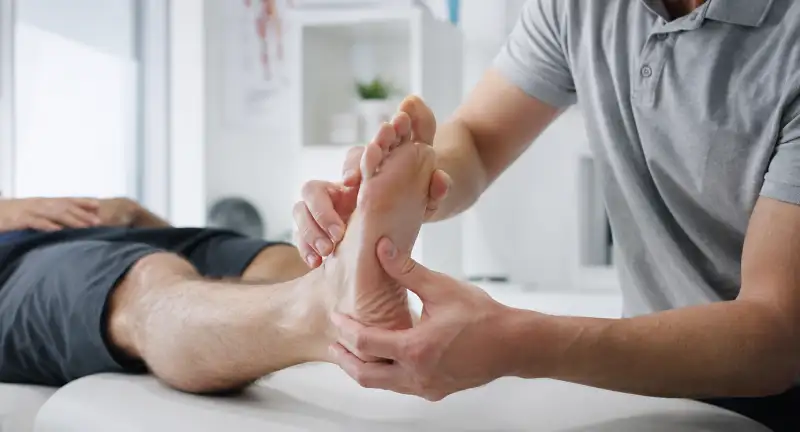
You rested it. You iced it. You bought the arch supports and did the calf stretches every night for a month. For a while, the sharp pain under your heel eased up, so you went back to your normal routine, and within a week or two it was right back. If that cycle sounds familiar, you are not doing anything wrong, and you are not alone. It is one of the most common frustrations we hear from patients in Kaysville and Draper. You are just missing the piece that rest alone was never going to fix.
The short version: plantar fasciitis treatment that works has to address two things, the irritated tissue in the fascia itself and the calf and foot muscle dysfunction that keeps overloading it. Rest and stretching only touch the first piece. Skip the second and the pain almost always comes back once you resume normal activity.
Why rest alone doesn't fix plantar fasciitis
Rest works by removing the load that irritates the fascia, so the pain quiets down. That is genuine progress, but it is temporary progress, because rest does nothing to change what put that load on the fascia in the first place. The moment you return to standing, walking, or running the same way you always have, the same forces are back.
This is the pattern we see constantly in our Kaysville and Draper clinics: someone rests for a few weeks, feels better, resumes activity, and the heel pain returns within days. It is not that they rested wrong or didn't rest long enough. Effective plantar fasciitis treatment has to change the mechanics that overload the fascia, not just wait out the current flare.
What's actually going on in your foot
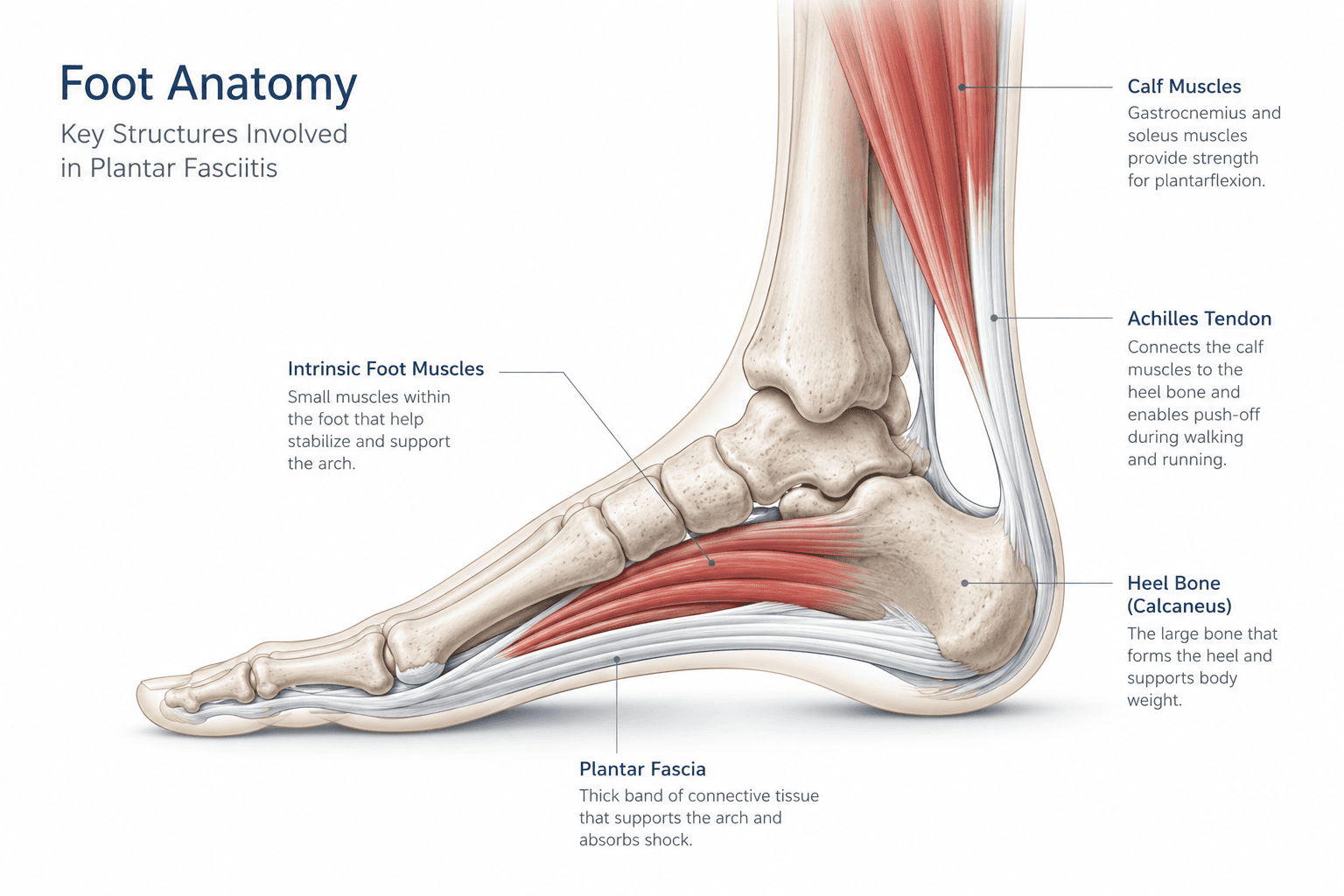
Plantar fascia: a thick band of tissue that runs along the bottom of the foot, connecting the heel bone to the base of the toes and supporting the arch with every step. When that band is repeatedly overstretched or overloaded, small tears and irritation develop where it attaches to the heel, which is what produces the classic stabbing pain, especially with the first steps in the morning.
The fascia does not overload itself in a vacuum. The calf muscles and the small intrinsic muscles inside the foot are supposed to share the work of supporting the arch and absorbing impact. When those muscles are tight, weak, or firing at the wrong time, the fascia picks up the slack, step after step, thousands of times a day. That constant extra load is why the tissue never gets a real chance to settle down.
This is also why the pain is often worst with the very first steps out of bed. Overnight, the fascia tightens back up in a shortened position. The first steps of the day stretch it out abruptly, before the surrounding muscles have warmed up and started sharing the load again, which is exactly the kind of sudden strain that irritates already-inflamed tissue the most.
What increases your risk of plantar fasciitis
Certain patterns make the fascia more likely to become overloaded in the first place. Runners and people who spend long hours on their feet, whether on a job site or behind a retail counter, put repeated, cumulative stress on the same structures with every step. Sudden increases in activity, like ramping up mileage or starting a new job that keeps you standing all day, often line up with when symptoms first appear.
Foot structure plays a role too. Both flat feet and unusually high arches change how load moves through the foot, and either one can leave the fascia doing more work than it should. Extra body weight adds load directly, and tight calf muscles, the same muscles that so often turn out to be part of the underlying dysfunction, pull on the heel and limit how well the ankle absorbs impact. None of these factors are things to feel bad about, and having one or several does not guarantee you will develop plantar fasciitis. They simply explain why the fascia became overloaded, which matters because a real fix has to change the load, not just wait for the pain to pass.
Comparing your options side by side
Not every approach to heel pain works the same way or on the same timeline. Here is how the common options compare.
Approach | What it targets | Typical timeline | Fixes muscle overload? |
|---|---|---|---|
Rest and ice only | The pain signal, not the cause | Relief while resting, returns with activity | No |
Stretching and orthotics | Redistributes pressure on the fascia | Weeks to months, partial relief | Partially |
Softwave (shockwave) therapy | Stimulates healing in the fascia tissue itself | Often several sessions to notice change | Targets tissue, not the muscle driver |
Muscle reactivation (A.M.I.T.) | Calf and intrinsic foot muscle function | Builds progressively over a treatment plan | Yes, addresses the mechanical root cause |
The pattern in this table is the point: everything on it can help, but only an approach that also restores calf and foot muscle function actually removes the reason the fascia keeps getting overloaded. That is why combining tissue-level care with muscle-level care tends to outperform either one alone.
The muscle dysfunction driving your heel pain
Tight calves are the most familiar piece of this picture, but tightness is only half the problem. Just as often, the muscles have gone quiet rather than tight, meaning they are not activating and stabilizing the foot the way they should during walking or running. A muscle that is not doing its job forces the fascia and surrounding tissue to compensate, which is exactly the setup for chronic overload.
This is where muscle reactivation for plantar fasciitis changes the outcome. Rather than stretching a tight muscle or resting an irritated one, the goal is to identify which specific calf or foot muscles have stopped firing correctly and retrain them, so the arch has real support again instead of relying on the fascia to hold everything together. In our experience, patients who only stretch and ice tend to plateau; patients whose muscle function gets addressed tend to keep improving.
How Softwave therapy speeds up healing
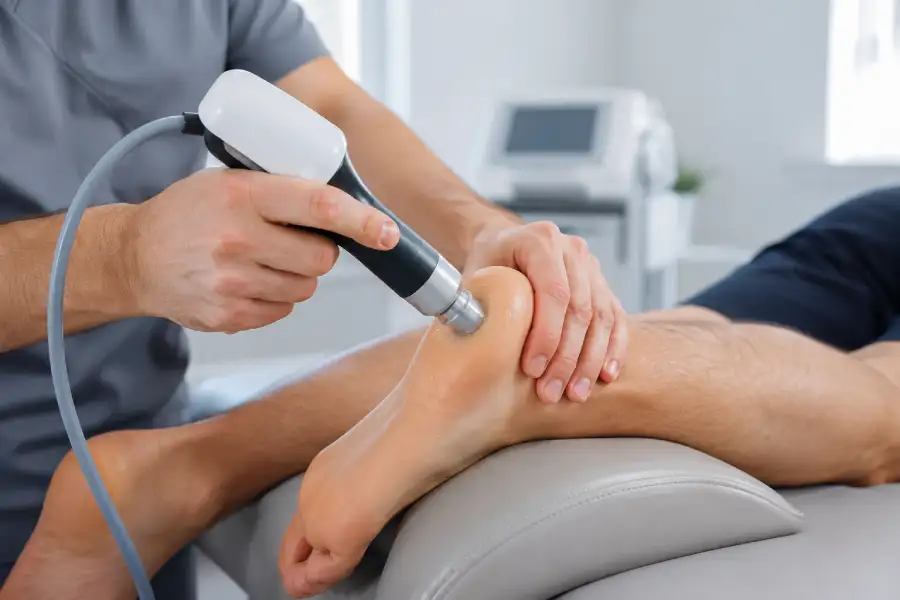
While muscle reactivation addresses why the fascia keeps getting overloaded, the irritated tissue itself often needs direct help to heal. Softwave therapy for foot pain uses acoustic pressure waves delivered directly to the injured area to stimulate blood flow and the body's own repair response in tissue that has been inflamed for months and stopped healing on its own.
Unlike rest, which simply waits for healing to happen, Softwave actively encourages it, which is why patients who have been stuck in a rest-flare-rest cycle for months often respond faster once the fascia itself is directly treated. It is also a non-surgical, non-invasive option, which matters to patients who want real progress without committing to an injection or a procedure before trying a more conservative path first. Pairing this tissue-level care with muscle reactivation covers both halves of the problem at the same time instead of one at a time.
When to see someone about heel pain
Most plantar fasciitis does not require urgent care, but a few signs mean it is worth getting checked sooner rather than later: pain that is worsening despite weeks of home care, swelling or bruising after a specific injury, numbness or tingling in the foot, or pain severe enough that you are limping or avoiding weight on the foot entirely.
Short of those red flags, heel pain that has lasted more than a few weeks, or that keeps returning every time you resume normal activity, is a reasonable point to get a professional assessment rather than continuing to cycle through rest on your own. The longer the fascia stays irritated and the muscle dysfunction goes unaddressed, the longer a full recovery tends to take, and the more the body tends to compensate in ways that create secondary aches in the knee, hip, or lower back.
Ready for plantar fasciitis treatment that works
If you have already tried rest, ice, and stretching and your heel pain keeps coming back, the missing piece is almost always the muscle dysfunction behind it, not a lack of willpower or patience. At AMIT Clinics in Kaysville and Draper, we assess both the fascia and the calf and foot muscles feeding into it, then combine Softwave therapy with muscle reactivation to address the full picture instead of just the symptom you feel today. Reach out to schedule a consultation and get off the rest-and-repeat cycle for good.
Plantar Fasciitis Treatment: Frequently Asked Questions
What is the fastest way to treat plantar fasciitis?
The fastest results usually come from combining direct tissue treatment, such as Softwave therapy, with muscle reactivation that restores calf and foot muscle function. Rest and stretching alone are slower because they only reduce irritation without correcting the mechanical overload causing it.
Why won't my plantar fasciitis go away even after months of rest and stretching?
Plantar fasciitis often persists because rest and stretching address the irritated tissue but not the underlying muscle dysfunction overloading it. If the calf or intrinsic foot muscles are not activating correctly, the fascia keeps absorbing extra load the moment you resume normal activity.
Is Softwave therapy effective for plantar fasciitis?
Softwave therapy is effective for plantar fasciitis because it uses acoustic pressure waves to stimulate blood flow and the body's healing response directly in fascia tissue that has stalled out. It is often most effective when paired with care that also addresses the muscle overload driving the injury.
Can plantar fasciitis be treated without surgery or injections?
Yes, most cases of plantar fasciitis respond to non-surgical care such as Softwave therapy and muscle reactivation, especially when the treatment addresses both the fascia and the calf and foot muscle function around it. Surgery is typically considered only after an extended course of conservative treatment has not helped.
How long does plantar fasciitis treatment take to work?
Many patients notice meaningful improvement within several sessions once both the fascia and the muscle dysfunction behind it are being treated. Cases that have lingered for many months, or that only ever received rest and stretching, generally take longer because compensations have had more time to build up.
Where can I get plantar fasciitis treatment in Kaysville or Draper, UT?
AMIT Clinics treats plantar fasciitis at both its Kaysville and Draper, Utah locations. Care starts with an assessment of the fascia and the calf and foot muscles involved, then combines Softwave therapy and muscle reactivation to target the full cause of the heel pain.