
Shoulder pain that won't heal after two to three weeks of rest is rarely just a strain. It's typically rotator cuff irritation, shoulder impingement, or a stability deficit in the muscles that hold the joint in place, and pushing through it without addressing the underlying mechanics tends to make it worse, not better.
When "It'll Work Itself Out" Stops Being True
Every athlete has iced a sore shoulder and gone back to practice the next week. That works fine for a normal overuse ache. It stops working when the pain sticks around past the two-to-three-week mark, shows up at night, or changes how you move your arm without you noticing.
At our Draper and Kaysville clinics, this is one of the most common patterns we see: someone treated a shoulder like a bruise for a month, and by the time they came in, a manageable issue had become a guarded, weak, and painful one. rotator cuff syndrome treatment is one of the two conditions we screen for first in these cases, because it's frequently misdiagnosed as "just tendonitis" and treated with rest alone, which rarely fixes it.
Rotator Cuff Pain vs. Shoulder Impingement: They're Not the Same Injury
These two conditions get lumped together constantly, and the treatment overlap makes that understandable. But the mechanics are different enough that it matters.
Rotator cuff pain: usually comes from irritation, a partial tear, or weakness in one of the four muscles that stabilize the shoulder joint. It tends to ache deep in the shoulder, worsens with overhead reaching, and often includes a specific weak spot you can point to.
shoulder impingement relief :happens when the space between the top of the arm bone and the shoulder blade narrows, pinching tendons and the bursa every time you lift your arm. It produces a sharper, catching pain in a specific arc of motion, usually between shoulder height and just above it.
The overlap: both get worse with repetitive overhead motion (swimming, throwing, lifting, painting), and both are frequently caused by the same root problem: the small stabilizing muscles around the shoulder blade aren't doing their job, so the joint compensates in ways it wasn't built for.
Feature | Rotator Cuff Pain | Shoulder Impingement |
Pain location | Deep, diffuse ache | Sharp, catching |
Trigger | Weight-bearing, lifting | Specific arm angle |
Night pain | Common | Less common |
Weakness | Often noticeable | Usually minimal |
Root cause | Muscle tear or degeneration | Structural narrowing/compensation |
Why Rest Alone Rarely Fixes It
Rest reduces inflammation. It does nothing to correct the muscle imbalance that put excess load on the rotator cuff or narrowed the shoulder space in the first place. That's why so many athletes rest for a month, feel better, go back to the same activity, and end up right back where they started within a few weeks.
In our clinical experience treating active adults across Utah County, the shoulders that heal and stay healed are the ones where the stabilizing muscles, particularly the serratus anterior and lower trapezius, get retrained to actually fire during overhead movement. A 2019 review in the British Journal of Sports Medicine found that exercise-based rehabilitation produced outcomes comparable to surgery for many rotator cuff and impingement cases, without the recovery time. That's the direction we push toward whenever it's clinically appropriate.
What Actually Resolves Shoulder Pain That Won't Heal
1. Accurate diagnosis first. A thorough movement and strength assessment identifies whether you're dealing with a cuff issue, impingement, joint instability, or a combination.
2. Muscle reactivation. Restoring the neuromuscular signal to the stabilizers that have gone quiet is often the real reason the shoulder keeps re-aggravating, since a weak or "asleep" stabilizer forces the rotator cuff to overwork.
3. Progressive loading. Once the joint moves through its full range without pain, controlled strength work rebuilds capacity so the shoulder can handle real activity again, not just daily life.
4. Movement pattern correction. For throwers, swimmers, and lifters, the mechanics that caused the problem need to change, or the same pain returns with the same motion.
We see this pattern constantly with weekend athletes in Draper and Kaysville who assumed a sore shoulder from pickleball or golf would fade on its own. It's the same joint, the same tissue, whether the sport is competitive or recreational, and it responds to the same corrective process either way.
Common Causes We See in Draper and Kaysville Patients
The specific activity varies, but the pattern behind shoulder pain that won't heal is remarkably consistent across the patients we treat at both locations.
Overhead athletes and weekend warriors. Swimmers, volleyball players, and pickleball regulars in Draper load the shoulder in the same overhead arc thousands of times a season. Once the stabilizers fatigue, the joint starts relying on the rotator cuff to do a job it wasn't designed to handle alone.
Desk work followed by weekend intensity. A lot of Kaysville patients spend forty hours a week with rounded shoulders at a keyboard, then hit the gym or the golf course hard on weekends. That combination, chronically shortened chest muscles and weak mid-back stabilizers, sets the shoulder up for impingement the moment load increases.
Prior injury that never fully rehabbed. We regularly see shoulders that were "fine" after a fall or a strain a year or two earlier, but never regained full stabilizer strength. The joint compensated silently until a new activity pushed it past its adjusted limit.
Age-related tendon changes. Rotator cuff tissue naturally loses some elasticity and blood supply with age, which is part of why shoulder pain that won't heal becomes more common in active adults over 40, even without a specific injury moment they can point to.
None of these causes are unusual or complicated. What they have in common is that they build gradually, which is exactly why rest, a strategy built for acute injuries, doesn't reliably fix them.
When to Stop Waiting and Get It Looked At
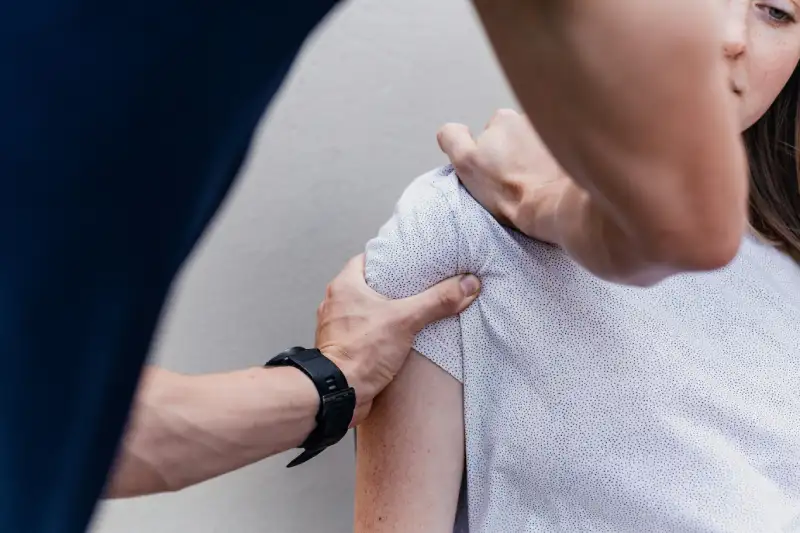
A shoulder that's still painful after three weeks of rest, that wakes you up at night, or that has visibly lost strength compared to the other side has moved past the point where self-treatment is likely to work. Waiting longer generally means a longer recovery once you do get help, because the compensation patterns around the joint have more time to settle in.
This article is educational and doesn't replace an in-person evaluation. If your shoulder pain has lasted more than a few weeks, changed how you sleep, or limited your range of motion, a licensed provider should assess it directly before you decide on a treatment path.
Frequently Asked Questions
Why won't my shoulder pain go away with rest?
Rest reduces inflammation but doesn't correct the muscle weakness or joint mechanics that caused the pain in the first place, so the underlying problem is usually still there once you resume activity.
Is it rotator cuff damage or just a strain?
A strain typically improves noticeably within one to two weeks; rotator cuff issues tend to persist, worsen with overhead motion, and sometimes come with a specific weak point you can identify by touch or movement testing.
Can shoulder impingement heal without surgery?
Yes, in most cases. Research consistently shows that structured, progressive rehabilitation resolves impingement symptoms and restores function without surgical intervention for the majority of patients.
How long does shoulder pain from impingement usually take to resolve?
With consistent, targeted rehab, most people see meaningful improvement within six to eight weeks, though timelines vary based on how long the compensation pattern had been present before treatment started.
Should athletes in Draper or Kaysville see a specialist for shoulder pain, or wait it out?
If pain persists past two to three weeks, involves the arm going numb or weak, or disrupts sleep, it's worth a professional evaluation rather than continued waiting, since early correction is almost always faster than delayed correction.
What's the difference between shoulder pain treatment and shoulder pain management?
Treatment addresses the mechanical cause (weak stabilizers, poor movement patterns, joint compensation) so the pain doesn't return. Management, like ice or anti-inflammatories, only controls symptoms while the underlying cause stays unresolved.