A.M.I.T. Treatment in Draper, UT
Muscle Reactivation Treatments in Draper
When a muscle has stopped firing — after a sports injury, a surgery, an old fall the body never quite forgot — every joint above and below it has to compensate. At our Draper chiropractic clinic on 12371 S 900 E (Unit 101), we use the Advanced Muscle Integration Technique (AMIT Method) to find those silent muscles and bring them back online. That's what muscle reactivation means in practice — not stretching the muscle, not strengthening it, but restoring the nerve-to-muscle signal so the body can finally use it again.
What Muscle Reactivation Means in a Clinical Sense
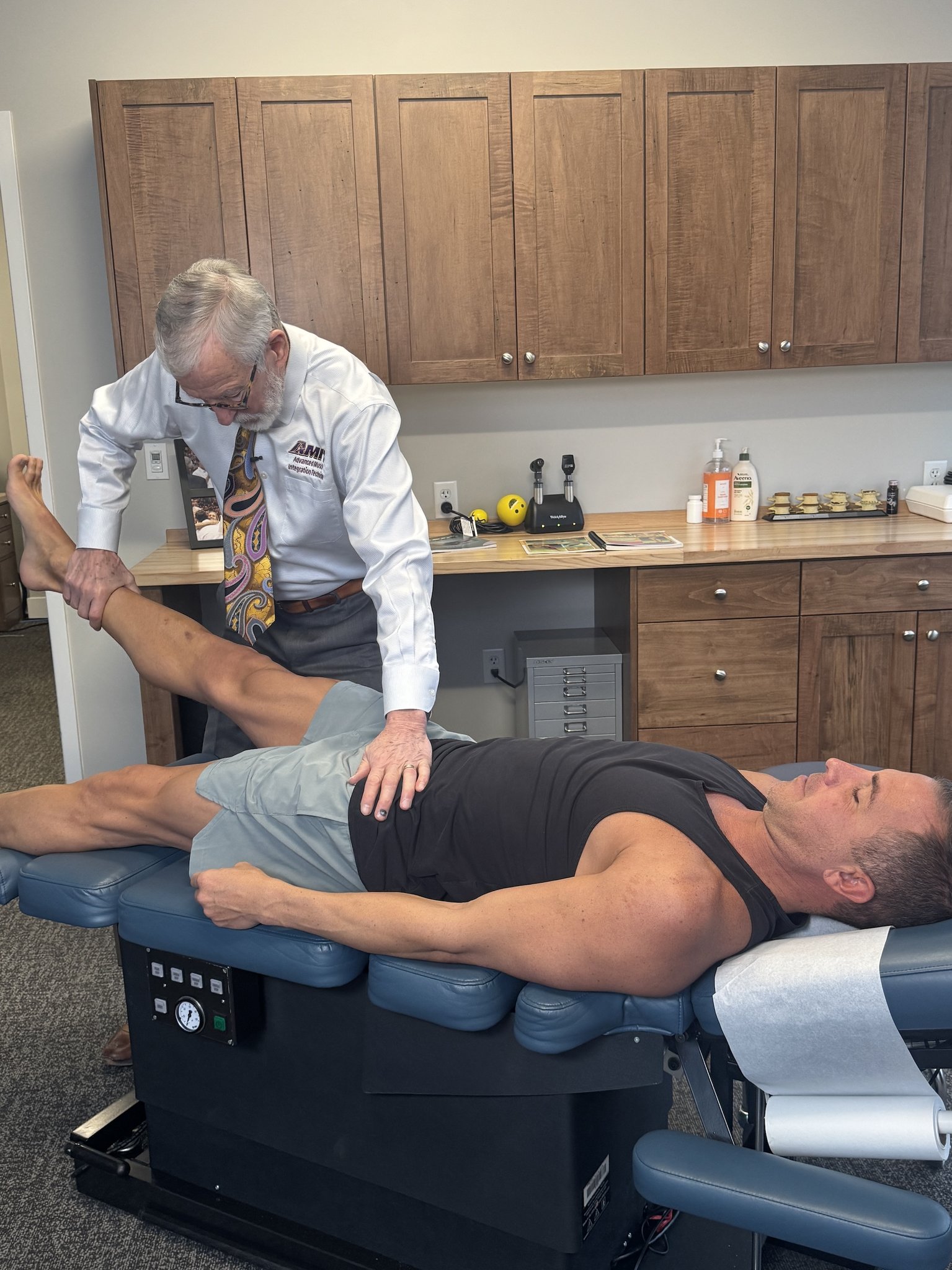
Muscle reactivation is a manual neuromuscular procedure. The clinician resistance-tests specific muscles to identify which ones aren't responding to the nervous system, then applies a precise contact at the muscle's origin or insertion to restore the connection. The muscle that wouldn't hold against pressure a moment earlier suddenly holds. The joint it supports finally has the input it needs to stop compensating.
This is different from massage, stretching, dry needling, or strength work. Patients across Salt Lake County often arrive at AMIT Draper after months of physical therapy and rehab exercises that didn't deliver lasting results — usually because the targeted muscle was inhibited the entire time and physically couldn't respond to the work being asked of it.
Who Comes In For Muscle Reactivation in Draper
Common patient profiles at our Draper office:
Post-surgical patients (knee, shoulder, hip, spine) whose strength hasn't returned even after completing physical therapy.
Active adults whose recurring sprains, pulls, or weakness keep coming back to the same area.
Endurance, strength, and recreational athletes managing performance plateaus that don't respond to training.
Patients with chronic neck, hip, or glute weakness from long hours of sitting and driving.
Expectant and post-partum patients with pelvic, core, or hip weakness that hasn't returned to baseline.
If you've been told "there's nothing structurally wrong" but the same problem keeps recurring, an inhibited muscle is one of the most under-diagnosed explanations in conventional musculoskeletal care.
How a Reactivation Visit Works at AMIT Draper
The first session follows the same sequence every time:
Functional history. We map the original injury, surgeries, and events your body is still compensating around — even if they're decades old.
Manual muscle testing. We isolate and resistance-test individual muscles in sequence. A muscle either holds against pressure or it doesn't, so the findings aren't subjective.
Reactivation. For each inhibited muscle we apply a specific contact at the muscle's origin or insertion to restore the neurological signal. Most patients feel the difference in the same visit.
Re-test. Each muscle is re-tested before we move on. If it doesn't hold yet, we don't move on.
Home plan. You leave with movement work that supports the new firing pattern — short, specific drills, not generic stretches.
Why a Local Clinic Matters for This Kind of Care
Reactivation is hands-on and progressive. Most patients come in two to four times in the first month, then taper. At our Draper location we keep the schedule tight Monday through Thursday — including 6:30 AM Tuesday slots — so the visit fits before work. The clinic is at 12371 S 900 E Unit 101, with parking on-site, and serves patients from Draper, Sandy, Riverton, Herriman, South Jordan, and the surrounding Salt Lake County area.
Care at AMIT Draper is delivered by the same clinical team behind the AMIT Method. Dr. Craig Buhler, who developed the protocol over 45+ years of practice and previously served as team chiropractor for the Utah Jazz, oversees the clinical approach. Dr. Alec Russell is fluent in Spanish and brings an exercise-science background to functional cases. Dr. Daphne Tolman is Webster Certified and works with athletes, families, and expectant mothers.
What to Expect at Your First Visit
Plan for about 60 minutes. Wear something you can move in — shorts and a t-shirt work for most exams. The first appointment is heavier on testing than treatment because the priority is identifying every inhibited muscle before we start reactivating. You'll leave with a clear plan: which muscles came up inhibited, what we treated today, what we'll address next visit, and what to do at home in between.
Most patients notice change in the same session — a hip that finally feels like it's loading evenly, a shoulder that stops catching, a low back that doesn't grab on the way home.
Conditions Reactivation Work Helps With
Reactivation work is most often used alongside care for:
Lumbar disc herniation, sciatica, and chronic low back pain
Rotator cuff syndrome, frozen shoulder, and shoulder impingement
Knee instability after ACL/PCL injury, MCL sprain, or meniscus tear
Hip bursitis, piriformis syndrome, and chronic hip weakness
Plantar fasciitis, Achilles tendinitis, and recurring ankle sprains
Post-concussion movement and balance issues
If your condition isn't listed, call 801.544.2355 — most musculoskeletal complaints have an inhibited-muscle component, and we'll tell you on the phone if AMIT is the right fit.
Learn more about muscle reactivation therapy and how it restores inhibited muscles.
Schedule an Adjustment in Draper
Call 801.544.2355 to book a new-patient exam at our Draper office. Hours: Monday and Wednesday–Thursday 7:30 AM – 4:00 PM, Tuesday 6:30 AM – 4:00 PM. Friday, Saturday, and Sunday closed. Address: 12371 S 900 E Unit 101, Draper, UT 84020. Existing patients can reschedule through the patient portal.
Frequently Asked Questions
How is muscle reactivation different from physical therapy?
Reactivation restores the nerve signal to a muscle that has stopped firing; physical therapy strengthens and mobilizes muscles that are already firing. If the muscle is inhibited, no amount of strengthening will fix it — the muscle physically cannot respond to the load. Many of our Draper patients arrive after PT because the targeted muscle was silent the whole time.
How quickly do patients see results?
Most patients at AMIT Draper notice some change in the first or second visit. Acute injuries often resolve in 2 to 4 sessions; long-standing compensation patterns from old injuries or surgeries take longer because more muscles tend to be involved. We re-test each muscle in the same visit, so progress is measurable instead of inferred from how you feel.
Is muscle reactivation safe after surgery?
Yes — reactivation is non-invasive and non-manipulative, and is regularly used in post-surgical recovery once your surgeon has cleared soft-tissue work. We treat patients in Draper recovering from knee replacements, rotator cuff repairs, spinal procedures, and abdominal surgeries, and coordinate with your surgical team when needed.
Does the procedure hurt?
No, reactivation itself is gentle — usually firm, brief pressure at a specific muscle attachment. Manual muscle testing requires you to hold against light resistance, which can feel surprising when an inhibited muscle simply gives way, but the procedure isn't painful.
Do you work with athletes in Draper and Salt Lake County?
Yes. AMIT was originally developed in a high-performance sports context (Dr. Buhler served as team chiropractor for the Utah Jazz) and is now used with athletes at every level. At our Draper location, common cases include recurring hamstring or hip flexor strains, shoulder weakness in throwing athletes, and unresolved ankle weakness after sprains.
Do I need a referral to come to AMIT Draper?
No referral is required. You can call 801.544.2355 and book a new-patient exam directly. We ask a few screening questions on the phone to confirm we're the right fit and send intake forms ahead of time so the visit is spent on testing and treatment, not paperwork
When a muscle has stopped firing — after a sports injury, a surgery, an old fall the body never quite forgot — every joint above and below it has to compensate. At our Draper chiropractic clinic on 12371 S 900 E (Unit 101), we use the Advanced Muscle Integration Technique (AMIT Method) to find those silent muscles and bring them back online. That's what muscle reactivation means in practice — not stretching the muscle, not strengthening it, but restoring the nerve-to-muscle signal so the body can finally use it again.
What Muscle Reactivation Means in a Clinical Sense
Muscle reactivation is a manual neuromuscular procedure. The clinician resistance-tests specific muscles to identify which ones aren't responding to the nervous system, then applies a precise contact at the muscle's origin or insertion to restore the connection. The muscle that wouldn't hold against pressure a moment earlier suddenly holds. The joint it supports finally has the input it needs to stop compensating.
This is different from massage, stretching, dry needling, or strength work. Patients across Salt Lake County often arrive at AMIT Draper after months of physical therapy and rehab exercises that didn't deliver lasting results — usually because the targeted muscle was inhibited the entire time and physically couldn't respond to the work being asked of it.
Who Comes In For Muscle Reactivation in Draper
Common patient profiles at our Draper office:
Post-surgical patients (knee, shoulder, hip, spine) whose strength hasn't returned even after completing physical therapy.
Active adults whose recurring sprains, pulls, or weakness keep coming back to the same area.
Endurance, strength, and recreational athletes managing performance plateaus that don't respond to training.
Patients with chronic neck, hip, or glute weakness from long hours of sitting and driving.
Expectant and post-partum patients with pelvic, core, or hip weakness that hasn't returned to baseline.
If you've been told "there's nothing structurally wrong" but the same problem keeps recurring, an inhibited muscle is one of the most under-diagnosed explanations in conventional musculoskeletal care.
How a Reactivation Visit Works at AMIT Draper
The first session follows the same sequence every time:
Functional history. We map the original injury, surgeries, and events your body is still compensating around — even if they're decades old.
Manual muscle testing. We isolate and resistance-test individual muscles in sequence. A muscle either holds against pressure or it doesn't, so the findings aren't subjective.
Reactivation. For each inhibited muscle we apply a specific contact at the muscle's origin or insertion to restore the neurological signal. Most patients feel the difference in the same visit.
Re-test. Each muscle is re-tested before we move on. If it doesn't hold yet, we don't move on.
Home plan. You leave with movement work that supports the new firing pattern — short, specific drills, not generic stretches.
Why a Local Clinic Matters for This Kind of Care
Reactivation is hands-on and progressive. Most patients come in two to four times in the first month, then taper. At our Draper location we keep the schedule tight Monday through Thursday — including 6:30 AM Tuesday slots — so the visit fits before work. The clinic is at 12371 S 900 E Unit 101, with parking on-site, and serves patients from Draper, Sandy, Riverton, Herriman, South Jordan, and the surrounding Salt Lake County area.
Care at AMIT Draper is delivered by the same clinical team behind the AMIT Method. Dr. Craig Buhler, who developed the protocol over 45+ years of practice and previously served as team chiropractor for the Utah Jazz, oversees the clinical approach. Dr. Alec Russell is fluent in Spanish and brings an exercise-science background to functional cases. Dr. Daphne Tolman is Webster Certified and works with athletes, families, and expectant mothers.
What to Expect at Your First Visit
Plan for about 60 minutes. Wear something you can move in — shorts and a t-shirt work for most exams. The first appointment is heavier on testing than treatment because the priority is identifying every inhibited muscle before we start reactivating. You'll leave with a clear plan: which muscles came up inhibited, what we treated today, what we'll address next visit, and what to do at home in between.
Most patients notice change in the same session — a hip that finally feels like it's loading evenly, a shoulder that stops catching, a low back that doesn't grab on the way home.
Conditions Reactivation Work Helps With
Reactivation work is most often used alongside care for:
Lumbar disc herniation, sciatica, and chronic low back pain
Rotator cuff syndrome, frozen shoulder, and shoulder impingement
Knee instability after ACL/PCL injury, MCL sprain, or meniscus tear
Hip bursitis, piriformis syndrome, and chronic hip weakness
Plantar fasciitis, Achilles tendinitis, and recurring ankle sprains
Post-concussion movement and balance issues
If your condition isn't listed, call 801.544.2355 — most musculoskeletal complaints have an inhibited-muscle component, and we'll tell you on the phone if AMIT is the right fit.
Learn more about muscle reactivation therapy and how it restores inhibited muscles.
Schedule an Adjustment in Draper
Call 801.544.2355 to book a new-patient exam at our Draper office. Hours: Monday and Wednesday–Thursday 7:30 AM – 4:00 PM, Tuesday 6:30 AM – 4:00 PM. Friday, Saturday, and Sunday closed. Address: 12371 S 900 E Unit 101, Draper, UT 84020. Existing patients can reschedule through the patient portal.
Frequently Asked Questions
How is muscle reactivation different from physical therapy?
Reactivation restores the nerve signal to a muscle that has stopped firing; physical therapy strengthens and mobilizes muscles that are already firing. If the muscle is inhibited, no amount of strengthening will fix it — the muscle physically cannot respond to the load. Many of our Draper patients arrive after PT because the targeted muscle was silent the whole time.
How quickly do patients see results?
Most patients at AMIT Draper notice some change in the first or second visit. Acute injuries often resolve in 2 to 4 sessions; long-standing compensation patterns from old injuries or surgeries take longer because more muscles tend to be involved. We re-test each muscle in the same visit, so progress is measurable instead of inferred from how you feel.
Is muscle reactivation safe after surgery?
Yes — reactivation is non-invasive and non-manipulative, and is regularly used in post-surgical recovery once your surgeon has cleared soft-tissue work. We treat patients in Draper recovering from knee replacements, rotator cuff repairs, spinal procedures, and abdominal surgeries, and coordinate with your surgical team when needed.
Does the procedure hurt?
No, reactivation itself is gentle — usually firm, brief pressure at a specific muscle attachment. Manual muscle testing requires you to hold against light resistance, which can feel surprising when an inhibited muscle simply gives way, but the procedure isn't painful.
Do you work with athletes in Draper and Salt Lake County?
Yes. AMIT was originally developed in a high-performance sports context (Dr. Buhler served as team chiropractor for the Utah Jazz) and is now used with athletes at every level. At our Draper location, common cases include recurring hamstring or hip flexor strains, shoulder weakness in throwing athletes, and unresolved ankle weakness after sprains.
Do I need a referral to come to AMIT Draper?
No referral is required. You can call 801.544.2355 and book a new-patient exam directly. We ask a few screening questions on the phone to confirm we're the right fit and send intake forms ahead of time so the visit is spent on testing and treatment, not paperwork
When a muscle has stopped firing — after a sports injury, a surgery, an old fall the body never quite forgot — every joint above and below it has to compensate. At our Draper chiropractic clinic on 12371 S 900 E (Unit 101), we use the Advanced Muscle Integration Technique (AMIT Method) to find those silent muscles and bring them back online. That's what muscle reactivation means in practice — not stretching the muscle, not strengthening it, but restoring the nerve-to-muscle signal so the body can finally use it again.
What Muscle Reactivation Means in a Clinical Sense
Muscle reactivation is a manual neuromuscular procedure. The clinician resistance-tests specific muscles to identify which ones aren't responding to the nervous system, then applies a precise contact at the muscle's origin or insertion to restore the connection. The muscle that wouldn't hold against pressure a moment earlier suddenly holds. The joint it supports finally has the input it needs to stop compensating.
This is different from massage, stretching, dry needling, or strength work. Patients across Salt Lake County often arrive at AMIT Draper after months of physical therapy and rehab exercises that didn't deliver lasting results — usually because the targeted muscle was inhibited the entire time and physically couldn't respond to the work being asked of it.
Who Comes In For Muscle Reactivation in Draper
Common patient profiles at our Draper office:
Post-surgical patients (knee, shoulder, hip, spine) whose strength hasn't returned even after completing physical therapy.
Active adults whose recurring sprains, pulls, or weakness keep coming back to the same area.
Endurance, strength, and recreational athletes managing performance plateaus that don't respond to training.
Patients with chronic neck, hip, or glute weakness from long hours of sitting and driving.
Expectant and post-partum patients with pelvic, core, or hip weakness that hasn't returned to baseline.
If you've been told "there's nothing structurally wrong" but the same problem keeps recurring, an inhibited muscle is one of the most under-diagnosed explanations in conventional musculoskeletal care.
How a Reactivation Visit Works at AMIT Draper
The first session follows the same sequence every time:
Functional history. We map the original injury, surgeries, and events your body is still compensating around — even if they're decades old.
Manual muscle testing. We isolate and resistance-test individual muscles in sequence. A muscle either holds against pressure or it doesn't, so the findings aren't subjective.
Reactivation. For each inhibited muscle we apply a specific contact at the muscle's origin or insertion to restore the neurological signal. Most patients feel the difference in the same visit.
Re-test. Each muscle is re-tested before we move on. If it doesn't hold yet, we don't move on.
Home plan. You leave with movement work that supports the new firing pattern — short, specific drills, not generic stretches.
Why a Local Clinic Matters for This Kind of Care
Reactivation is hands-on and progressive. Most patients come in two to four times in the first month, then taper. At our Draper location we keep the schedule tight Monday through Thursday — including 6:30 AM Tuesday slots — so the visit fits before work. The clinic is at 12371 S 900 E Unit 101, with parking on-site, and serves patients from Draper, Sandy, Riverton, Herriman, South Jordan, and the surrounding Salt Lake County area.
Care at AMIT Draper is delivered by the same clinical team behind the AMIT Method. Dr. Craig Buhler, who developed the protocol over 45+ years of practice and previously served as team chiropractor for the Utah Jazz, oversees the clinical approach. Dr. Alec Russell is fluent in Spanish and brings an exercise-science background to functional cases. Dr. Daphne Tolman is Webster Certified and works with athletes, families, and expectant mothers.
What to Expect at Your First Visit
Plan for about 60 minutes. Wear something you can move in — shorts and a t-shirt work for most exams. The first appointment is heavier on testing than treatment because the priority is identifying every inhibited muscle before we start reactivating. You'll leave with a clear plan: which muscles came up inhibited, what we treated today, what we'll address next visit, and what to do at home in between.
Most patients notice change in the same session — a hip that finally feels like it's loading evenly, a shoulder that stops catching, a low back that doesn't grab on the way home.
Conditions Reactivation Work Helps With
Reactivation work is most often used alongside care for:
Lumbar disc herniation, sciatica, and chronic low back pain
Rotator cuff syndrome, frozen shoulder, and shoulder impingement
Knee instability after ACL/PCL injury, MCL sprain, or meniscus tear
Hip bursitis, piriformis syndrome, and chronic hip weakness
Plantar fasciitis, Achilles tendinitis, and recurring ankle sprains
Post-concussion movement and balance issues
If your condition isn't listed, call 801.544.2355 — most musculoskeletal complaints have an inhibited-muscle component, and we'll tell you on the phone if AMIT is the right fit.
Learn more about muscle reactivation therapy and how it restores inhibited muscles.
Schedule an Adjustment in Draper
Call 801.544.2355 to book a new-patient exam at our Draper office. Hours: Monday and Wednesday–Thursday 7:30 AM – 4:00 PM, Tuesday 6:30 AM – 4:00 PM. Friday, Saturday, and Sunday closed. Address: 12371 S 900 E Unit 101, Draper, UT 84020. Existing patients can reschedule through the patient portal.
Frequently Asked Questions
How is muscle reactivation different from physical therapy?
Reactivation restores the nerve signal to a muscle that has stopped firing; physical therapy strengthens and mobilizes muscles that are already firing. If the muscle is inhibited, no amount of strengthening will fix it — the muscle physically cannot respond to the load. Many of our Draper patients arrive after PT because the targeted muscle was silent the whole time.
How quickly do patients see results?
Most patients at AMIT Draper notice some change in the first or second visit. Acute injuries often resolve in 2 to 4 sessions; long-standing compensation patterns from old injuries or surgeries take longer because more muscles tend to be involved. We re-test each muscle in the same visit, so progress is measurable instead of inferred from how you feel.
Is muscle reactivation safe after surgery?
Yes — reactivation is non-invasive and non-manipulative, and is regularly used in post-surgical recovery once your surgeon has cleared soft-tissue work. We treat patients in Draper recovering from knee replacements, rotator cuff repairs, spinal procedures, and abdominal surgeries, and coordinate with your surgical team when needed.
Does the procedure hurt?
No, reactivation itself is gentle — usually firm, brief pressure at a specific muscle attachment. Manual muscle testing requires you to hold against light resistance, which can feel surprising when an inhibited muscle simply gives way, but the procedure isn't painful.
Do you work with athletes in Draper and Salt Lake County?
Yes. AMIT was originally developed in a high-performance sports context (Dr. Buhler served as team chiropractor for the Utah Jazz) and is now used with athletes at every level. At our Draper location, common cases include recurring hamstring or hip flexor strains, shoulder weakness in throwing athletes, and unresolved ankle weakness after sprains.
Do I need a referral to come to AMIT Draper?
No referral is required. You can call 801.544.2355 and book a new-patient exam directly. We ask a few screening questions on the phone to confirm we're the right fit and send intake forms ahead of time so the visit is spent on testing and treatment, not paperwork