
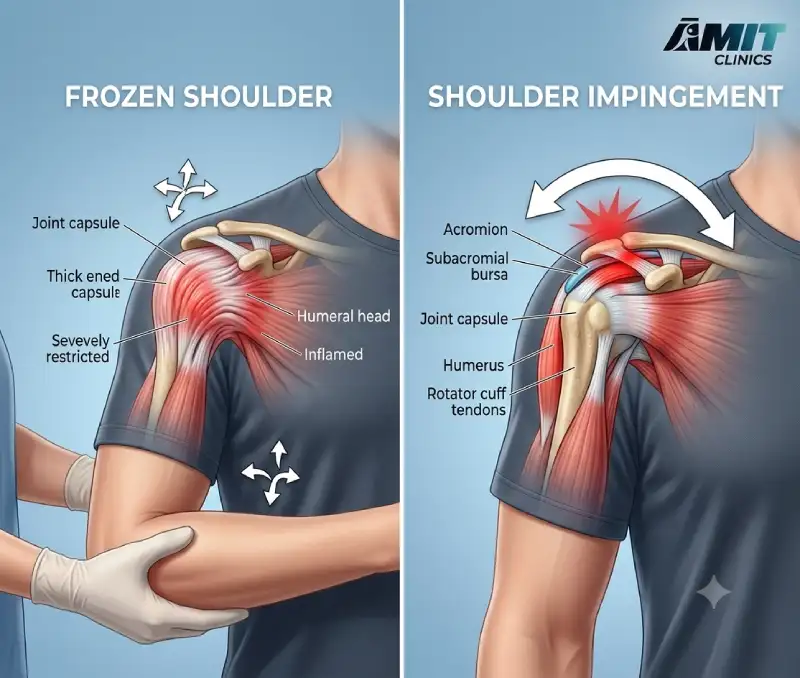
Frozen shoulder is a stiffening of the joint capsule itself, causing loss of motion in every direction, while shoulder impingement is a pinching of tendons that mainly limits motion in one arc, usually overhead. The stiffness test is the fastest way to tell them apart: frozen shoulder restricts a passive movement, someone else moving your arm for you, while impingement usually doesn't.
Two Different Shoulders, One Confusing Symptom
Patients walk into our Draper and Kaysville clinics all the time describing the same complaint: "I can't lift my arm the way I used to." That single sentence can describe two almost unrelated conditions, and getting the distinction wrong before starting treatment wastes weeks, sometimes months.
Both frozen shoulder and shoulder impingement cause stiffness, pain with movement, and difficulty reaching overhead or behind the back. But one is a problem with the joint capsule, and the other is a problem with the space tendons move through. Treating one like the other doesn't just fail to help, it can actively slow recovery.
What Frozen Shoulder Actually Is
frozen shoulder treatment , also called adhesive capsulitis, happens when the connective tissue capsule surrounding the shoulder joint thickens and tightens. The capsule essentially shrink-wraps the joint, restricting movement in every direction, not just one.
It typically develops in three stages. The freezing stage brings gradually worsening pain and stiffness, often over several months. The frozen stage brings less pain but significant stiffness, sometimes limiting the arm to a fraction of its normal range. The thawing stage is a slow return of motion, which can take anywhere from several months to over a year without intervention.
Frozen shoulder is more common in adults between 40 and 60, in people with diabetes, and, notably, following a period of shoulder immobilization, such as after surgery or a fracture in another part of the arm.
What Shoulder Impingement Actually Is
shoulder impingement causes is a mechanical problem, not a capsule problem. The space between the top of the arm bone and the shoulder blade narrows, and every time the arm lifts through a certain range, usually shoulder height to just above it, tendons and the bursa get pinched.
Unlike frozen shoulder, impingement usually spares most of the shoulder's range. You can typically still reach behind your back or across your body without much trouble. The pain shows up specifically in that overhead arc, often described as a sharp catch rather than a deep, constant ache.
The Test That Tells Them Apart
The single most useful distinguishing test is passive range of motion, meaning someone else moves your arm while you stay relaxed.
Frozen shoulder: passive movement is restricted just as much as active movement. The capsule itself is tight, so it doesn't matter who's doing the moving.
Shoulder impingement: passive movement is usually close to normal, or at least noticeably better than when you try to lift the arm yourself, because the limitation comes from the pinching mechanism during active muscle contraction, not from the capsule.
Feature | Frozen Shoulder | Shoulder Impingement |
Range of motion loss | All directions | Mainly overhead arc |
Passive motion | Restricted | Usually near-normal |
Onset | Gradual, over months | Can be gradual or sudden |
Typical age | 40 to 60 | Any active adult |
Night pain | Common, often severe | Occasional |
Root cause | Capsule thickening | Structural pinching |
Why Getting This Right Changes Treatment
Frozen shoulder responds best to gentle, progressive mobility work that gradually stretches the tightened capsule, often paired with pain-reducing treatment that improves how much mobility work a patient can tolerate. Aggressive strengthening too early can aggravate an already irritated capsule.
Shoulder impingement responds best to addressing the mechanical cause: retraining the shoulder blade stabilizers so the arm bone stops crowding the space where tendons pass through, then rebuilding strength through the corrected movement pattern. Excessive stretching isn't the priority here the way it is for frozen shoulder; correcting the mechanics is.
In our clinical experience, patients who were told they had "just impingement" and given generic exercises, when the actual diagnosis was frozen shoulder, often spent months without progress. The stretches weren't wrong for a mobility problem in general, they just weren't matched to a capsule that needed a different pace and approach entirely.
For many patients working through either condition, chiropractic for shoulder pain plays a supporting role by restoring joint mobility in the shoulder girdle and upper spine, which often move less efficiently once someone has spent weeks or months guarding a painful shoulder. Freeing up motion in the surrounding joints makes the targeted rehab work more effective, since the shoulder isn't compensating for stiffness elsewhere in the chain.
Other Clues That Point One Way or the Other
Beyond the passive motion test, a few other details help separate the two conditions in day-to-day symptoms.
Sleep disruption. Frozen shoulder frequently causes deep, aching night pain that makes it hard to lie on the affected side at all, regardless of position. Impingement-related night pain tends to be more position-specific, easing once the arm settles into a comfortable angle.
Reaching behind the back. This motion, needed for tucking in a shirt or fastening a bra, is one of the first to disappear with frozen shoulder and one of the last to be affected by impingement, since it doesn't load the same pinched space that overhead reaching does.
Recent history. A recent period of arm immobilization, whether from a wrist fracture, a sling after a different injury, or even a long illness that limited activity, raises suspicion for frozen shoulder. A recent increase in overhead activity, like a new workout routine or a home improvement project involving painting or reaching overhead repeatedly, points more toward impingement.
What This Looks Like in Practice
A thorough evaluation checks both active and passive range of motion in multiple directions, screens for diabetes and recent immobilization history, and identifies exactly which arc of motion is painful versus globally restricted. That combination of findings determines whether you're dealing with a capsule problem, a mechanical problem, or in some cases, both at once, since a shoulder guarded long enough from impingement pain can eventually stiffen into a secondary frozen shoulder pattern.
This is one of the more common diagnostic overlaps we manage across our Draper and Kaysville patients, and it's exactly why an accurate initial assessment matters more than jumping straight into a generic stretching routine.
Frequently Asked Questions
How do I know if I have frozen shoulder or impingement?
The clearest sign is passive motion: if someone else moving your arm is just as restricted as when you move it yourself, that points to frozen shoulder; if passive motion is noticeably freer, that points to impingement.
Can frozen shoulder go away on its own?
Frozen shoulder can eventually resolve without treatment, but it often takes one to three years to run its full course, and untreated cases frequently retain some permanent stiffness.
Does shoulder impingement ever turn into frozen shoulder?
Yes, it can. Prolonged guarding of a painful, impinged shoulder can lead the capsule to tighten secondarily, which is one reason early treatment of impingement matters.
Is frozen shoulder more common in people with diabetes?
Yes. Diabetes is one of the strongest known risk factors for frozen shoulder, with some studies estimating a two to four times higher incidence compared to the general population. The exact mechanism isn't fully understood, but elevated blood sugar is thought to affect collagen in the joint capsule over time.
What's the fastest way to relieve shoulder impingement pain?
Correcting the underlying shoulder blade mechanics, rather than only resting or stretching, produces the most reliable and lasting relief, since rest alone doesn't fix the muscular imbalance causing the pinching.