Frozen Shoulder
Treatment in Salt Lake City, UT Advanced Muscle Integration Technique (A.M.I.T.)
Frozen Shoulder
Treatment in Salt Lake City, UT Advanced Muscle Integration Technique (A.M.I.T.)
Frozen Shoulder
Treatment in Salt Lake City, UT Advanced Muscle Integration Technique (A.M.I.T.)
Understanding Frozen Shoulder and the AMIT & OTZ Solution
Frozen shoulder, or adhesive capsulitis, is a condition in which the capsule around the shoulder joint becomes thick and tight, causing pain and stiffness that limit movement. It develops in three stages, freezing, frozen, and thawing, and according to the American Academy of Orthopaedic Surgeons full recovery can take up to three years.
It most commonly affects people between 40 and 60, women more often than men, and people with diabetes much more often than the general population. Because the shoulder slowly loses motion in every direction, the longer the muscles around it stay inhibited, the harder it becomes to get that motion back.
Frozen Shoulder, also known as adhesive capsulitis, is a painful condition characterized by stiffness and limited range of motion in the shoulder joint. Patients often experience difficulty lifting their arm, with symptoms worsening over time, especially at night.
Frozen shoulder progresses through three stages: painful, frozen, and thawing, and can last several months. This is one of the upper-body program AMIT addresses by restoring proper muscle activation instead of relying on surgery.
On This Page:
Symptoms of Frozen Shoulder
The Three Stages of Frozen Shoulder
Who Gets Frozen Shoulder?
Frozen Shoulder vs. Shoulder Impingement
AMIT & OTZ Explanation for Frozen Shoulder
Symptoms of Frozen Shoulder
Signs and symptoms may include:
Difficulty Moving the Shoulder: Inability to lift the arm past 45 degrees.
Night Pain: Symptoms often worsen during sleep.
Staged Pain Progression: Pain starts slowly, worsens during the frozen stage, and gradually subsides in the thawing stage.
The Three Stages of Frozen Shoulder
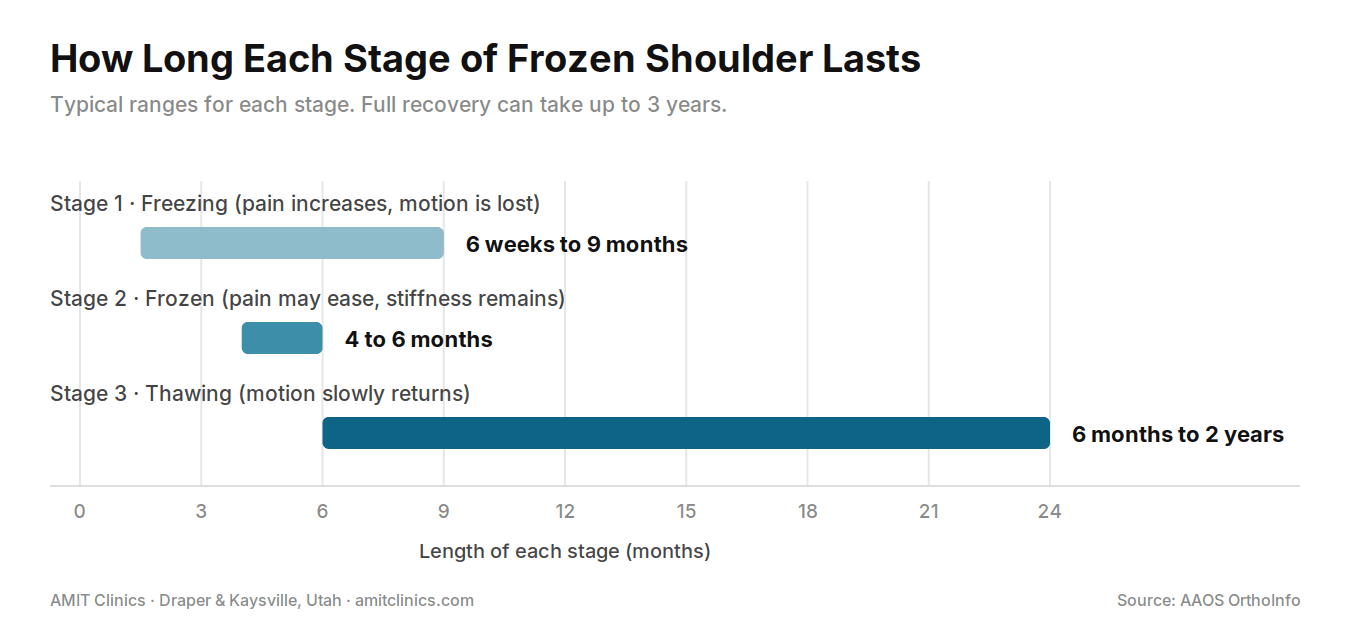
Each stage has a different feel and a different typical length. These ranges come from the American Academy of Orthopaedic Surgeons:
Freezing: Pain slowly increases and the shoulder loses motion. This stage typically lasts anywhere from 6 weeks to 9 months.
Frozen: Pain may actually improve, but the stiffness remains. During these 4 to 6 months, daily activities like dressing or reaching a back pocket can be very difficult.
Thawing: Motion slowly comes back. Return to normal or close to normal strength and motion typically takes 6 months to 2 years.
The pain is often worse at night and can disturb sleep.
Who Gets Frozen Shoulder?
Frozen shoulder most commonly affects people between the ages of 40 and 60 and occurs in women more often than men. Other risk factors include:
Diabetes: Frozen shoulder occurs much more often in people with diabetes, and they tend to have more stiffness that lasts longer before thawing.
Thyroid conditions: People with thyroid conditions are also at increased risk.
A period of immobilization: Frozen shoulder can develop after the shoulder has been held still for a while because of surgery, a fracture, or another injury. Moving the shoulder soon after an injury or surgery is one of the measures used to prevent it.
There is no clear connection to which arm is dominant or to the kind of work a person does.
Frozen Shoulder vs. Shoulder Impingement
Both cause shoulder pain, and the two are often mixed up. With shoulder impingement, the shoulder still moves but certain positions, especially overhead, are painful. With frozen shoulder, the shoulder itself becomes stiff and loses movement in several directions. Our article on frozen shoulder vs. shoulder impingement walks through the differences, and weakness when lifting the arm can point to a rotator cuff problem instead.
AMIT & OTZ Explanation for Frozen Shoulder
Frozen shoulder is caused by muscle inhibition resulting from injuries that create imbalances and tightness in the shoulder. The body protects itself by restricting movement, making it difficult to activate the shoulder muscles without pain. Another contributing factor is a restriction in motion at the base of the skull (suboccipital muscles), which may become inhibited due to upper neck trauma.
The OTZ (One-To-Zero) Method:
Developed by Dr. Francis Murphy, the OTZ method addresses Atlanto-Occipital Joint Dysfunction (C0-C1), a common cause of proprioceptive dysfunction, which impacts the head, neck, and shoulder. Research has shown that by correcting proprioceptive dysfunction at the C0-C1 joint, patients experience improved neck mobility and reduction in shoulder pain and stiffness.
Research Findings:
Study 1: A randomized controlled trial showed that the OTZ method significantly improved neck range of motion and proprioceptive awareness, helping frozen shoulder patients regain functional movement.
Study 2: OTZ treatment enhanced motor control in the neck and limbs, improving shoulder range of motion and neuromuscular efficiency.
How AMIT & OTZ Help?
The combination of AMIT and OTZ addresses both the root causes of frozen shoulder, providing a comprehensive approach to healing:
Reactivating Inhibited Muscles: Correcting muscle imbalances and restoring function.
Manipulating the Neck and Shoulder Joint: Restoring proper alignment and reducing stiffness.
Restoring Motion and Relieving Pain: Allowing for full mobility without surgery.
On a first visit we measure how far your shoulder moves in each direction, test the muscles around the shoulder and shoulder blade one at a time, and check the upper neck, since the OTZ part of the treatment works at the joint between the skull and the first neck vertebra. The visit takes about 40 minutes; what to expect explains how to prepare. Our article on frozen shoulder treatment in Draper with AMIT and OTZ describes the approach in more detail.
Steps to Take If You Have Frozen Shoulder
Consult a Certified AMIT Practitioner: Contact our clinic for an evaluation and personalized treatment plan.
Rehabilitation: After AMIT and OTZ treatment, we guide you through exercises to restore full function and prevent future issues.
If you're experiencing symptoms of frozen shoulder, contact Advanced Muscle Integration Clinics in the Salt lake City Area today for effective treatment using Advanced Muscle Integration Technique (AMIT) and the OTZ Method. Our certified practitioners can help you recover faster and avoid surgery.
Frozen Shoulder Treatment in Draper and Kaysville
AMIT Clinics treats frozen shoulder at both Utah locations: Draper, at 12371 S 900 E Unit 101, and Kaysville, at 447 North 300 West Ste 5. We see people at every stage, from the early freezing phase to shoulders that have been stiff for a year or more, as well as people whose shoulder stiffened after surgery or an injury that kept the arm still.
Frequently Asked Questions About Frozen Shoulder
How long does frozen shoulder last?
It can take up to three years to fully recover. The freezing stage typically lasts 6 weeks to 9 months, the frozen stage 4 to 6 months, and the thawing stage 6 months to 2 years.
What are the three stages of frozen shoulder?
Freezing, when pain slowly increases and motion is lost; frozen, when pain may ease but stiffness remains; and thawing, when motion gradually returns.
Who is most likely to get frozen shoulder?
People between 40 and 60, women more often than men, and people with diabetes or thyroid conditions. It can also follow a period when the shoulder was kept still after surgery or injury.
Why does diabetes increase the risk of frozen shoulder?
The exact reason is not clear, but frozen shoulder occurs much more often in people with diabetes, and they tend to have more stiffness for longer. Good blood sugar control is considered part of managing it.
Is frozen shoulder the same as shoulder impingement?
No. Impingement causes pain in certain positions while the shoulder still moves. Frozen shoulder causes stiffness that limits movement in several directions.
Does frozen shoulder need surgery?
Usually not. Frozen shoulder generally gets better over time without surgery, and most people improve with treatment aimed at controlling pain and restoring motion.
Call 801.544.2355 to be seen.
Schedule an Appointment
Call: 801.544.2355
Or, use the link below to get started:
Understanding Frozen Shoulder and the AMIT & OTZ Solution
Frozen shoulder, or adhesive capsulitis, is a condition in which the capsule around the shoulder joint becomes thick and tight, causing pain and stiffness that limit movement. It develops in three stages, freezing, frozen, and thawing, and according to the American Academy of Orthopaedic Surgeons full recovery can take up to three years.
It most commonly affects people between 40 and 60, women more often than men, and people with diabetes much more often than the general population. Because the shoulder slowly loses motion in every direction, the longer the muscles around it stay inhibited, the harder it becomes to get that motion back.
Frozen Shoulder, also known as adhesive capsulitis, is a painful condition characterized by stiffness and limited range of motion in the shoulder joint. Patients often experience difficulty lifting their arm, with symptoms worsening over time, especially at night.
Frozen shoulder progresses through three stages: painful, frozen, and thawing, and can last several months. This is one of the upper-body program AMIT addresses by restoring proper muscle activation instead of relying on surgery.
On This Page:
Symptoms of Frozen Shoulder
The Three Stages of Frozen Shoulder
Who Gets Frozen Shoulder?
Frozen Shoulder vs. Shoulder Impingement
AMIT & OTZ Explanation for Frozen Shoulder
Symptoms of Frozen Shoulder
Signs and symptoms may include:
Difficulty Moving the Shoulder: Inability to lift the arm past 45 degrees.
Night Pain: Symptoms often worsen during sleep.
Staged Pain Progression: Pain starts slowly, worsens during the frozen stage, and gradually subsides in the thawing stage.
The Three Stages of Frozen Shoulder
Each stage has a different feel and a different typical length. These ranges come from the American Academy of Orthopaedic Surgeons:
Freezing: Pain slowly increases and the shoulder loses motion. This stage typically lasts anywhere from 6 weeks to 9 months.
Frozen: Pain may actually improve, but the stiffness remains. During these 4 to 6 months, daily activities like dressing or reaching a back pocket can be very difficult.
Thawing: Motion slowly comes back. Return to normal or close to normal strength and motion typically takes 6 months to 2 years.
The pain is often worse at night and can disturb sleep.
Who Gets Frozen Shoulder?
Frozen shoulder most commonly affects people between the ages of 40 and 60 and occurs in women more often than men. Other risk factors include:
Diabetes: Frozen shoulder occurs much more often in people with diabetes, and they tend to have more stiffness that lasts longer before thawing.
Thyroid conditions: People with thyroid conditions are also at increased risk.
A period of immobilization: Frozen shoulder can develop after the shoulder has been held still for a while because of surgery, a fracture, or another injury. Moving the shoulder soon after an injury or surgery is one of the measures used to prevent it.
There is no clear connection to which arm is dominant or to the kind of work a person does.
Frozen Shoulder vs. Shoulder Impingement
Both cause shoulder pain, and the two are often mixed up. With shoulder impingement, the shoulder still moves but certain positions, especially overhead, are painful. With frozen shoulder, the shoulder itself becomes stiff and loses movement in several directions. Our article on frozen shoulder vs. shoulder impingement walks through the differences, and weakness when lifting the arm can point to a rotator cuff problem instead.
AMIT & OTZ Explanation for Frozen Shoulder
Frozen shoulder is caused by muscle inhibition resulting from injuries that create imbalances and tightness in the shoulder. The body protects itself by restricting movement, making it difficult to activate the shoulder muscles without pain. Another contributing factor is a restriction in motion at the base of the skull (suboccipital muscles), which may become inhibited due to upper neck trauma.
The OTZ (One-To-Zero) Method:
Developed by Dr. Francis Murphy, the OTZ method addresses Atlanto-Occipital Joint Dysfunction (C0-C1), a common cause of proprioceptive dysfunction, which impacts the head, neck, and shoulder. Research has shown that by correcting proprioceptive dysfunction at the C0-C1 joint, patients experience improved neck mobility and reduction in shoulder pain and stiffness.
Research Findings:
Study 1: A randomized controlled trial showed that the OTZ method significantly improved neck range of motion and proprioceptive awareness, helping frozen shoulder patients regain functional movement.
Study 2: OTZ treatment enhanced motor control in the neck and limbs, improving shoulder range of motion and neuromuscular efficiency.
How AMIT & OTZ Help?
The combination of AMIT and OTZ addresses both the root causes of frozen shoulder, providing a comprehensive approach to healing:
Reactivating Inhibited Muscles: Correcting muscle imbalances and restoring function.
Manipulating the Neck and Shoulder Joint: Restoring proper alignment and reducing stiffness.
Restoring Motion and Relieving Pain: Allowing for full mobility without surgery.
On a first visit we measure how far your shoulder moves in each direction, test the muscles around the shoulder and shoulder blade one at a time, and check the upper neck, since the OTZ part of the treatment works at the joint between the skull and the first neck vertebra. The visit takes about 40 minutes; what to expect explains how to prepare. Our article on frozen shoulder treatment in Draper with AMIT and OTZ describes the approach in more detail.
Steps to Take If You Have Frozen Shoulder
Consult a Certified AMIT Practitioner: Contact our clinic for an evaluation and personalized treatment plan.
Rehabilitation: After AMIT and OTZ treatment, we guide you through exercises to restore full function and prevent future issues.
If you're experiencing symptoms of frozen shoulder, contact Advanced Muscle Integration Clinics in the Salt lake City Area today for effective treatment using Advanced Muscle Integration Technique (AMIT) and the OTZ Method. Our certified practitioners can help you recover faster and avoid surgery.
Frozen Shoulder Treatment in Draper and Kaysville
AMIT Clinics treats frozen shoulder at both Utah locations: Draper, at 12371 S 900 E Unit 101, and Kaysville, at 447 North 300 West Ste 5. We see people at every stage, from the early freezing phase to shoulders that have been stiff for a year or more, as well as people whose shoulder stiffened after surgery or an injury that kept the arm still.
Frequently Asked Questions About Frozen Shoulder
How long does frozen shoulder last?
It can take up to three years to fully recover. The freezing stage typically lasts 6 weeks to 9 months, the frozen stage 4 to 6 months, and the thawing stage 6 months to 2 years.
What are the three stages of frozen shoulder?
Freezing, when pain slowly increases and motion is lost; frozen, when pain may ease but stiffness remains; and thawing, when motion gradually returns.
Who is most likely to get frozen shoulder?
People between 40 and 60, women more often than men, and people with diabetes or thyroid conditions. It can also follow a period when the shoulder was kept still after surgery or injury.
Why does diabetes increase the risk of frozen shoulder?
The exact reason is not clear, but frozen shoulder occurs much more often in people with diabetes, and they tend to have more stiffness for longer. Good blood sugar control is considered part of managing it.
Is frozen shoulder the same as shoulder impingement?
No. Impingement causes pain in certain positions while the shoulder still moves. Frozen shoulder causes stiffness that limits movement in several directions.
Does frozen shoulder need surgery?
Usually not. Frozen shoulder generally gets better over time without surgery, and most people improve with treatment aimed at controlling pain and restoring motion.
Call 801.544.2355 to be seen.
Schedule an Appointment
Call: 801.544.2355
Or, use the link below to get started:
Understanding Frozen Shoulder and the AMIT & OTZ Solution
Frozen shoulder, or adhesive capsulitis, is a condition in which the capsule around the shoulder joint becomes thick and tight, causing pain and stiffness that limit movement. It develops in three stages, freezing, frozen, and thawing, and according to the American Academy of Orthopaedic Surgeons full recovery can take up to three years.
It most commonly affects people between 40 and 60, women more often than men, and people with diabetes much more often than the general population. Because the shoulder slowly loses motion in every direction, the longer the muscles around it stay inhibited, the harder it becomes to get that motion back.
Frozen Shoulder, also known as adhesive capsulitis, is a painful condition characterized by stiffness and limited range of motion in the shoulder joint. Patients often experience difficulty lifting their arm, with symptoms worsening over time, especially at night.
Frozen shoulder progresses through three stages: painful, frozen, and thawing, and can last several months. This is one of the upper-body program AMIT addresses by restoring proper muscle activation instead of relying on surgery.
On This Page:
Symptoms of Frozen Shoulder
The Three Stages of Frozen Shoulder
Who Gets Frozen Shoulder?
Frozen Shoulder vs. Shoulder Impingement
AMIT & OTZ Explanation for Frozen Shoulder
Symptoms of Frozen Shoulder
Signs and symptoms may include:
Difficulty Moving the Shoulder: Inability to lift the arm past 45 degrees.
Night Pain: Symptoms often worsen during sleep.
Staged Pain Progression: Pain starts slowly, worsens during the frozen stage, and gradually subsides in the thawing stage.
The Three Stages of Frozen Shoulder
Each stage has a different feel and a different typical length. These ranges come from the American Academy of Orthopaedic Surgeons:
Freezing: Pain slowly increases and the shoulder loses motion. This stage typically lasts anywhere from 6 weeks to 9 months.
Frozen: Pain may actually improve, but the stiffness remains. During these 4 to 6 months, daily activities like dressing or reaching a back pocket can be very difficult.
Thawing: Motion slowly comes back. Return to normal or close to normal strength and motion typically takes 6 months to 2 years.
The pain is often worse at night and can disturb sleep.
Who Gets Frozen Shoulder?
Frozen shoulder most commonly affects people between the ages of 40 and 60 and occurs in women more often than men. Other risk factors include:
Diabetes: Frozen shoulder occurs much more often in people with diabetes, and they tend to have more stiffness that lasts longer before thawing.
Thyroid conditions: People with thyroid conditions are also at increased risk.
A period of immobilization: Frozen shoulder can develop after the shoulder has been held still for a while because of surgery, a fracture, or another injury. Moving the shoulder soon after an injury or surgery is one of the measures used to prevent it.
There is no clear connection to which arm is dominant or to the kind of work a person does.
Frozen Shoulder vs. Shoulder Impingement
Both cause shoulder pain, and the two are often mixed up. With shoulder impingement, the shoulder still moves but certain positions, especially overhead, are painful. With frozen shoulder, the shoulder itself becomes stiff and loses movement in several directions. Our article on frozen shoulder vs. shoulder impingement walks through the differences, and weakness when lifting the arm can point to a rotator cuff problem instead.
AMIT & OTZ Explanation for Frozen Shoulder
Frozen shoulder is caused by muscle inhibition resulting from injuries that create imbalances and tightness in the shoulder. The body protects itself by restricting movement, making it difficult to activate the shoulder muscles without pain. Another contributing factor is a restriction in motion at the base of the skull (suboccipital muscles), which may become inhibited due to upper neck trauma.
The OTZ (One-To-Zero) Method:
Developed by Dr. Francis Murphy, the OTZ method addresses Atlanto-Occipital Joint Dysfunction (C0-C1), a common cause of proprioceptive dysfunction, which impacts the head, neck, and shoulder. Research has shown that by correcting proprioceptive dysfunction at the C0-C1 joint, patients experience improved neck mobility and reduction in shoulder pain and stiffness.
Research Findings:
Study 1: A randomized controlled trial showed that the OTZ method significantly improved neck range of motion and proprioceptive awareness, helping frozen shoulder patients regain functional movement.
Study 2: OTZ treatment enhanced motor control in the neck and limbs, improving shoulder range of motion and neuromuscular efficiency.
How AMIT & OTZ Help?
The combination of AMIT and OTZ addresses both the root causes of frozen shoulder, providing a comprehensive approach to healing:
Reactivating Inhibited Muscles: Correcting muscle imbalances and restoring function.
Manipulating the Neck and Shoulder Joint: Restoring proper alignment and reducing stiffness.
Restoring Motion and Relieving Pain: Allowing for full mobility without surgery.
On a first visit we measure how far your shoulder moves in each direction, test the muscles around the shoulder and shoulder blade one at a time, and check the upper neck, since the OTZ part of the treatment works at the joint between the skull and the first neck vertebra. The visit takes about 40 minutes; what to expect explains how to prepare. Our article on frozen shoulder treatment in Draper with AMIT and OTZ describes the approach in more detail.
Steps to Take If You Have Frozen Shoulder
Consult a Certified AMIT Practitioner: Contact our clinic for an evaluation and personalized treatment plan.
Rehabilitation: After AMIT and OTZ treatment, we guide you through exercises to restore full function and prevent future issues.
If you're experiencing symptoms of frozen shoulder, contact Advanced Muscle Integration Clinics in the Salt lake City Area today for effective treatment using Advanced Muscle Integration Technique (AMIT) and the OTZ Method. Our certified practitioners can help you recover faster and avoid surgery.
Frozen Shoulder Treatment in Draper and Kaysville
AMIT Clinics treats frozen shoulder at both Utah locations: Draper, at 12371 S 900 E Unit 101, and Kaysville, at 447 North 300 West Ste 5. We see people at every stage, from the early freezing phase to shoulders that have been stiff for a year or more, as well as people whose shoulder stiffened after surgery or an injury that kept the arm still.
Frequently Asked Questions About Frozen Shoulder
How long does frozen shoulder last?
It can take up to three years to fully recover. The freezing stage typically lasts 6 weeks to 9 months, the frozen stage 4 to 6 months, and the thawing stage 6 months to 2 years.
What are the three stages of frozen shoulder?
Freezing, when pain slowly increases and motion is lost; frozen, when pain may ease but stiffness remains; and thawing, when motion gradually returns.
Who is most likely to get frozen shoulder?
People between 40 and 60, women more often than men, and people with diabetes or thyroid conditions. It can also follow a period when the shoulder was kept still after surgery or injury.
Why does diabetes increase the risk of frozen shoulder?
The exact reason is not clear, but frozen shoulder occurs much more often in people with diabetes, and they tend to have more stiffness for longer. Good blood sugar control is considered part of managing it.
Is frozen shoulder the same as shoulder impingement?
No. Impingement causes pain in certain positions while the shoulder still moves. Frozen shoulder causes stiffness that limits movement in several directions.
Does frozen shoulder need surgery?
Usually not. Frozen shoulder generally gets better over time without surgery, and most people improve with treatment aimed at controlling pain and restoring motion.
Call 801.544.2355 to be seen.
Schedule an Appointment
Call: 801.544.2355
Or, use the link below to get started: