
Surgery fixes the structure. Rehabilitation is what gets you using it again, and the gap between the two is where most recoveries stall.
Post-surgical rehabilitation is the guided process of restoring motion, strength, and control after an operation, usually starting within days and lasting anywhere from six weeks to a year depending on the procedure. If you are searching for post-surgical rehabilitation near me in Draper or Kaysville, here is the short answer to "what should I expect?": a phased plan that moves from protection to mobility to strength to full activity, with your surgeon's protocol setting the limits at every step.
What speeds it up is less exciting than most people hope. Show up for the early sessions, sleep enough, eat enough protein, and make sure the muscles around the surgical site are actually firing again. That last one gets missed more than any other, and it is usually where our work at AMIT Clinics starts.
What Is Post-Surgical Rehabilitation?
Post-surgical rehabilitation is a structured program of movement, hands-on therapy, and progressive loading that restores function after an operation. It covers everything from the first assisted steps after a hip replacement to the sport-specific drills that come months after an ACL reconstruction.
Most people picture one provider handling all of it. In practice, a good recovery usually involves a small team. The surgeon owns the protocol and the restrictions. A physical therapist runs the exercise progression. And for many of our patients in Draper and Kaysville, a chiropractor trained in muscle activation work handles a piece the others rarely have time to chase: why a muscle that should be getting stronger isn't.
The procedures we see most often in rehab are knee and hip replacements, ACL and meniscus repairs, rotator cuff repairs, and spine surgeries such as discectomies. Each has its own timeline. The problem that slows people down after all of them, though, is surprisingly similar.
Why Strength Doesn't Come Back on Its Own
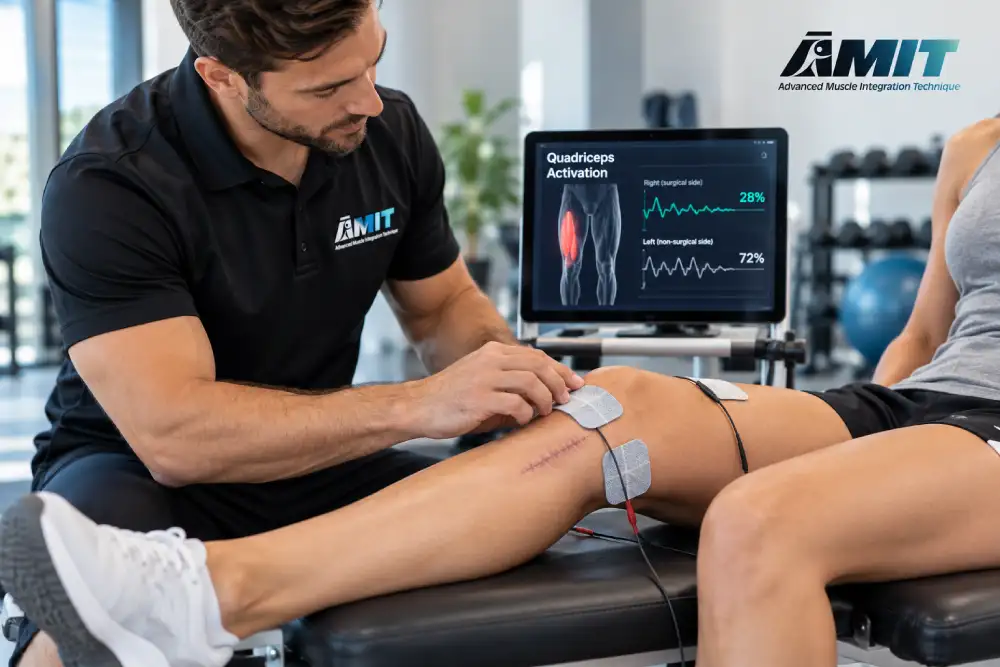
Here is the part most recovery guides skip. After surgery, the muscles around the joint don't just get weaker from disuse. The nervous system actively turns them down.
The clinical term is arthrogenic muscle inhibition: a reflex in which swelling, pain, and irritated joint receptors cause the spinal cord to reduce the signal to nearby muscles. A 2010 review in Seminars in Arthritis and Rheumatism called it a significant barrier to rehabilitation after knee injury and surgery, and noted that it can last well after the tissue itself has healed.
The numbers are striking. Researchers at the University of Delaware tested patients before and about a month after total knee replacement. Quadriceps strength had dropped 62%, while muscle size had shrunk only 10%. When they broke down the cause, failure of voluntary activation contributed nearly twice as much to the strength loss as atrophy did (Mizner et al., Journal of Bone and Joint Surgery, 2005).
Put plainly, much of the early weakness isn't missing muscle. It is muscle your brain isn't fully using yet.
That changes how you should think about rehab. Strengthening exercises work on muscles that respond. When a muscle is inhibited, the body tends to recruit its neighbors instead, so you build strength around the problem rather than in it. Patients describe this as doing every exercise on the sheet and still having a knee that "doesn't trust itself," or a shoulder that tires twice as fast as the other side.
This is the gap our muscle reactivation treatment is built for. Using manual muscle testing, we identify which muscles around the surgical site aren't firing at full strength and work to restore the signal, so your physical therapy exercises land on muscles that can respond. We cover the mechanism in more depth in why your muscles stop working after an injury.
What to Expect: A Phase-by-Phase Recovery Timeline
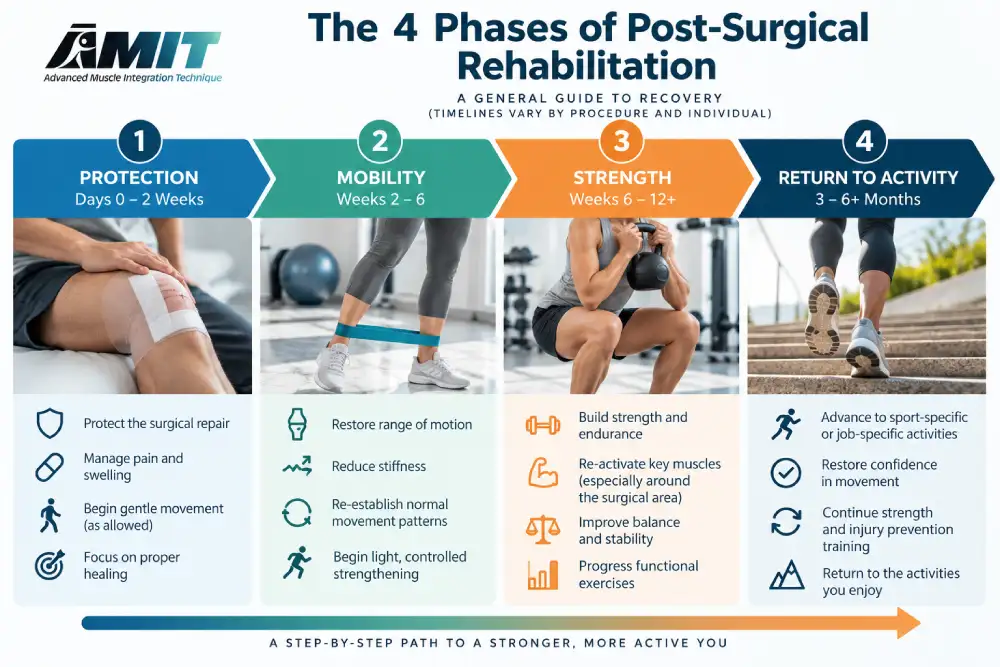
Every surgeon has a protocol, and the protocol always wins. With that said, most orthopedic procedures follow a similar arc. The ranges below are typical for joint and soft-tissue surgeries like knee, hip, and shoulder repairs. Spine surgery and complex reconstructions often run longer.
Phase | Typical window | Main goal | What you'll do |
|---|---|---|---|
1. Protection | Weeks 0 to 2 | Protect the repair and control swelling | Short walks, gentle motion if allowed, ice and elevation, activation drills |
2. Mobility | Weeks 2 to 6 | Restore range of motion and normal walking or arm use | Outpatient therapy, stretching, light daily tasks |
3. Strength | Weeks 6 to 12 | Rebuild strength, balance, and endurance | Resistance training, balance work, light cardio |
4. Return to activity | Month 3 onward | Get back to work, sport, and daily life | Job or sport-specific drills, function testing |
Phase 1: Protection (roughly weeks 0 to 2)
The goal is to protect the repair, control swelling, and keep you moving safely. Expect short walks, gentle range-of-motion work if your surgeon allows it, ice and elevation, and wound care. It feels slow. It is supposed to. This is also when inhibition sets in fastest, so the simple activation exercises your therapist assigns (quad sets after knee surgery, for example) matter more than they look.
Phase 2: Mobility (roughly weeks 2 to 6)
Range of motion becomes the priority, along with walking normally or using the arm for light daily tasks. Stiffness is the main enemy here, and most people start outpatient therapy two or three times a week. Once your surgeon clears it, this is often when hands-on work for compensation patterns in the hips, back, or neck can begin.
Phase 3: Strength (roughly weeks 6 to 12)
Loading increases. Resistance exercises, balance training, and longer walks or light cardio come in. This is the phase where plateaus tend to show up. If one side stalls while the plan keeps progressing, flag it with your care team instead of pushing harder and hoping it catches up.
Phase 4: Return to Activity (roughly month 3 onward)
Now the work gets specific to your life: running, lifting grandkids, getting back on the ski hill, or returning to a physical job. Progress is measured by function tests, not the calendar. Ligament reconstructions in particular take considerably longer to clear for cutting and jumping sports than joint replacements take to clear for daily life, so don't let a date someone mentioned in passing overrule what your body and your surgeon are telling you.
Where Chiropractic Care Fits After Surgery
People are often surprised that a chiropractor has any role in post-surgical rehab. The role is specific, and it is worth being clear about what it is and isn't.
What it isn't: manipulating a fresh surgical site, replacing your physical therapist, or overriding your surgeon. We don't adjust a fused segment, and we don't treat anyone in the early protection phase without clearance from the surgical team.
What it is: caring for the rest of the body while the surgical site heals, and restoring muscle activation so your rehab works better. After a knee replacement, months of limping before and after surgery commonly load the opposite hip and the lower back. After shoulder surgery, the neck and upper back pick up the slack. Those compensation patterns can outlast the recovery and turn into their own problem a year later.
For patients looking for post-surgical rehabilitation chiropractic services in the Salt Lake City area, our approach starts with the same neuromuscular evaluation we use for non-surgical pain treatment: muscle activation testing, joint stability, posture, and movement patterns. The difference is that we work inside your surgical restrictions and around the protocol you already have.
Some patients recovering from spine surgery ask about spinal decompression on a traction table. It can help selected patients with ongoing disc-related symptoms, but it isn't appropriate for everyone after spine surgery. Fusion hardware, a recent operation, or incomplete bone healing are common reasons to skip it, and we only consider it once your surgeon has signed off.
How to Speed Up Recovery After Surgery: 7 Things That Help
No supplement or gadget beats the basics. These are the factors with the biggest effect that are also within your control.
Don't skip the early sessions. The first weeks of therapy feel minor. They are when stiffness and inhibition are easiest to prevent and when they are cheapest to fix.
Move early, within your limits. Bed rest feels safe, but it slows recovery and raises the risk of stiffness and blood clots. Walk as often as your surgeon allows, even if it is only to the kitchen and back.
Protect your sleep. Much of tissue repair happens during sleep. The CDC recommends at least seven hours a night for adults, and recovery is a bad time to run a deficit. If pain is what wakes you, tell your care team rather than accepting it as normal.
Eat enough, and eat protein. Healing raises your energy needs, yet appetite often drops after surgery. Under-eating stalls repair. Include a protein source at every meal, not just dinner.
Stop smoking, even now. A meta-analysis in the American Journal of Medicine found that former smokers had about 27% fewer wound-healing complications than current smokers. Quitting helps at any point in your recovery.
Manage swelling on purpose. Swelling is one of the main triggers of muscle inhibition. Elevation, ice, and compression (as directed) are part of getting your strength back, not just comfort measures.
Get muscle activation checked if you plateau. If you are doing the work and one side stays weak, unstable, or tires early, the limit may be the signal rather than your effort. That is a reason to get evaluated, not a reason to quit.
Signs Your Recovery Has Stalled
Some setbacks are normal. Others are worth a phone call. Contact your surgeon right away for signs of infection, a sudden jump in swelling, calf pain, chest pain, or shortness of breath. Those aren't rehab questions.
The quieter signs of a stalled recovery usually show up later:
Strength has stopped improving for several weeks despite consistent exercise.
The joint feels unstable or "gives way" even though imaging looks fine.
A muscle feels disconnected or "not there" when you try to contract it.
New pain has appeared somewhere else, such as the opposite hip, your low back, or your neck.
You have finished therapy, but you still don't trust the joint.
If two or more of these fit, your recovery may be limited by compensation or inhibition rather than by healing. In our experience, that is often fixable even many months after surgery. Rest alone rarely solves it, for reasons we explain in why rest isn't enough for true injury recovery.
Finding Post-Surgical Rehabilitation Near You in Draper and Kaysville
If you are comparing options for post-surgical rehabilitation near you, ask a few direct questions before you book. Will they coordinate with your surgeon's protocol? Do they test muscle activation, or only range of motion and strength? How do they measure progress? And what is the plan if you plateau?
AMIT Clinics has two locations: our Kaysville clinic, serving Davis County, and our Draper clinic, serving the south end of Salt Lake County. The practice was founded by Dr. Craig Buhler, who developed the Advanced Muscle Integration Technique, completed a postdoctoral fellowship in motor physiology at the University of Utah School of Medicine, and spent more than 23 years as team chiropractor for the Utah Jazz. Post-surgical patients come to us at every stage, but most often during the strength phase, when progress slows and nobody can say exactly why.
You don't have to choose between us and your physical therapist. Most of our post-surgical patients see both. If you aren't sure whether muscle activation is what's holding you back, our page on what to expect at your first visit walks through how an evaluation works, or you can call us at 801.544.2355.
Frequently Asked Questions
How long does post-surgical rehabilitation take?
Most orthopedic rehab takes six weeks to six months, and some procedures take a year or more. Joint replacements often reach their main milestones in around three months, while ligament reconstructions and spine surgeries usually run longer. Your surgeon's protocol and your function tests, not the calendar, decide when you are done.
When should I start rehab after surgery?
Usually within days. Many patients begin gentle movement in the hospital or during the first week, and outpatient therapy commonly starts within the first two weeks. Starting late makes stiffness and muscle inhibition harder to reverse, so follow your surgeon's start date closely.
Can a chiropractor help after surgery?
Yes, once your surgeon clears it and when the care is matched to your restrictions. A chiropractor can treat compensation patterns in other areas, such as the back, hips, or neck, and work on muscle activation around the surgical site. It should complement physical therapy, not replace it.
Why do I still feel weak after physical therapy?
Often because the muscle isn't fully activating, not because it is too small. Research on knee replacement patients found that failed voluntary activation contributed nearly twice as much to early strength loss as muscle shrinkage did. Exercise alone can't fully strengthen a muscle the nervous system is holding back.
What slows down recovery after surgery?
The most common factors are skipping early therapy, too much bed rest, poor sleep, under-eating, smoking, and uncontrolled swelling. Doing too much too soon causes setbacks as well. Most of these are within your control.
Is post-surgical rehabilitation the same as physical therapy?
Not exactly. Physical therapy is usually the core of post-surgical rehabilitation, but rehab can also include your surgeon's follow-up care, chiropractic and muscle activation work, and home exercise. Think of physical therapy as the main engine and the other pieces as support.