
You've tried the ice pack. You've tried the stretches your neighbor swears by. Three weeks later, that sharp line running from your lower back through your hip and down your leg is still there, and it's starting to feel less like an injury and more like a permanent houseguest.
If you're searching for sciatica treatment near me at eleven at night because the pain woke you up again, here's the short answer: most sciatica improves with the right combination of chiropractic care, targeted movement, and time, not surgery. Surgery is a last resort for a small share of cases, not the default next step. The rest of this guide covers why sciatica sticks around longer than people expect, what actually helps, and when it's worth talking to a specialist about more invasive options.
Key Takeaways
Sciatica is nerve pain caused by irritation or compression of the sciatic nerve, most often from a herniated disc, piriformis syndrome, or spinal stenosis.
Most cases improve over several weeks to a few months with conservative care: chiropractic adjustments, targeted stretching, and smart activity modification.
Surgery is typically only on the table when there's significant weakness, loss of bladder or bowel control, or no meaningful improvement after months of consistent conservative treatment.
A chiropractor for sciatica in Draper can identify which structure is actually causing your pain instead of you guessing at home remedies.
What Is Sciatica, Really?

Sciatica is the term for pain, tingling, or numbness that travels along the path of the sciatic nerve, the longest nerve in the body, running from the lower back through the hip and buttock and down the back of each leg. Sciatica itself isn't a diagnosis so much as a symptom pattern. Something is pressing on or irritating that nerve, and the job of treatment is to figure out what.
That's the detail that trips people up. Regular low back pain tends to stay in the back. Sciatica moves. If your pain travels past your knee, or if you're getting pins-and-needles or numbness down one leg along with the ache, that's a meaningfully different problem than a pulled muscle, and it usually responds to a different kind of treatment.
What's Actually Causing Your Sciatica
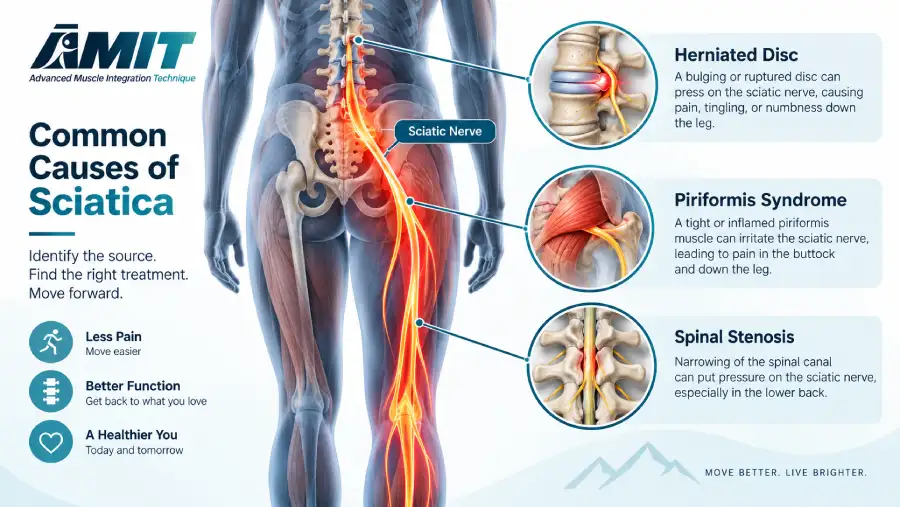
Sciatica has a short list of usual suspects, and the right treatment depends heavily on which one you're dealing with.
Herniated or Bulging Discs
The discs that cushion the bones of your spine can bulge or tear, and when that happens near the lower back, the disc material can press directly on the nerve roots that form the sciatic nerve. This is the most common cause of sciatica in adults under 50. If you want the full picture on how this is diagnosed and treated, we cover it in detail on our lumbar disc herniation treatment page.
Piriformis Syndrome
The piriformis is a small muscle deep in the buttock, and the sciatic nerve runs right underneath it (or sometimes through it). When that muscle tightens or spasms, it can squeeze the nerve and mimic disc-related sciatica almost exactly, which is part of why this cause gets missed so often. See our piriformis syndrome treatment page (/conditions/piriformis-syndrome-treatment-utah) for how we tell it apart from a disc issue.
Spinal Stenosis
This is a narrowing of the spinal canal, usually tied to age-related changes in the spine, that reduces the space available for the nerve roots. It tends to show up as leg pain that gets worse the longer you stand or walk and eases when you sit or lean forward, which is a useful clue in telling it apart from disc-related sciatica.
Why the Pain Keeps Coming Back After You Thought It Was Gone
This is the part that frustrates people the most. You do the stretches, the pain fades for a week or two, and then one wrong twist while loading the dishwasher and it's back, sometimes worse than before. That pattern usually means the underlying cause was never fully addressed, only calmed down.
It's especially common after a round of physical therapy that focused on general strengthening without pinpointing which structure was actually compressing the nerve. We've written more about that specific pattern, including why the improvement often doesn't hold, in our post on why back pain keeps returning after physical therapy. If that sounds like your situation, a fresh evaluation focused on the specific cause, rather than another round of the same general exercises, is usually the more useful next step.
Non-Surgical Sciatica Treatments Worth Trying First

For the large majority of people, sciatica responds to conservative care. Here's what that actually looks like in practice.
Chiropractic Care for Sciatica
Chiropractic adjustments aim to restore normal motion and reduce pressure at the specific spinal level or joint that's irritating the nerve. For piriformis-related sciatica, that's often paired with soft-tissue work directly on the muscle. For disc-related sciatica, adjustments are typically combined with specific decompression-style techniques and a home exercise plan built around your particular presentation, not a generic sheet handed to everyone with back pain.
Targeted Stretching and Movement
Not all stretching helps, and some generic stretches can aggravate a disc-related case while helping a piriformis case, or the reverse. Movement matched to the actual cause matters more than the volume of stretching.
Heat, Ice, and Activity Modification
Ice tends to help in the first few days when irritation is acute; heat is usually more useful once the sharp phase has passed and the muscles around the area have tightened up defensively. Complete bed rest is rarely the right call. Staying as active as the pain allows, with the specific movements that aggravate your case dialed back, generally leads to faster recovery than staying still.
Chiropractic Care vs. Physical Therapy
These aren't competing options so much as different tools. Physical therapy tends to focus on strengthening and endurance over a longer arc. Chiropractic care tends to focus more directly on restoring joint motion and reducing nerve irritation early, which is often what needs to happen before strengthening work will actually stick. Many people do best with an evaluation that identifies which is the more pressing need first.
When Chiropractic Care Helps Most for Draper Patients
In our experience treating sciatica pain in chiropractic patients around Draper, the cases that respond fastest are the ones where someone comes in within the first few weeks of symptoms, before the body has had time to build up months of compensating movement patterns around the pain. That doesn't mean it's too late if you've been dealing with this for a while. It means the earlier a chiropractor for sciatica can identify the actual cause, the fewer visits it typically takes to get real relief.
A first visit for sciatica pain with a Draper chiropractic team usually includes orthopedic and neurological testing to narrow down whether the issue is disc-related, piriformis-related, or something else, since the treatment plan differs meaningfully between those causes.
Red Flags: When Sciatica Needs More Than Conservative Care
Most sciatica is not an emergency, but a small number of cases are, and it's worth knowing the difference.
Sudden loss of bladder or bowel control, or numbness in the groin or inner thighs (saddle anesthesia). This combination needs emergency care immediately, since it can signal a serious condition called cauda equina syndrome.
Progressive weakness in the leg or foot, especially difficulty lifting the front of the foot when walking.
Pain following a significant injury, fall, or accident.
No meaningful improvement after several months of consistent, well-directed conservative care.
That last point is where the surgery conversation usually starts, and it's worth having with real information rather than worst-case assumptions. We've laid out the non-fusion options that are typically tried first, and where the evidence actually supports fusion versus alternatives, in our post on lower back pain treatment alternatives to fusion (/blog/lower-back-pain-treatment-draper-alternative-to-fusion).
How Long Does Sciatica Take to Heal?
For most people, sciatica improves substantially within a few weeks to a few months of starting focused conservative care, though the exact timeline depends heavily on the underlying cause and how long it went untreated before that care started. Piriformis-related cases often respond faster than disc-related cases. The single biggest factor in how long it takes isn't the initial injury, it's how quickly the actual cause gets identified and addressed.
Frequently Asked Questions
What is the fastest way to relieve sciatica pain at home?
Alternating ice and gentle movement in the first few days, avoiding prolonged sitting, and steering clear of stretches that shoot pain down the leg tend to bring the fastest short-term relief. Home care can calm symptoms, but it rarely resolves the underlying cause on its own if the pain has lasted more than a week or two.
Can a chiropractor fix sciatica permanently?
A chiropractor can address the mechanical causes of sciatica, such as a misaligned joint or a tight piriformis muscle, which often resolves the pain long-term. Whether it's truly permanent depends on the cause and on follow-through with any home exercise or posture changes recommended, since some causes (like disc degeneration) can flare again under the wrong conditions.
Is walking good for sciatica pain?
For most causes of sciatica, gentle walking is helpful rather than harmful, since it keeps blood flow moving to the area without loading the spine the way sitting or heavy lifting does. If walking sharply increases leg pain or numbness, that's worth mentioning at your evaluation rather than pushing through it.
How do I know if my sciatica is from a herniated disc or piriformis syndrome?
Disc-related sciatica often worsens with sitting, bending forward, or coughing and sneezing. Piriformis-related sciatica often worsens with prolonged sitting on the affected side, climbing stairs, or crossing that leg. The two overlap enough that a hands-on orthopedic exam is the reliable way to tell them apart.
When should I see a doctor instead of a chiropractor for sciatica?
Go straight to emergency care for sudden bladder or bowel changes, saddle numbness, or rapidly worsening leg weakness. Outside of those red flags, starting with a chiropractic evaluation is a reasonable first step for most sciatica, and a good chiropractor will refer out for imaging or a specialist opinion if the exam points that direction.
Finding the Right Sciatica Chiropractor Near You
Sciatica that's stuck around for more than a couple of weeks is worth a real evaluation rather than another round of guessing. If you're searching for a sciatica chiropractor near me in the Draper area, look for a clinic that starts with orthopedic testing to identify the actual cause before recommending a treatment plan, since a piriformis issue and a disc issue are treated differently even though they can feel almost identical.