MCL Sprain Treatment in Utah
Treatment in Salt Lake City, UT Advanced Muscle Integration Technique (A.M.I.T.)
MCL Sprain Treatment in Utah
Treatment in Salt Lake City, UT Advanced Muscle Integration Technique (A.M.I.T.)
MCL Sprain Treatment in Utah
Treatment in Salt Lake City, UT Advanced Muscle Integration Technique (A.M.I.T.)
How to Identify MCL Sprains and the AMIT Solution
An MCL sprain is a stretch or tear of the medial collateral ligament, the band on the inner side of the knee that keeps the joint from buckling inward. Most MCL sprains come from a blow to the outside of the knee or a hard twist, and most heal without surgery. Recovery runs from about one week for a mild sprain to several months for a complete tear.
What decides whether the knee is trustworthy afterward is not only whether the ligament healed. It is whether the muscles that share the job of holding the joint together started firing again.
The medial collateral ligament (MCL) supports the knee on the inner side of the leg. MCL injuries are common in contact sports and can occur from a direct sideways blow to the outside of the knee or lower leg.
These injuries can cause pain, instability, and difficulty walking or bearing weight. This is one of the lower-body programs AMIT addresses by restoring proper muscle activation instead of relying on surgery.
On This Page:
Causes of MCL Sprains
Symptoms and Signs of MCL Sprains
MCL Sprain Grades: Grade 1, Grade 2 and Grade 3
How AMIT Treats MCL Sprains
Causes of MCL Sprains
The MCL can be sprained or torn due to:
Direct Impact: A sideways blow to the knee, often occurring in sports such as football or soccer.
Twisting Movements: Severe knee twisting, particularly when the lower leg twists outward while the upper leg stays in place, can strain the MCL.
Falls: Falling in a way that twists or overstresses the knee joint.
Symptoms of MCL Sprains
Common signs of an MCL sprain include:
Pain and Swelling: Pain along the inner side of the knee, often accompanied by swelling.
Instability: The knee may feel unstable, particularly during weight-bearing activities.
Limited Range of Motion: Difficulty fully straightening or bending the knee due to pain or swelling.
MCL Sprain Grades: Grade 1, Grade 2 and Grade 3
MCL sprains are graded by how much of the ligament is damaged and how far the joint opens under a sideways stress test. The grade sets both the treatment plan and the timeline.
Grade 1 MCL Sprain (Mild)
The ligament is stretched but its fibers stay intact. You feel tenderness along the inner side of the knee and there is usually mild swelling, but the joint still feels solid when you put weight on it. Most Grade 1 sprains settle in about one to three weeks.
Grade 2 MCL Sprain (Moderate)
The ligament is partially torn. Swelling and bruising are obvious, the inner knee hurts with side-to-side movement, and the joint starts to feel loose. Recovery usually runs about four to six weeks, and a brace for the first week or two is common.
Grade 3 MCL Sprain (Severe)
The ligament is torn all the way through. Swelling is significant, the knee is unstable rather than just sore, and putting weight through the leg is difficult. Recovery takes six weeks to several months. A Grade 3 tear also frequently comes with an ACL or meniscus injury, which changes both the imaging and the plan.
How Long Does an MCL Sprain Take to Heal?
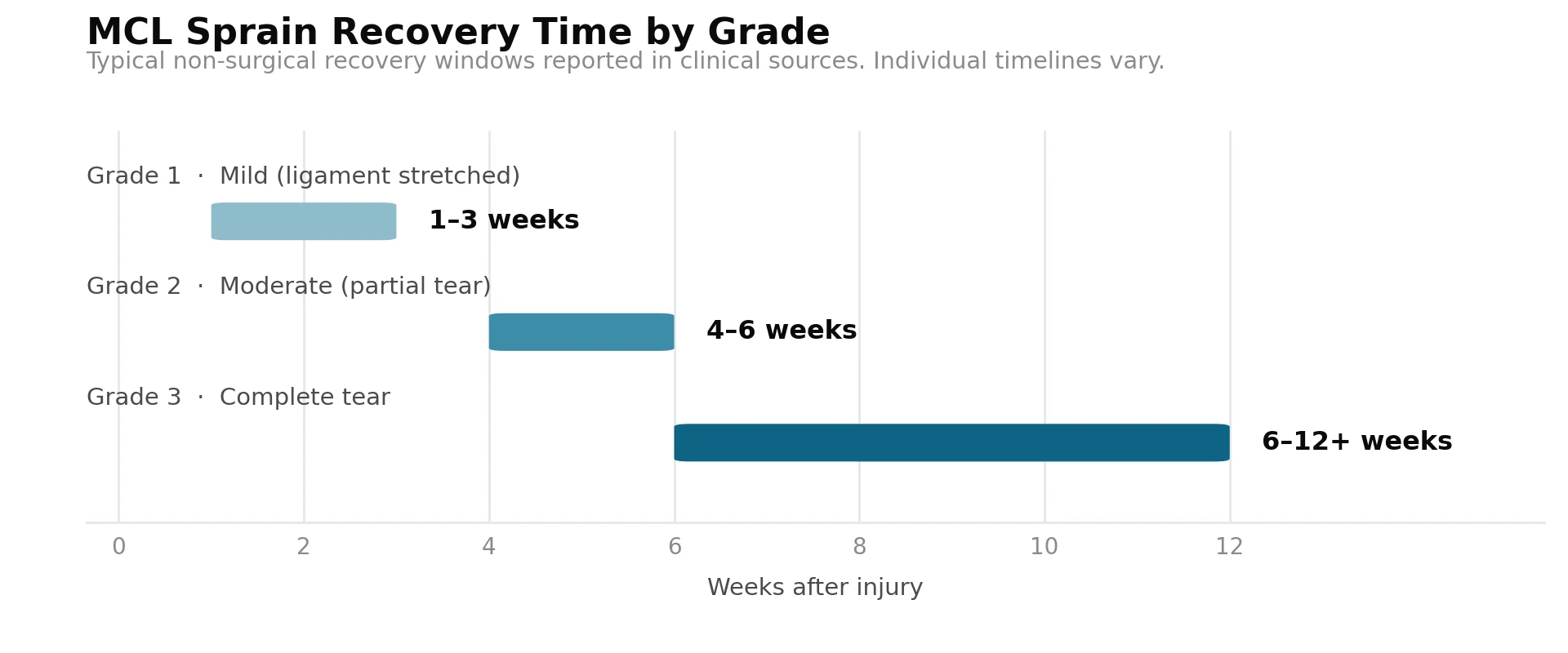
A mild MCL sprain usually settles within one to three weeks. A moderate sprain takes about four to six weeks. A complete tear takes six weeks or longer, and clearance for cutting or contact sport comes later than clearance for daily activity.
Those numbers describe the ligament. They do not describe the knee. Patients regularly arrive here months after an MCL sprain with imaging that looks fine and a knee they still cannot trust on a lateral step. That gap is usually a muscle that never switched back on, not a ligament that failed to heal.
Can You Walk on a Sprained MCL?
With a Grade 1 sprain most people can walk, often with a limp for the first few days. With a Grade 2, walking is uncomfortable and a brace or crutches for the first week or two is common. With a Grade 3, putting weight through the leg is frequently not possible at first, and the knee should be evaluated before you keep loading it.
A practical rule: soreness on the inner knee is one signal, and a knee that feels like it might give way sideways is a different one. If it is the second, stop walking on it and get it examined.
Can an MCL Sprain Heal on Its Own?
The MCL sits outside the joint capsule and has a good blood supply, so it heals on its own far more reliably than the ligaments inside the knee. That is why the large majority of MCL sprains are managed without surgery.
Healing on its own is not the same as recovering fully. The ligament can scar down and still leave a knee that collapses inward under load, because the muscle that shares the stabilizing job is still inhibited. Rest does not correct that part.
MCL Sprain vs. MCL Tear: What Is the Difference?
They describe the same injury. A sprain is damage to a ligament, and every MCL sprain above Grade 1 involves some degree of tearing. In everyday use people say “sprain” for the mild and moderate versions and “tear” for a complete rupture, but clinically it is the same three-grade scale.
AMIT Treatment for MCL Sprains
A first visit starts with a valgus stress test. We apply gentle sideways pressure to the knee, feel how far the joint opens along the inner side, and check whether there is a firm endpoint. That gives us the grade. If the exam points to a complete tear or suggests another structure is involved, we refer for imaging before treating.
Then comes the part most knee exams skip. We test each muscle around the knee and hip individually to find which ones stopped firing at the moment of injury. With an MCL sprain the usual finding is the vastus medialis, the inner quadriceps division that keeps the knee from drifting inward. Knowing which muscles are offline is what tells us how to make the joint stable again, rather than only less painful.
What Happens During an MCL Sprain?
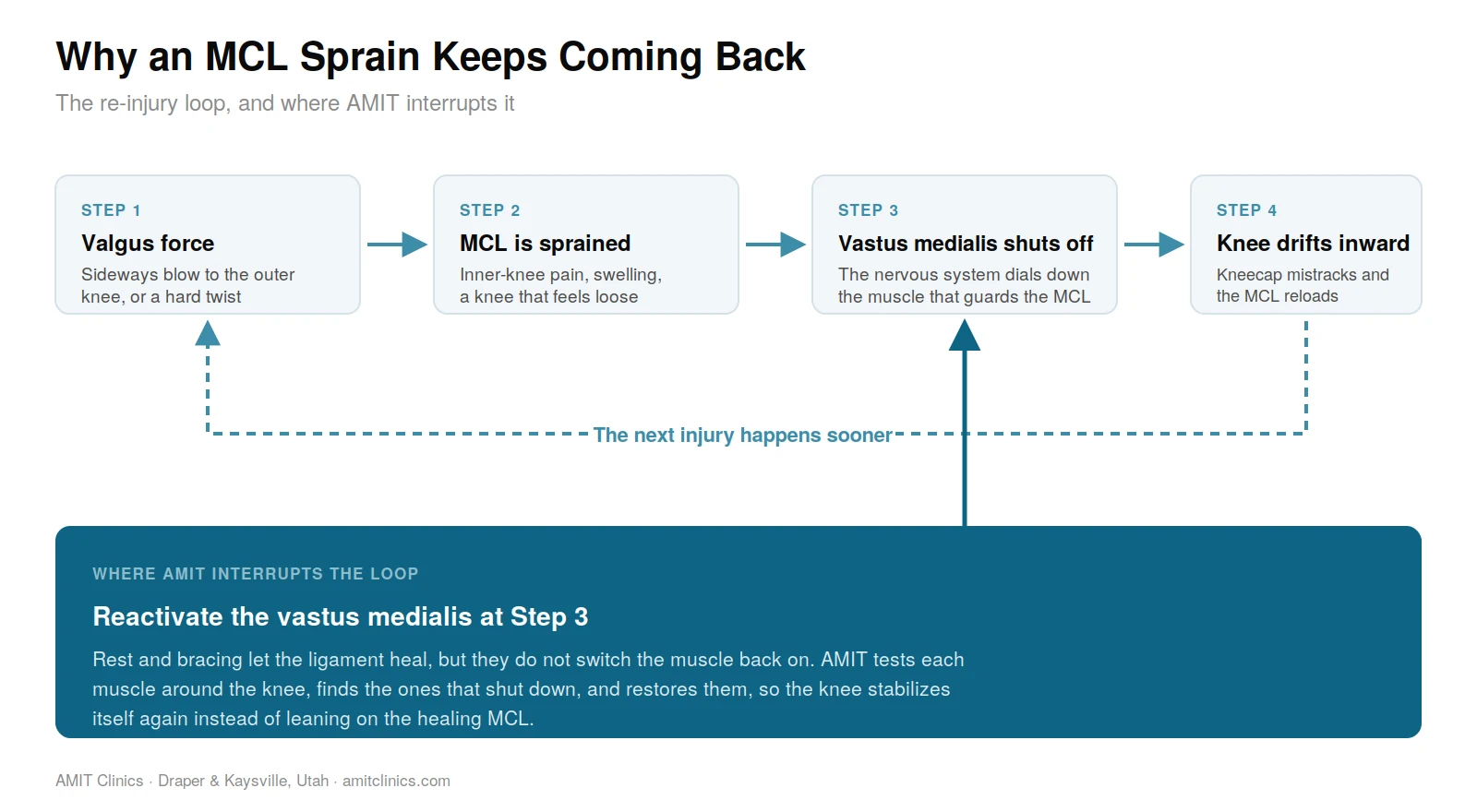
When the vastus medialis muscle group becomes inhibited, the knee loses medial stability, increasing stress on the MCL. This can result in the knee shifting into a valgus (knocked knee) position, which places more pressure on the MCL, making it more susceptible to injury. Additionally, inhibited muscles can cause improper kneecap tracking, further increasing the likelihood of ligament damage.
Rest and a brace protect the ligament while it heals. Neither one tells the vastus medialis to start working again. The knee comes out of the brace with a healed ligament and no active medial support, and the next awkward landing puts the same load through the same tissue.
How Does AMIT Help?
Advanced Muscle Integration Technique (AMIT) reactivates the inhibited vastus medialis and other supporting muscles, restoring proper knee stability. This reduces the risk of further MCL injuries and ensures that the kneecap tracks properly. Treatment from a certified AMIT physician can help you avoid surgical intervention by addressing the underlying muscle imbalances that lead to MCL sprains.
Steps to Take If You Have an MCL Sprain
Rest and Ice: Rest the knee and apply ice to reduce swelling.
Consult a Certified AMIT Physician: At AMIT, we specialize in treating MCL sprains by correcting muscle imbalances and reactivating inhibited muscles. Contact us today to schedule a consultation.
Rehabilitation: After AMIT treatment, our team will guide you through exercises to restore strength and stability to the knee, preventing future ligament injuries.
Why Choose AMIT for MCL Sprains?
Non-Invasive Treatment: AMIT offers a non-surgical solution to MCL sprains by addressing the root cause—muscle inhibition.
Restores Knee Stability: AMIT reactivates the vastus medialis and other muscles to improve knee stability.
Prevents Re-Injury: By correcting muscle imbalances, AMIT helps prevent further ligament injuries and ensures proper kneecap alignment.
If you're suffering from an MCL sprain, contact Advanced Muscle Integration Clinics in the Salt lake City Area for professional, effective treatment using Advanced Muscle Integration Technique. A certified AMIT physician can help you recover and prevent future injuries.
MCL Sprain Treatment in Draper and Kaysville
AMIT Clinics treats knee ligament injuries at both Utah locations: Draper, at 12371 S 900 E Unit 101, and Kaysville, at 447 North 300 West Ste 5. We see skiers, high school and college athletes, weekend soccer and basketball players, and people whose knee has not felt right since an injury years ago.
Frequently Asked Questions About MCL Sprains
How long does it take for a sprained MCL to heal?
A Grade 1 MCL sprain typically heals in one to three weeks, a Grade 2 in about four to six weeks, and a Grade 3 in six weeks or longer. Return to cutting and contact sport takes longer than return to walking and daily activity.
What does an MCL sprain feel like?
Pain and tenderness along the inner side of the knee, swelling within the first day, and a knee that feels loose or unreliable when you move side to side. Many people also cannot fully straighten or bend the knee at first.
Is it okay to walk on a sprained MCL?
Usually yes with a mild sprain, often with a limp. With a moderate or severe sprain, walking should wait for an examination, especially if the knee feels like it might buckle sideways. Instability is the sign to stop loading it.
Can an MCL sprain heal on its own?
Most do. The MCL has a good blood supply and heals without surgery in the large majority of cases. What does not resolve on its own is the muscle inhibition that follows the injury, which is why some knees stay unstable after the ligament has healed.
Do I need surgery for an MCL sprain?
Isolated MCL sprains rarely require surgery, including many complete tears. Surgery is considered mainly when the MCL injury comes with an ACL, PCL, or meniscus injury, or when instability persists after conservative treatment.
How soon can I go back to sport after an MCL sprain?
It depends on the grade and on whether the knee has regained active stability, not only on the calendar. Before returning to cutting or contact sport you should be able to load the knee laterally without pain, apprehension, or the inner knee giving way.
Call 801.544.2355 to be seen. If you are inside the first week of an acute injury, mention that when you call.
Schedule an Appointment
Call: 801.544.2355
Or, use the link below to get started:
How to Identify MCL Sprains and the AMIT Solution
An MCL sprain is a stretch or tear of the medial collateral ligament, the band on the inner side of the knee that keeps the joint from buckling inward. Most MCL sprains come from a blow to the outside of the knee or a hard twist, and most heal without surgery. Recovery runs from about one week for a mild sprain to several months for a complete tear.
What decides whether the knee is trustworthy afterward is not only whether the ligament healed. It is whether the muscles that share the job of holding the joint together started firing again.
The medial collateral ligament (MCL) supports the knee on the inner side of the leg. MCL injuries are common in contact sports and can occur from a direct sideways blow to the outside of the knee or lower leg.
These injuries can cause pain, instability, and difficulty walking or bearing weight. This is one of the lower-body programs AMIT addresses by restoring proper muscle activation instead of relying on surgery.
On This Page:
Causes of MCL Sprains
Symptoms and Signs of MCL Sprains
MCL Sprain Grades: Grade 1, Grade 2 and Grade 3
How AMIT Treats MCL Sprains
Causes of MCL Sprains
The MCL can be sprained or torn due to:
Direct Impact: A sideways blow to the knee, often occurring in sports such as football or soccer.
Twisting Movements: Severe knee twisting, particularly when the lower leg twists outward while the upper leg stays in place, can strain the MCL.
Falls: Falling in a way that twists or overstresses the knee joint.
Symptoms of MCL Sprains
Common signs of an MCL sprain include:
Pain and Swelling: Pain along the inner side of the knee, often accompanied by swelling.
Instability: The knee may feel unstable, particularly during weight-bearing activities.
Limited Range of Motion: Difficulty fully straightening or bending the knee due to pain or swelling.
MCL Sprain Grades: Grade 1, Grade 2 and Grade 3
MCL sprains are graded by how much of the ligament is damaged and how far the joint opens under a sideways stress test. The grade sets both the treatment plan and the timeline.
Grade 1 MCL Sprain (Mild)
The ligament is stretched but its fibers stay intact. You feel tenderness along the inner side of the knee and there is usually mild swelling, but the joint still feels solid when you put weight on it. Most Grade 1 sprains settle in about one to three weeks.
Grade 2 MCL Sprain (Moderate)
The ligament is partially torn. Swelling and bruising are obvious, the inner knee hurts with side-to-side movement, and the joint starts to feel loose. Recovery usually runs about four to six weeks, and a brace for the first week or two is common.
Grade 3 MCL Sprain (Severe)
The ligament is torn all the way through. Swelling is significant, the knee is unstable rather than just sore, and putting weight through the leg is difficult. Recovery takes six weeks to several months. A Grade 3 tear also frequently comes with an ACL or meniscus injury, which changes both the imaging and the plan.
How Long Does an MCL Sprain Take to Heal?
A mild MCL sprain usually settles within one to three weeks. A moderate sprain takes about four to six weeks. A complete tear takes six weeks or longer, and clearance for cutting or contact sport comes later than clearance for daily activity.
Those numbers describe the ligament. They do not describe the knee. Patients regularly arrive here months after an MCL sprain with imaging that looks fine and a knee they still cannot trust on a lateral step. That gap is usually a muscle that never switched back on, not a ligament that failed to heal.
Can You Walk on a Sprained MCL?
With a Grade 1 sprain most people can walk, often with a limp for the first few days. With a Grade 2, walking is uncomfortable and a brace or crutches for the first week or two is common. With a Grade 3, putting weight through the leg is frequently not possible at first, and the knee should be evaluated before you keep loading it.
A practical rule: soreness on the inner knee is one signal, and a knee that feels like it might give way sideways is a different one. If it is the second, stop walking on it and get it examined.
Can an MCL Sprain Heal on Its Own?
The MCL sits outside the joint capsule and has a good blood supply, so it heals on its own far more reliably than the ligaments inside the knee. That is why the large majority of MCL sprains are managed without surgery.
Healing on its own is not the same as recovering fully. The ligament can scar down and still leave a knee that collapses inward under load, because the muscle that shares the stabilizing job is still inhibited. Rest does not correct that part.
MCL Sprain vs. MCL Tear: What Is the Difference?
They describe the same injury. A sprain is damage to a ligament, and every MCL sprain above Grade 1 involves some degree of tearing. In everyday use people say “sprain” for the mild and moderate versions and “tear” for a complete rupture, but clinically it is the same three-grade scale.
AMIT Treatment for MCL Sprains
A first visit starts with a valgus stress test. We apply gentle sideways pressure to the knee, feel how far the joint opens along the inner side, and check whether there is a firm endpoint. That gives us the grade. If the exam points to a complete tear or suggests another structure is involved, we refer for imaging before treating.
Then comes the part most knee exams skip. We test each muscle around the knee and hip individually to find which ones stopped firing at the moment of injury. With an MCL sprain the usual finding is the vastus medialis, the inner quadriceps division that keeps the knee from drifting inward. Knowing which muscles are offline is what tells us how to make the joint stable again, rather than only less painful.
What Happens During an MCL Sprain?
When the vastus medialis muscle group becomes inhibited, the knee loses medial stability, increasing stress on the MCL. This can result in the knee shifting into a valgus (knocked knee) position, which places more pressure on the MCL, making it more susceptible to injury. Additionally, inhibited muscles can cause improper kneecap tracking, further increasing the likelihood of ligament damage.
Rest and a brace protect the ligament while it heals. Neither one tells the vastus medialis to start working again. The knee comes out of the brace with a healed ligament and no active medial support, and the next awkward landing puts the same load through the same tissue.
How Does AMIT Help?
Advanced Muscle Integration Technique (AMIT) reactivates the inhibited vastus medialis and other supporting muscles, restoring proper knee stability. This reduces the risk of further MCL injuries and ensures that the kneecap tracks properly. Treatment from a certified AMIT physician can help you avoid surgical intervention by addressing the underlying muscle imbalances that lead to MCL sprains.
Steps to Take If You Have an MCL Sprain
Rest and Ice: Rest the knee and apply ice to reduce swelling.
Consult a Certified AMIT Physician: At AMIT, we specialize in treating MCL sprains by correcting muscle imbalances and reactivating inhibited muscles. Contact us today to schedule a consultation.
Rehabilitation: After AMIT treatment, our team will guide you through exercises to restore strength and stability to the knee, preventing future ligament injuries.
Why Choose AMIT for MCL Sprains?
Non-Invasive Treatment: AMIT offers a non-surgical solution to MCL sprains by addressing the root cause—muscle inhibition.
Restores Knee Stability: AMIT reactivates the vastus medialis and other muscles to improve knee stability.
Prevents Re-Injury: By correcting muscle imbalances, AMIT helps prevent further ligament injuries and ensures proper kneecap alignment.
If you're suffering from an MCL sprain, contact Advanced Muscle Integration Clinics in the Salt lake City Area for professional, effective treatment using Advanced Muscle Integration Technique. A certified AMIT physician can help you recover and prevent future injuries.
MCL Sprain Treatment in Draper and Kaysville
AMIT Clinics treats knee ligament injuries at both Utah locations: Draper, at 12371 S 900 E Unit 101, and Kaysville, at 447 North 300 West Ste 5. We see skiers, high school and college athletes, weekend soccer and basketball players, and people whose knee has not felt right since an injury years ago.
Frequently Asked Questions About MCL Sprains
How long does it take for a sprained MCL to heal?
A Grade 1 MCL sprain typically heals in one to three weeks, a Grade 2 in about four to six weeks, and a Grade 3 in six weeks or longer. Return to cutting and contact sport takes longer than return to walking and daily activity.
What does an MCL sprain feel like?
Pain and tenderness along the inner side of the knee, swelling within the first day, and a knee that feels loose or unreliable when you move side to side. Many people also cannot fully straighten or bend the knee at first.
Is it okay to walk on a sprained MCL?
Usually yes with a mild sprain, often with a limp. With a moderate or severe sprain, walking should wait for an examination, especially if the knee feels like it might buckle sideways. Instability is the sign to stop loading it.
Can an MCL sprain heal on its own?
Most do. The MCL has a good blood supply and heals without surgery in the large majority of cases. What does not resolve on its own is the muscle inhibition that follows the injury, which is why some knees stay unstable after the ligament has healed.
Do I need surgery for an MCL sprain?
Isolated MCL sprains rarely require surgery, including many complete tears. Surgery is considered mainly when the MCL injury comes with an ACL, PCL, or meniscus injury, or when instability persists after conservative treatment.
How soon can I go back to sport after an MCL sprain?
It depends on the grade and on whether the knee has regained active stability, not only on the calendar. Before returning to cutting or contact sport you should be able to load the knee laterally without pain, apprehension, or the inner knee giving way.
Call 801.544.2355 to be seen. If you are inside the first week of an acute injury, mention that when you call.
Schedule an Appointment
Call: 801.544.2355
Or, use the link below to get started:
How to Identify MCL Sprains and the AMIT Solution
An MCL sprain is a stretch or tear of the medial collateral ligament, the band on the inner side of the knee that keeps the joint from buckling inward. Most MCL sprains come from a blow to the outside of the knee or a hard twist, and most heal without surgery. Recovery runs from about one week for a mild sprain to several months for a complete tear.
What decides whether the knee is trustworthy afterward is not only whether the ligament healed. It is whether the muscles that share the job of holding the joint together started firing again.
The medial collateral ligament (MCL) supports the knee on the inner side of the leg. MCL injuries are common in contact sports and can occur from a direct sideways blow to the outside of the knee or lower leg.
These injuries can cause pain, instability, and difficulty walking or bearing weight. This is one of the lower-body programs AMIT addresses by restoring proper muscle activation instead of relying on surgery.
On This Page:
Causes of MCL Sprains
Symptoms and Signs of MCL Sprains
MCL Sprain Grades: Grade 1, Grade 2 and Grade 3
How AMIT Treats MCL Sprains
Causes of MCL Sprains
The MCL can be sprained or torn due to:
Direct Impact: A sideways blow to the knee, often occurring in sports such as football or soccer.
Twisting Movements: Severe knee twisting, particularly when the lower leg twists outward while the upper leg stays in place, can strain the MCL.
Falls: Falling in a way that twists or overstresses the knee joint.
Symptoms of MCL Sprains
Common signs of an MCL sprain include:
Pain and Swelling: Pain along the inner side of the knee, often accompanied by swelling.
Instability: The knee may feel unstable, particularly during weight-bearing activities.
Limited Range of Motion: Difficulty fully straightening or bending the knee due to pain or swelling.
MCL Sprain Grades: Grade 1, Grade 2 and Grade 3
MCL sprains are graded by how much of the ligament is damaged and how far the joint opens under a sideways stress test. The grade sets both the treatment plan and the timeline.
Grade 1 MCL Sprain (Mild)
The ligament is stretched but its fibers stay intact. You feel tenderness along the inner side of the knee and there is usually mild swelling, but the joint still feels solid when you put weight on it. Most Grade 1 sprains settle in about one to three weeks.
Grade 2 MCL Sprain (Moderate)
The ligament is partially torn. Swelling and bruising are obvious, the inner knee hurts with side-to-side movement, and the joint starts to feel loose. Recovery usually runs about four to six weeks, and a brace for the first week or two is common.
Grade 3 MCL Sprain (Severe)
The ligament is torn all the way through. Swelling is significant, the knee is unstable rather than just sore, and putting weight through the leg is difficult. Recovery takes six weeks to several months. A Grade 3 tear also frequently comes with an ACL or meniscus injury, which changes both the imaging and the plan.
How Long Does an MCL Sprain Take to Heal?
A mild MCL sprain usually settles within one to three weeks. A moderate sprain takes about four to six weeks. A complete tear takes six weeks or longer, and clearance for cutting or contact sport comes later than clearance for daily activity.
Those numbers describe the ligament. They do not describe the knee. Patients regularly arrive here months after an MCL sprain with imaging that looks fine and a knee they still cannot trust on a lateral step. That gap is usually a muscle that never switched back on, not a ligament that failed to heal.
Can You Walk on a Sprained MCL?
With a Grade 1 sprain most people can walk, often with a limp for the first few days. With a Grade 2, walking is uncomfortable and a brace or crutches for the first week or two is common. With a Grade 3, putting weight through the leg is frequently not possible at first, and the knee should be evaluated before you keep loading it.
A practical rule: soreness on the inner knee is one signal, and a knee that feels like it might give way sideways is a different one. If it is the second, stop walking on it and get it examined.
Can an MCL Sprain Heal on Its Own?
The MCL sits outside the joint capsule and has a good blood supply, so it heals on its own far more reliably than the ligaments inside the knee. That is why the large majority of MCL sprains are managed without surgery.
Healing on its own is not the same as recovering fully. The ligament can scar down and still leave a knee that collapses inward under load, because the muscle that shares the stabilizing job is still inhibited. Rest does not correct that part.
MCL Sprain vs. MCL Tear: What Is the Difference?
They describe the same injury. A sprain is damage to a ligament, and every MCL sprain above Grade 1 involves some degree of tearing. In everyday use people say “sprain” for the mild and moderate versions and “tear” for a complete rupture, but clinically it is the same three-grade scale.
AMIT Treatment for MCL Sprains
A first visit starts with a valgus stress test. We apply gentle sideways pressure to the knee, feel how far the joint opens along the inner side, and check whether there is a firm endpoint. That gives us the grade. If the exam points to a complete tear or suggests another structure is involved, we refer for imaging before treating.
Then comes the part most knee exams skip. We test each muscle around the knee and hip individually to find which ones stopped firing at the moment of injury. With an MCL sprain the usual finding is the vastus medialis, the inner quadriceps division that keeps the knee from drifting inward. Knowing which muscles are offline is what tells us how to make the joint stable again, rather than only less painful.
What Happens During an MCL Sprain?
When the vastus medialis muscle group becomes inhibited, the knee loses medial stability, increasing stress on the MCL. This can result in the knee shifting into a valgus (knocked knee) position, which places more pressure on the MCL, making it more susceptible to injury. Additionally, inhibited muscles can cause improper kneecap tracking, further increasing the likelihood of ligament damage.
Rest and a brace protect the ligament while it heals. Neither one tells the vastus medialis to start working again. The knee comes out of the brace with a healed ligament and no active medial support, and the next awkward landing puts the same load through the same tissue.
How Does AMIT Help?
Advanced Muscle Integration Technique (AMIT) reactivates the inhibited vastus medialis and other supporting muscles, restoring proper knee stability. This reduces the risk of further MCL injuries and ensures that the kneecap tracks properly. Treatment from a certified AMIT physician can help you avoid surgical intervention by addressing the underlying muscle imbalances that lead to MCL sprains.
Steps to Take If You Have an MCL Sprain
Rest and Ice: Rest the knee and apply ice to reduce swelling.
Consult a Certified AMIT Physician: At AMIT, we specialize in treating MCL sprains by correcting muscle imbalances and reactivating inhibited muscles. Contact us today to schedule a consultation.
Rehabilitation: After AMIT treatment, our team will guide you through exercises to restore strength and stability to the knee, preventing future ligament injuries.
Why Choose AMIT for MCL Sprains?
Non-Invasive Treatment: AMIT offers a non-surgical solution to MCL sprains by addressing the root cause—muscle inhibition.
Restores Knee Stability: AMIT reactivates the vastus medialis and other muscles to improve knee stability.
Prevents Re-Injury: By correcting muscle imbalances, AMIT helps prevent further ligament injuries and ensures proper kneecap alignment.
If you're suffering from an MCL sprain, contact Advanced Muscle Integration Clinics in the Salt lake City Area for professional, effective treatment using Advanced Muscle Integration Technique. A certified AMIT physician can help you recover and prevent future injuries.
MCL Sprain Treatment in Draper and Kaysville
AMIT Clinics treats knee ligament injuries at both Utah locations: Draper, at 12371 S 900 E Unit 101, and Kaysville, at 447 North 300 West Ste 5. We see skiers, high school and college athletes, weekend soccer and basketball players, and people whose knee has not felt right since an injury years ago.
Frequently Asked Questions About MCL Sprains
How long does it take for a sprained MCL to heal?
A Grade 1 MCL sprain typically heals in one to three weeks, a Grade 2 in about four to six weeks, and a Grade 3 in six weeks or longer. Return to cutting and contact sport takes longer than return to walking and daily activity.
What does an MCL sprain feel like?
Pain and tenderness along the inner side of the knee, swelling within the first day, and a knee that feels loose or unreliable when you move side to side. Many people also cannot fully straighten or bend the knee at first.
Is it okay to walk on a sprained MCL?
Usually yes with a mild sprain, often with a limp. With a moderate or severe sprain, walking should wait for an examination, especially if the knee feels like it might buckle sideways. Instability is the sign to stop loading it.
Can an MCL sprain heal on its own?
Most do. The MCL has a good blood supply and heals without surgery in the large majority of cases. What does not resolve on its own is the muscle inhibition that follows the injury, which is why some knees stay unstable after the ligament has healed.
Do I need surgery for an MCL sprain?
Isolated MCL sprains rarely require surgery, including many complete tears. Surgery is considered mainly when the MCL injury comes with an ACL, PCL, or meniscus injury, or when instability persists after conservative treatment.
How soon can I go back to sport after an MCL sprain?
It depends on the grade and on whether the knee has regained active stability, not only on the calendar. Before returning to cutting or contact sport you should be able to load the knee laterally without pain, apprehension, or the inner knee giving way.
Call 801.544.2355 to be seen. If you are inside the first week of an acute injury, mention that when you call.
Schedule an Appointment
Call: 801.544.2355
Or, use the link below to get started: