
In this article
Tear, tendinitis, strain: what the words actually mean
Rotator cuff tear vs tendinitis: how they compare
Why weakness tells you more than pain
Why an MRI does not always settle it
The "something else" list
What a non-surgical evaluation looks like
When to get it checked soon
Frequently asked questions
Not sure which one you are dealing with?
Key takeaways
Rotator cuff tendinitis and a rotator cuff tear can hurt in almost the same way, so pain level is a poor tiebreaker. What separates them is usually function: a tear tends to bring true weakness, trouble holding the arm up, and pain at rest or at night, while tendinitis tends to ache with use and ease with rest. Only a hands-on exam, and sometimes imaging, can confirm which one you have. Most tendinitis and many tears improve without surgery, so the first job is an accurate diagnosis.
You reach into the back seat for a bag, or push through one more overhead set, and your shoulder lights up. Now you are wondering whether you strained something, inflamed a tendon, or tore it.
Here is the short answer on rotator cuff tear vs tendinitis: tendinitis is an irritated tendon that still works, and a tear is a break in the tendon fibers that usually costs you strength. The two overlap so much in pain that people who feel certain about which one they have are often wrong. Weakness, how the shoulder behaves at night, and what happens when someone else moves your arm are better clues than how much it hurts.
This guide covers how the two conditions differ, why a scan does not always settle the question, what else can mimic both, and what a non-surgical evaluation looks like. If your shoulder has been sore for weeks with no sign of improving, our post on shoulder pain that won't heal after a few weeks covers that wider picture.
Tear, tendinitis, strain: what the words actually mean
The rotator cuff is a group of four muscles (the supraspinatus, infraspinatus, teres minor, and subscapularis) whose tendons wrap the top of the upper arm bone and keep it centered in the shoulder socket. Each term below describes damage somewhere along that muscle and tendon unit.
Rotator cuff tendinitis is irritation of a cuff tendon, usually from repetitive loading, overhead work, or a sudden jump in training. Many clinicians now say tendinopathy instead, because in long-standing cases the tendon is often degenerating rather than inflamed.
A rotator cuff strain is an overstretch of the muscle or tendon fibers, often with minor fiber damage. It usually follows a specific moment, like an awkward catch or a heavy lift.
A rotator cuff tear is a break in the tendon fibers. A partial tear leaves some of the tendon intact, and a full-thickness tear runs all the way through.
Rotator cuff tear vs strain
Strain and tear sit on one spectrum. A mild strain stretches the tissue, and a severe strain starts to rip it. At that point the line between a strain and a partial tear comes down to imaging and degree, not to a different kind of injury. If you came looking for a clean dividing line between a rotator cuff tear vs strain, the practical one is how much of the tendon is still doing its job. Tendinitis and strain can also progress to a tear when the shoulder keeps being loaded through pain.
Rotator cuff tear vs tendinitis: how they compare
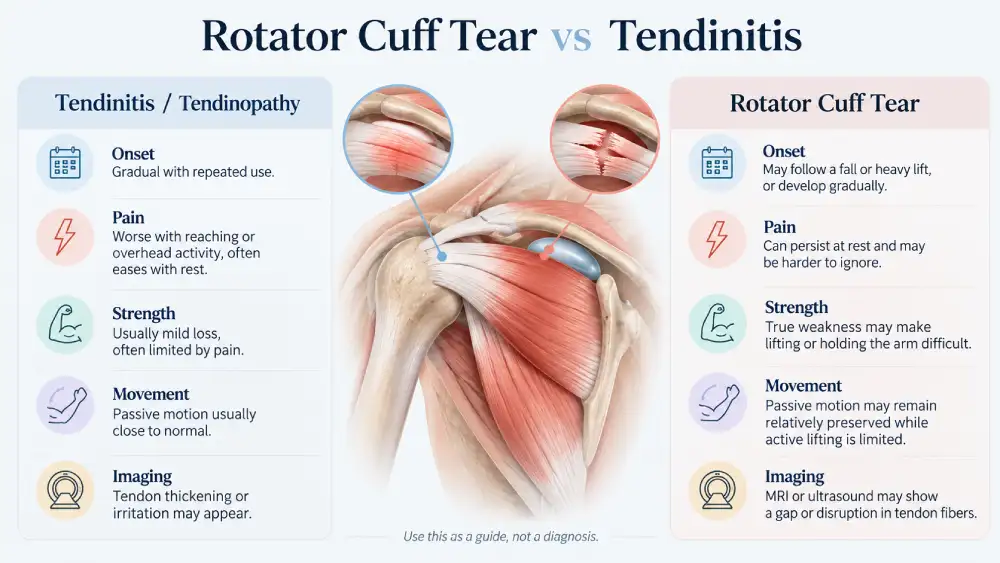
Clinics describe these differences in broad strokes, and the table below does the same. Use it as a map, not a diagnosis.
Tendinitis or tendinopathy | Tear | |
Onset | Builds gradually with repeated use | Sudden after a fall or heavy lift, sometimes with a pop, or gradual in a degenerating tendon |
Pain pattern | Dull ache, worse with reaching or overhead work, eases with rest | Can persist at rest and is often harder to ignore |
Night pain | Common, especially lying on the shoulder | Common, and more likely to wake you repeatedly |
Strength | Usually mild loss, often limited by pain | Often true weakness, such as trouble raising or holding the arm up |
Active vs passive motion | Passive motion usually close to normal | Passive motion often fine, but active lifting is limited |
Imaging | May show thickening or irritation of the tendon | MRI or ultrasound shows a gap or disruption in the fibers |
Plenty of people with a tear have mild symptoms, and plenty of people with tendinitis have pain that wakes them at night. That is why the next section matters more than the table.
Why weakness tells you more than pain

Pain is a weak referee between these two conditions. Both hurt, and how much they hurt depends on how irritated the tissue is that day more than on how much tendon is damaged. Function is steadier.
If it is comfortable to try, ask yourself three things. Can you lift your arm out to the side and hold it at shoulder height without it sagging? Can you lower it slowly, or does it drop? And does the shoulder feel weak, or does it just hurt too much to try? Stop if anything is sharp.
Those answers separate two kinds of weakness. Pain-limited weakness means you could push harder if it did not hurt, and it points toward irritation. True weakness means the arm will not go up or will not stay up even when you try, and it raises suspicion for a tear. That difference is why clinicians use tests such as the drop arm test and the external rotation lag sign.
No single test settles it. They are screening tools, and their accuracy varies with the size and location of the tear. A proper exam combines them with strength testing of each cuff muscle, range of motion, and your history, which is why a quick self-test at home can reassure you or alarm you for the wrong reasons.
Why an MRI does not always settle it

Imaging can confirm a tear, but it cannot always tell you whether the tear is the source of your pain. In an ultrasound screening of 664 residents of one village, 22.1% had a full-thickness rotator cuff tear, and 65.3% of those tears caused no symptoms. No one in their 20s to 40s had one, but tears showed up in 10.7% of people in their 50s and 36.6% of people in their 80s (Minagawa et al., Journal of Orthopaedics, 2013).
That changes how to read a scan. A tear on the MRI of a 62 year old with shoulder pain may be the culprit, or it may be a bystander while something else generates the pain. The exam, the history, and how the shoulder responds to treatment decide which. Imaging is most useful when the exam already points toward a tear, and the report is best read in that context rather than on its own.
The "something else" list
When the pattern does not fit tendinitis or a tear cleanly, a few lookalikes are worth ruling out.
Shoulder impingement and frozen shoulder. Both cause pain with lifting and can be confused with a cuff problem. A simple clue is passive motion: if someone else can lift your arm much higher than you can, the problem is on the muscle side. If neither of you can, the joint itself is stiff. We walk through that test in our guide to frozen shoulder and shoulder impingement.
The neck. Irritation of the C5 and C6 nerve roots in the neck can cause shoulder and upper arm pain with weakness in the same muscles the cuff uses. Tingling down the arm, neck pain, or symptoms that change with head position point in this direction.
Muscle inhibition. After an injury, the nervous system can switch off a muscle as a protective reflex. An inhibited cuff muscle tests weak like a torn one, but the tendon is intact. We explain the mechanics in why your muscles stop working after an injury. In our experience at AMIT Clinics, this is the explanation people are most surprised to hear, because the weakness feels structural.
The biceps tendon. It runs through the same space at the front of the shoulder, and irritation there can mimic a cuff problem.
What a non-surgical evaluation looks like
A good evaluation for a suspected cuff problem follows a sequence. It starts with your history: when it began, what you were doing, and what makes it better or worse. Then come active and passive range of motion, strength testing of each cuff muscle on its own, orthopedic tests, and a look at the neck and shoulder blade.
At AMIT Clinics in Draper and Kaysville, we add muscle activation testing, because a cuff muscle that is switched off is very different from one that is torn. If an inhibited muscle does not respond to treatment within a few visits, we take that seriously. It raises the likelihood of a structural tear, and we refer for imaging instead of continuing to treat. You can read how we approach rotator cuff injury treatment for the full picture of how this works in practice.
Not every tear needs an operating room. The MOON Shoulder Group followed 452 patients with symptomatic, atraumatic full-thickness tears (meaning no single injury started it) who began with a physical therapy program. At 10 years, therapy had been effective for over 70% of them, and only one patient (0.2%) needed a reverse shoulder replacement (MOON Shoulder Group, Journal of the American Academy of Orthopaedic Surgeons, 2024). That study tested physical therapy, and it supports a conservative first approach in general, not any one clinic's method. A sudden traumatic tear in a younger, active person is a different situation and often deserves an early surgical opinion.
When to get it checked soon
Book an evaluation promptly if you notice any of the following:
Sudden weakness after a fall or heavy lift, especially with a pop
You cannot lift the arm, or it will not stay up once raised
Pain at rest, or pain that wakes you most nights
Bruising, or a bulge in the upper arm
Numbness or tingling down the arm
No improvement after two to three weeks of sensible rest and activity changes
Shoulder pain that comes with chest pressure, shortness of breath, jaw pain, or sweating is an emergency. Call 911 instead of waiting for an appointment.
Frequently asked questions
How do I know if I have tendonitis or a torn rotator cuff?
You cannot be sure without an exam and sometimes imaging. True weakness, trouble holding the arm up, pain at rest, and a sudden onset with a pop favor a tear, while an ache that builds with use and eases with rest favors tendinitis. Because the two overlap, a hands-on evaluation is the reliable way to tell.
Can rotator cuff tendinitis heal on its own?
Mild cases often settle over a few weeks once you reduce the aggravating activity. If the pain lingers past two to three weeks or keeps returning, the underlying cause, such as muscle imbalance or poor shoulder blade control, usually has not been fixed. That is when an evaluation pays off.
Can a torn rotator cuff heal without surgery?
A full-thickness tear generally does not close on its own, but pain and function can improve a great deal without surgery. In a 10-year study of 452 patients with atraumatic full-thickness tears, physical therapy worked for over 70% of them. Size, age, activity level, and how the tear started all shape the decision.
How can I test for rotator cuff tendinitis?
Clinicians use tests such as the empty can test, the painful arc test, and resisted external rotation, then combine them with strength and range of motion findings. No single test is definitive, and self-testing at home is unreliable. If lifting the arm is painful, avoid forcing it.
What is the difference between a rotator cuff strain and a tear?
A strain is an overstretch with minor fiber damage, and a tear is an actual break in the tendon, either partial or complete. They sit on one spectrum, so a severe strain and a small partial tear can look alike. Imaging and strength testing show where an injury falls.
What should I avoid with rotator cuff tendinopathy?
Avoid pushing through sharp pain in overhead positions, repeated heavy overhead lifting, and sleeping on the painful side. Complete immobilization for weeks is also a mistake, because a shoulder held still can stiffen. Keep it moving within comfortable limits.
Not sure which one you are dealing with?
If you are dealing with rotator cuff pain in Draper or Kaysville, our team can work out whether it is tendinitis, a tear, or something else before you decide on next steps. You can reach our Draper clinic to schedule an evaluation.