Golfer's Elbow
Treatment in Salt Lake City, UT Advanced Muscle Integration Technique (A.M.I.T.)
Golfer's Elbow
Treatment in Salt Lake City, UT Advanced Muscle Integration Technique (A.M.I.T.)
Golfer's Elbow
Treatment in Salt Lake City, UT Advanced Muscle Integration Technique (A.M.I.T.)
How to Identify Golfer's Elbow and the AMIT Solution
Golfer's elbow, or medial epicondylitis, is pain on the inner side of the elbow where the tendons of the forearm muscles that bend the wrist and grip attach to bone. Pain can spread into the forearm and wrist, and gripping, making a fist, or lifting tends to make it worse. Despite the name, you do not need to play golf to get it; any repetitive gripping or wrist-bending activity can cause it.
Most cases get better without surgery, although improvement can take weeks to months. Since the irritated tendons belong to the wrist flexor muscles, whether those muscles are working properly again is what decides whether the elbow settles or keeps flaring.
Golfer’s Elbow, also known as medial epicondylitis, is a condition similar to tennis elbow, but the pain occurs on the inside of the elbow. The condition results from damage to the tendons and muscles that control the wrist and fingers.
This is one of the shoulder, arm & wrist conditions AMIT addresses by restoring proper muscle activation instead of relying on surgery.
On This Page:
Causes of Golfer's Elbow
Symptoms of Golfer's Elbow
Golfer's Elbow vs. Tennis Elbow
How Long Does Golfer's Elbow Take to Heal?
AMIT Treatment for Golfer's Elbow
Causes of Golfer's Elbow
Golfer’s Elbow is caused by repetitive stress and overuse of the wrist and forearm muscles. Common causes include:
Repetitive Movements: Sports like golf, tennis, and weightlifting involve repetitive wrist-bearing activities that can strain the forearm tendons.
Overuse of the Wrist and Fingers: Any activity that involves excessive or repetitive wrist movement can damage the muscles and tendons of the forearm.
In golfers it is especially common in beginners, and it shows up most often in the right elbow of right-handed players. Outside of golf, the same strain comes from racket sports, weightlifting, and any work that involves repetitive gripping or wrist bending.
Symptoms of Golfer's Elbow
The typical symptoms of Golfer's Elbow include:
Inner Elbow Pain: Tenderness and discomfort along the inner side of the elbow.
Stiffness and Weakness: Pain may worsen when making a fist, gripping objects, or lifting weights.
Tingling and Numbness: Some may experience numbness or tingling sensations in the ring and little fingers.
Tingling or numbness in the ring and little fingers is worth mentioning at your visit, since those fingers are supplied by the ulnar nerve, which passes close to the inner elbow.
Golfer's Elbow vs. Tennis Elbow
The two are close relatives. Both are overuse injuries of the forearm tendons where they attach at the elbow. The difference is the side:
Golfer's elbow (medial epicondylitis): Pain on the inner side of the elbow, from the tendons of the muscles that bend the wrist and fingers. Worse with gripping, making a fist, and bending the wrist.
Tennis elbow (lateral epicondylitis): Pain on the outer side of the elbow, from the tendons of the muscles that extend the wrist. Worse with holding a racquet, turning a wrench, or shaking hands.
Our article on golfer's elbow vs. tennis elbow covers how to tell them apart in more detail.

How Long Does Golfer's Elbow Take to Heal?
According to the Hospital for Special Surgery, most cases of golfer's elbow resolve with conservative care, though it can take weeks to months to see improvement. About 10% of cases need surgery, which is usually considered only after 6 to 12 months of conservative treatment have not resolved the symptoms.
If pain continues for several weeks despite rest, that is the point to get the elbow evaluated rather than continuing to play or work through it.
AMIT Treatment for Golfer's Elbow
What Happens During Golfer’s Elbow?
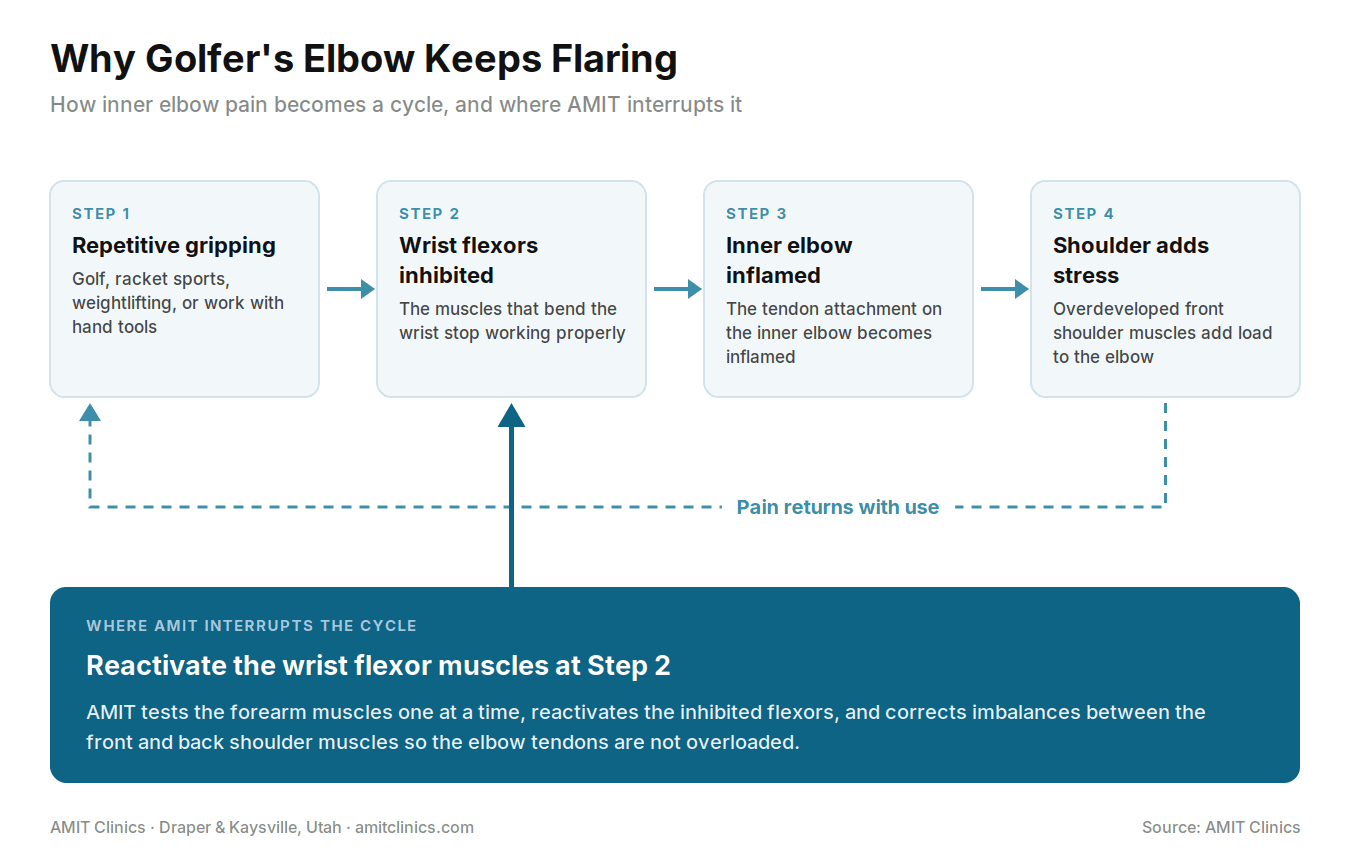
Golfer’s Elbow is caused by inhibition of the wrist flexor muscles, which leads to inflammation at the tendon attachment (enthesis) on the inner side of the elbow. Overdevelopment of the anterior shoulder muscles can also contribute to the condition, adding stress to the wrist and elbow tendons.
How Does AMIT Help?
Advanced Muscle Integration Technique (AMIT) helps reactivate the inhibited flexor muscles and correct imbalances in the shoulder and forearm. By strengthening these muscles and reactivating the proper function of the wrist and elbow, AMIT can reduce pain and inflammation, restoring full range of motion and function.
On a first visit we test the wrist flexor and forearm muscles one at a time, along with the front and back shoulder muscles, since the original content notes that overdeveloped front shoulder muscles add stress to the elbow. The visit takes about 40 minutes; what to expect explains how to prepare.
Steps to Take If You Have Golfer's Elbow
Consult a Certified AMIT Physician: At AMIT, we specialize in treating Golfer’s Elbow by correcting muscle imbalances and reactivating inhibited muscles. Contact us today to schedule a consultation.
Rehabilitation: After AMIT treatment, our team will guide you through exercises to strengthen the wrist flexors and posterior shoulder muscles to prevent recurrence.
Why Choose AMIT for Golfer’s Elbow?
Non-Invasive Treatment: AMIT provides a non-surgical solution to correcting muscle imbalances associated with Golfer’s Elbow.
Restores Muscle Function: By reactivating the inhibited flexor muscles, AMIT helps reduce pain and restore proper elbow and wrist function.
Prevents Future Injuries: Correcting muscle imbalances in the forearm and shoulder helps prevent future strain on the elbow.
If you’re suffering from Golfer’s Elbow, contact Advanced Muscle Integration Clinics in the Salt lake City Area for professional, effective treatment using Advanced Muscle Integration Technique. A certified AMIT physician can help you recover and regain pain-free movement.
Call us today at 801.544.2355 or fill out our online form to schedule a consultation.
Golfer's Elbow Treatment in Draper and Kaysville
AMIT Clinics treats elbow pain at both Utah locations: Draper, at 12371 S 900 E Unit 101, and Kaysville, at 447 North 300 West Ste 5. We see golfers, tennis players, lifters, and tradespeople who grip tools all day. If tendon pain is something you have been living with for a while, read tendinitis pain you don't have to endure.
Frequently Asked Questions About Golfer's Elbow
What does golfer's elbow feel like?
Pain and tenderness on the inner side of the elbow that can spread into the forearm and wrist, often with stiffness or weakness. Gripping, making a fist, and lifting usually make it worse.
Can you get golfer's elbow without playing golf?
Yes. Any activity with repetitive gripping or wrist bending can cause it, including racket sports, weightlifting, and work with hand tools.
How long does golfer's elbow take to heal?
Most cases resolve without surgery, but improvement can take weeks to months. Surgery is usually considered only if symptoms have not resolved after 6 to 12 months of conservative treatment.
What is the difference between golfer's elbow and tennis elbow?
Golfer's elbow causes pain on the inner side of the elbow from the wrist flexor tendons. Tennis elbow causes pain on the outer side from the wrist extensor tendons.
Does golfer's elbow need surgery?
Rarely. About 10% of cases need surgery, according to the Hospital for Special Surgery.
Why do my ring and little fingers tingle with golfer's elbow?
The ulnar nerve, which supplies feeling to those fingers, passes close to the inner elbow. Tingling there should be mentioned at your exam so the nerve can be checked.
Call 801.544.2355 to be seen.
Schedule an Appointment
Call: 801.544.2355
Or, use the link below to get started:
How to Identify Golfer's Elbow and the AMIT Solution
Golfer's elbow, or medial epicondylitis, is pain on the inner side of the elbow where the tendons of the forearm muscles that bend the wrist and grip attach to bone. Pain can spread into the forearm and wrist, and gripping, making a fist, or lifting tends to make it worse. Despite the name, you do not need to play golf to get it; any repetitive gripping or wrist-bending activity can cause it.
Most cases get better without surgery, although improvement can take weeks to months. Since the irritated tendons belong to the wrist flexor muscles, whether those muscles are working properly again is what decides whether the elbow settles or keeps flaring.
Golfer’s Elbow, also known as medial epicondylitis, is a condition similar to tennis elbow, but the pain occurs on the inside of the elbow. The condition results from damage to the tendons and muscles that control the wrist and fingers.
This is one of the shoulder, arm & wrist conditions AMIT addresses by restoring proper muscle activation instead of relying on surgery.
On This Page:
Causes of Golfer's Elbow
Symptoms of Golfer's Elbow
Golfer's Elbow vs. Tennis Elbow
How Long Does Golfer's Elbow Take to Heal?
AMIT Treatment for Golfer's Elbow
Causes of Golfer's Elbow
Golfer’s Elbow is caused by repetitive stress and overuse of the wrist and forearm muscles. Common causes include:
Repetitive Movements: Sports like golf, tennis, and weightlifting involve repetitive wrist-bearing activities that can strain the forearm tendons.
Overuse of the Wrist and Fingers: Any activity that involves excessive or repetitive wrist movement can damage the muscles and tendons of the forearm.
In golfers it is especially common in beginners, and it shows up most often in the right elbow of right-handed players. Outside of golf, the same strain comes from racket sports, weightlifting, and any work that involves repetitive gripping or wrist bending.
Symptoms of Golfer's Elbow
The typical symptoms of Golfer's Elbow include:
Inner Elbow Pain: Tenderness and discomfort along the inner side of the elbow.
Stiffness and Weakness: Pain may worsen when making a fist, gripping objects, or lifting weights.
Tingling and Numbness: Some may experience numbness or tingling sensations in the ring and little fingers.
Tingling or numbness in the ring and little fingers is worth mentioning at your visit, since those fingers are supplied by the ulnar nerve, which passes close to the inner elbow.
Golfer's Elbow vs. Tennis Elbow
The two are close relatives. Both are overuse injuries of the forearm tendons where they attach at the elbow. The difference is the side:
Golfer's elbow (medial epicondylitis): Pain on the inner side of the elbow, from the tendons of the muscles that bend the wrist and fingers. Worse with gripping, making a fist, and bending the wrist.
Tennis elbow (lateral epicondylitis): Pain on the outer side of the elbow, from the tendons of the muscles that extend the wrist. Worse with holding a racquet, turning a wrench, or shaking hands.
Our article on golfer's elbow vs. tennis elbow covers how to tell them apart in more detail.
How Long Does Golfer's Elbow Take to Heal?
According to the Hospital for Special Surgery, most cases of golfer's elbow resolve with conservative care, though it can take weeks to months to see improvement. About 10% of cases need surgery, which is usually considered only after 6 to 12 months of conservative treatment have not resolved the symptoms.
If pain continues for several weeks despite rest, that is the point to get the elbow evaluated rather than continuing to play or work through it.
AMIT Treatment for Golfer's Elbow
What Happens During Golfer’s Elbow?
Golfer’s Elbow is caused by inhibition of the wrist flexor muscles, which leads to inflammation at the tendon attachment (enthesis) on the inner side of the elbow. Overdevelopment of the anterior shoulder muscles can also contribute to the condition, adding stress to the wrist and elbow tendons.
How Does AMIT Help?
Advanced Muscle Integration Technique (AMIT) helps reactivate the inhibited flexor muscles and correct imbalances in the shoulder and forearm. By strengthening these muscles and reactivating the proper function of the wrist and elbow, AMIT can reduce pain and inflammation, restoring full range of motion and function.
On a first visit we test the wrist flexor and forearm muscles one at a time, along with the front and back shoulder muscles, since the original content notes that overdeveloped front shoulder muscles add stress to the elbow. The visit takes about 40 minutes; what to expect explains how to prepare.
Steps to Take If You Have Golfer's Elbow
Consult a Certified AMIT Physician: At AMIT, we specialize in treating Golfer’s Elbow by correcting muscle imbalances and reactivating inhibited muscles. Contact us today to schedule a consultation.
Rehabilitation: After AMIT treatment, our team will guide you through exercises to strengthen the wrist flexors and posterior shoulder muscles to prevent recurrence.
Why Choose AMIT for Golfer’s Elbow?
Non-Invasive Treatment: AMIT provides a non-surgical solution to correcting muscle imbalances associated with Golfer’s Elbow.
Restores Muscle Function: By reactivating the inhibited flexor muscles, AMIT helps reduce pain and restore proper elbow and wrist function.
Prevents Future Injuries: Correcting muscle imbalances in the forearm and shoulder helps prevent future strain on the elbow.
If you’re suffering from Golfer’s Elbow, contact Advanced Muscle Integration Clinics in the Salt lake City Area for professional, effective treatment using Advanced Muscle Integration Technique. A certified AMIT physician can help you recover and regain pain-free movement.
Call us today at 801.544.2355 or fill out our online form to schedule a consultation.
Golfer's Elbow Treatment in Draper and Kaysville
AMIT Clinics treats elbow pain at both Utah locations: Draper, at 12371 S 900 E Unit 101, and Kaysville, at 447 North 300 West Ste 5. We see golfers, tennis players, lifters, and tradespeople who grip tools all day. If tendon pain is something you have been living with for a while, read tendinitis pain you don't have to endure.
Frequently Asked Questions About Golfer's Elbow
What does golfer's elbow feel like?
Pain and tenderness on the inner side of the elbow that can spread into the forearm and wrist, often with stiffness or weakness. Gripping, making a fist, and lifting usually make it worse.
Can you get golfer's elbow without playing golf?
Yes. Any activity with repetitive gripping or wrist bending can cause it, including racket sports, weightlifting, and work with hand tools.
How long does golfer's elbow take to heal?
Most cases resolve without surgery, but improvement can take weeks to months. Surgery is usually considered only if symptoms have not resolved after 6 to 12 months of conservative treatment.
What is the difference between golfer's elbow and tennis elbow?
Golfer's elbow causes pain on the inner side of the elbow from the wrist flexor tendons. Tennis elbow causes pain on the outer side from the wrist extensor tendons.
Does golfer's elbow need surgery?
Rarely. About 10% of cases need surgery, according to the Hospital for Special Surgery.
Why do my ring and little fingers tingle with golfer's elbow?
The ulnar nerve, which supplies feeling to those fingers, passes close to the inner elbow. Tingling there should be mentioned at your exam so the nerve can be checked.
Call 801.544.2355 to be seen.
Schedule an Appointment
Call: 801.544.2355
Or, use the link below to get started: