Tennis Elbow
Treatment in Salt Lake City, UT Advanced Muscle Integration Technique (A.M.I.T.)
Tennis Elbow
Treatment in Salt Lake City, UT Advanced Muscle Integration Technique (A.M.I.T.)
Tennis Elbow
Treatment in Salt Lake City, UT Advanced Muscle Integration Technique (A.M.I.T.)
How to Identify Tennis Elbow and the AMIT Solution
Tennis elbow, or lateral epicondylitis, is pain and burning on the outer side of the elbow caused by overuse of the forearm muscles that extend the wrist. The tendon most often involved is the extensor carpi radialis brevis (ECRB). Grip strength usually drops, and holding a cup, turning a wrench, or shaking hands can hurt.
Most people who get tennis elbow are between 30 and 50, and many of them never play tennis. According to the American Academy of Orthopaedic Surgeons, about 80 to 95% of patients have success with nonsurgical treatment.
Tennis Elbow, also known as lateral epicondylitis, is a painful condition that occurs when repetitive motions of the wrist and arm overwork the tendons in the elbow.
This condition is common in athletes and individuals who perform repetitive wrist-bearing activities.
On This Page:
Causes of Tennis Elbow
Symptoms of Tennis Elbow
Who Gets Tennis Elbow?
Tennis Elbow vs. Golfer's Elbow
How Long Does Tennis Elbow Last?
AMIT Treatment for Tennis Elbow
Causes of Tennis Elbow
Tennis elbow is caused by overuse and muscle strain, resulting in small tears in the tendons that attach the forearm muscles to the outside of the elbow. Common causes include:
Repetitive Movements: Activities that involve repeated wrist and arm motions such as playing tennis, golf, or racket sports.
Wrist-Bearing Activities: Lifting weights, painting, or working with tools that strain the forearm muscles can lead to tennis elbow.
Symptoms of Tennis Elbow
Symptoms of Tennis Elbow typically include:
Pain Radiating from the Elbow: Pain starts at the outside of the elbow and may radiate into the forearm and wrist.
Weakness in Grip: Difficulty performing simple tasks like shaking hands, turning a doorknob, or holding a cup.
Tenderness and Swelling: The outside of the elbow may become tender or swollen, especially after wrist movements.
In most cases the pain starts mild and slowly gets worse over weeks and months, usually without a specific injury. Some people also have pain at night. The dominant arm is most often affected, though both arms can be.
Who Gets Tennis Elbow?
Most people who get tennis elbow are between the ages of 30 and 50, although anyone with the risk factors can get it. Racket sports are a classic cause, especially with poor technique or equipment that does not fit, but jobs that repeat the same forearm motion matter just as much: painters, plumbers, and carpenters are particularly prone to it, and auto workers, cooks, and butchers get it more often than the general population.
Tennis Elbow vs. Golfer's Elbow
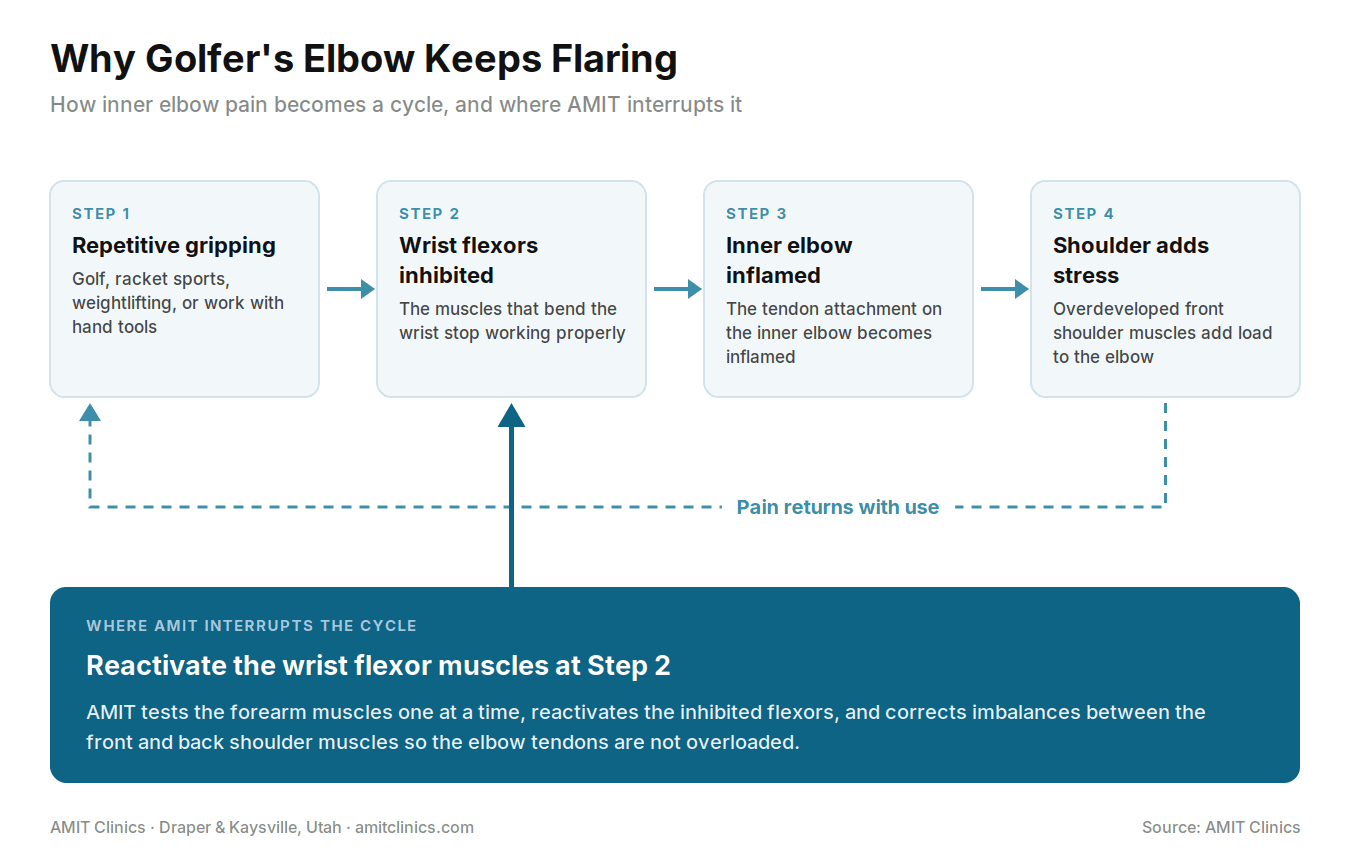
Both are overuse injuries of the forearm tendons at the elbow. Tennis elbow affects the outer side, where the wrist extensor tendons attach. Golfer's elbow affects the inner side, where the wrist flexor tendons attach, and gets worse with gripping and bending the wrist. Our article on golfer's elbow vs. tennis elbow explains the differences in more detail.

How Long Does Tennis Elbow Last?
Tennis elbow often improves after several weeks of resting the arm from the activities that cause pain, but it can sometimes last more than a year. Because it builds slowly, many people keep working or playing through it for months, and the longer the forearm muscles compensate, the longer it tends to take to settle.
Surgery is uncommon. With 80 to 95% of patients responding to nonsurgical treatment, it is usually considered only when symptoms have not improved after a long period of conservative care.
AMIT Treatment for Tennis Elbow
What Happens During Tennis Elbow?
Tennis elbow is caused by the inhibition of wrist extensor muscles and inflammation at the tendon insertions (enthesis) where these muscles attach. Overuse of the wrist extensors (extensor carpi radialis longus, extensor carpi radialis brevis, extensor carpi ulnaris, and extensor digitorum) can lead to pain. Additionally, overdevelopment of the anterior shoulder muscles can contribute to muscle imbalances, increasing strain on the forearm muscles.
How Does AMIT Help?
Advanced Muscle Integration Technique (AMIT) reactivates the inhibited extensor muscles, restoring balance and function to the affected areas. By reactivating these muscles and exercising the posterior shoulder muscles, AMIT helps correct the underlying cause of pain, reducing inflammation and restoring proper movement.
On a first visit we test the wrist extensors and other forearm muscles individually, along with the front and back shoulder muscles, and check grip strength. If the exam suggests something other than a tendon problem, we refer you for imaging first. The visit takes about 40 minutes; what to expect explains how to prepare.
Steps to Take If You Have Tennis Elbow
Consult a Certified AMIT Physician: At AMIT, we specialize in treating tennis elbow by correcting muscle imbalances and reactivating inhibited muscles. Contact us today to schedule a consultation.
Rehabilitation: After AMIT treatment, our team will guide you through exercises to strengthen the wrist extensors and posterior shoulder muscles, reducing the risk of recurrence.
Why Choose AMIT for Tennis Elbow?
Non-Invasive Treatment: AMIT provides a non-surgical approach to treating tennis elbow by addressing muscle imbalances.
Restores Muscle Function: AMIT reactivates the extensor muscles, alleviating the root cause of pain.
Prevents Re-Injury: By correcting the underlying muscle imbalances, AMIT reduces the risk of recurrence and long-term damage.
If you're suffering from tennis elbow, contact Advanced Muscle Integration Clinics in the Salt lake City Area for professional, effective treatment using Advanced Muscle Integration Technique. A certified AMIT physician can help you recover and return to pain-free movement.
This is one of the shoulder and arm care AMIT addresses by restoring proper muscle activation instead of relying on surgery.
Call us today at 801.544.2355 or fill out our online form to schedule a consultation.
Tennis Elbow Treatment in Draper and Kaysville
AMIT Clinics treats tennis elbow at both Utah locations: Draper, at 12371 S 900 E Unit 101, and Kaysville, at 447 North 300 West Ste 5. We see tennis and pickleball players, tradespeople, and people who spend hours at a keyboard and mouse. Wrist pain on the thumb side can be a related overuse problem, covered on our de Quervain's tenosynovitis page, and the full list is on our shoulder, arm & wrist conditions page.
Frequently Asked Questions About Tennis Elbow
What does tennis elbow feel like?
Pain or burning on the outer part of the elbow, weak grip strength, and sometimes pain at night. It is often worse when holding a racquet, turning a wrench, or shaking hands.
Can you get tennis elbow without playing tennis?
Yes. Painters, plumbers, and carpenters are particularly prone to it, and auto workers, cooks, and butchers get it more often than the general population.
How long does tennis elbow last?
It often improves after several weeks of resting the arm, but it can sometimes last more than a year, especially when people keep doing the activity that caused it.
Does tennis elbow need surgery?
Rarely. About 80 to 95% of patients have success with nonsurgical treatment, according to the American Academy of Orthopaedic Surgeons.
Who is most likely to get tennis elbow?
Most people who get it are between 30 and 50. The dominant arm is most often affected, and it usually comes from repetitive use rather than a single injury.
What is the difference between tennis elbow and golfer's elbow?
Tennis elbow causes pain on the outer side of the elbow from the wrist extensor tendons. Golfer's elbow causes pain on the inner side from the wrist flexor tendons.
Call 801.544.2355 to be seen.
Schedule an Appointment
Call: 801.544.2355
Or, use the link below to get started:
How to Identify Tennis Elbow and the AMIT Solution
Tennis elbow, or lateral epicondylitis, is pain and burning on the outer side of the elbow caused by overuse of the forearm muscles that extend the wrist. The tendon most often involved is the extensor carpi radialis brevis (ECRB). Grip strength usually drops, and holding a cup, turning a wrench, or shaking hands can hurt.
Most people who get tennis elbow are between 30 and 50, and many of them never play tennis. According to the American Academy of Orthopaedic Surgeons, about 80 to 95% of patients have success with nonsurgical treatment.
Tennis Elbow, also known as lateral epicondylitis, is a painful condition that occurs when repetitive motions of the wrist and arm overwork the tendons in the elbow.
This condition is common in athletes and individuals who perform repetitive wrist-bearing activities.
On This Page:
Causes of Tennis Elbow
Symptoms of Tennis Elbow
Who Gets Tennis Elbow?
Tennis Elbow vs. Golfer's Elbow
How Long Does Tennis Elbow Last?
AMIT Treatment for Tennis Elbow
Causes of Tennis Elbow
Tennis elbow is caused by overuse and muscle strain, resulting in small tears in the tendons that attach the forearm muscles to the outside of the elbow. Common causes include:
Repetitive Movements: Activities that involve repeated wrist and arm motions such as playing tennis, golf, or racket sports.
Wrist-Bearing Activities: Lifting weights, painting, or working with tools that strain the forearm muscles can lead to tennis elbow.
Symptoms of Tennis Elbow
Symptoms of Tennis Elbow typically include:
Pain Radiating from the Elbow: Pain starts at the outside of the elbow and may radiate into the forearm and wrist.
Weakness in Grip: Difficulty performing simple tasks like shaking hands, turning a doorknob, or holding a cup.
Tenderness and Swelling: The outside of the elbow may become tender or swollen, especially after wrist movements.
In most cases the pain starts mild and slowly gets worse over weeks and months, usually without a specific injury. Some people also have pain at night. The dominant arm is most often affected, though both arms can be.
Who Gets Tennis Elbow?
Most people who get tennis elbow are between the ages of 30 and 50, although anyone with the risk factors can get it. Racket sports are a classic cause, especially with poor technique or equipment that does not fit, but jobs that repeat the same forearm motion matter just as much: painters, plumbers, and carpenters are particularly prone to it, and auto workers, cooks, and butchers get it more often than the general population.
Tennis Elbow vs. Golfer's Elbow
Both are overuse injuries of the forearm tendons at the elbow. Tennis elbow affects the outer side, where the wrist extensor tendons attach. Golfer's elbow affects the inner side, where the wrist flexor tendons attach, and gets worse with gripping and bending the wrist. Our article on golfer's elbow vs. tennis elbow explains the differences in more detail.
How Long Does Tennis Elbow Last?
Tennis elbow often improves after several weeks of resting the arm from the activities that cause pain, but it can sometimes last more than a year. Because it builds slowly, many people keep working or playing through it for months, and the longer the forearm muscles compensate, the longer it tends to take to settle.
Surgery is uncommon. With 80 to 95% of patients responding to nonsurgical treatment, it is usually considered only when symptoms have not improved after a long period of conservative care.
AMIT Treatment for Tennis Elbow
What Happens During Tennis Elbow?
Tennis elbow is caused by the inhibition of wrist extensor muscles and inflammation at the tendon insertions (enthesis) where these muscles attach. Overuse of the wrist extensors (extensor carpi radialis longus, extensor carpi radialis brevis, extensor carpi ulnaris, and extensor digitorum) can lead to pain. Additionally, overdevelopment of the anterior shoulder muscles can contribute to muscle imbalances, increasing strain on the forearm muscles.
How Does AMIT Help?
Advanced Muscle Integration Technique (AMIT) reactivates the inhibited extensor muscles, restoring balance and function to the affected areas. By reactivating these muscles and exercising the posterior shoulder muscles, AMIT helps correct the underlying cause of pain, reducing inflammation and restoring proper movement.
On a first visit we test the wrist extensors and other forearm muscles individually, along with the front and back shoulder muscles, and check grip strength. If the exam suggests something other than a tendon problem, we refer you for imaging first. The visit takes about 40 minutes; what to expect explains how to prepare.
Steps to Take If You Have Tennis Elbow
Consult a Certified AMIT Physician: At AMIT, we specialize in treating tennis elbow by correcting muscle imbalances and reactivating inhibited muscles. Contact us today to schedule a consultation.
Rehabilitation: After AMIT treatment, our team will guide you through exercises to strengthen the wrist extensors and posterior shoulder muscles, reducing the risk of recurrence.
Why Choose AMIT for Tennis Elbow?
Non-Invasive Treatment: AMIT provides a non-surgical approach to treating tennis elbow by addressing muscle imbalances.
Restores Muscle Function: AMIT reactivates the extensor muscles, alleviating the root cause of pain.
Prevents Re-Injury: By correcting the underlying muscle imbalances, AMIT reduces the risk of recurrence and long-term damage.
If you're suffering from tennis elbow, contact Advanced Muscle Integration Clinics in the Salt lake City Area for professional, effective treatment using Advanced Muscle Integration Technique. A certified AMIT physician can help you recover and return to pain-free movement.
This is one of the shoulder and arm care AMIT addresses by restoring proper muscle activation instead of relying on surgery.
Call us today at 801.544.2355 or fill out our online form to schedule a consultation.
Tennis Elbow Treatment in Draper and Kaysville
AMIT Clinics treats tennis elbow at both Utah locations: Draper, at 12371 S 900 E Unit 101, and Kaysville, at 447 North 300 West Ste 5. We see tennis and pickleball players, tradespeople, and people who spend hours at a keyboard and mouse. Wrist pain on the thumb side can be a related overuse problem, covered on our de Quervain's tenosynovitis page, and the full list is on our shoulder, arm & wrist conditions page.
Frequently Asked Questions About Tennis Elbow
What does tennis elbow feel like?
Pain or burning on the outer part of the elbow, weak grip strength, and sometimes pain at night. It is often worse when holding a racquet, turning a wrench, or shaking hands.
Can you get tennis elbow without playing tennis?
Yes. Painters, plumbers, and carpenters are particularly prone to it, and auto workers, cooks, and butchers get it more often than the general population.
How long does tennis elbow last?
It often improves after several weeks of resting the arm, but it can sometimes last more than a year, especially when people keep doing the activity that caused it.
Does tennis elbow need surgery?
Rarely. About 80 to 95% of patients have success with nonsurgical treatment, according to the American Academy of Orthopaedic Surgeons.
Who is most likely to get tennis elbow?
Most people who get it are between 30 and 50. The dominant arm is most often affected, and it usually comes from repetitive use rather than a single injury.
What is the difference between tennis elbow and golfer's elbow?
Tennis elbow causes pain on the outer side of the elbow from the wrist extensor tendons. Golfer's elbow causes pain on the inner side from the wrist flexor tendons.
Call 801.544.2355 to be seen.
Schedule an Appointment
Call: 801.544.2355
Or, use the link below to get started: