Sprain or Strain (Whiplash)
Treatment in Salt Lake City, UT Advanced Muscle Integration Technique (A.M.I.T.)
Sprain or Strain (Whiplash)
Treatment in Salt Lake City, UT Advanced Muscle Integration Technique (A.M.I.T.)
Sprain or Strain (Whiplash)
Treatment in Salt Lake City, UT Advanced Muscle Integration Technique (A.M.I.T.)
Understanding Cervical Sprain or Strain (Whiplash) and the AMIT Solution
Whiplash is a sprain or strain of the neck caused by the head being thrown rapidly forward and back, most often in a rear-end collision. A sprain is damage to the ligaments that hold the neck bones together; a strain is damage to the muscles or tendons. Symptoms often do not show up right away and can start hours after the injury or the next day.
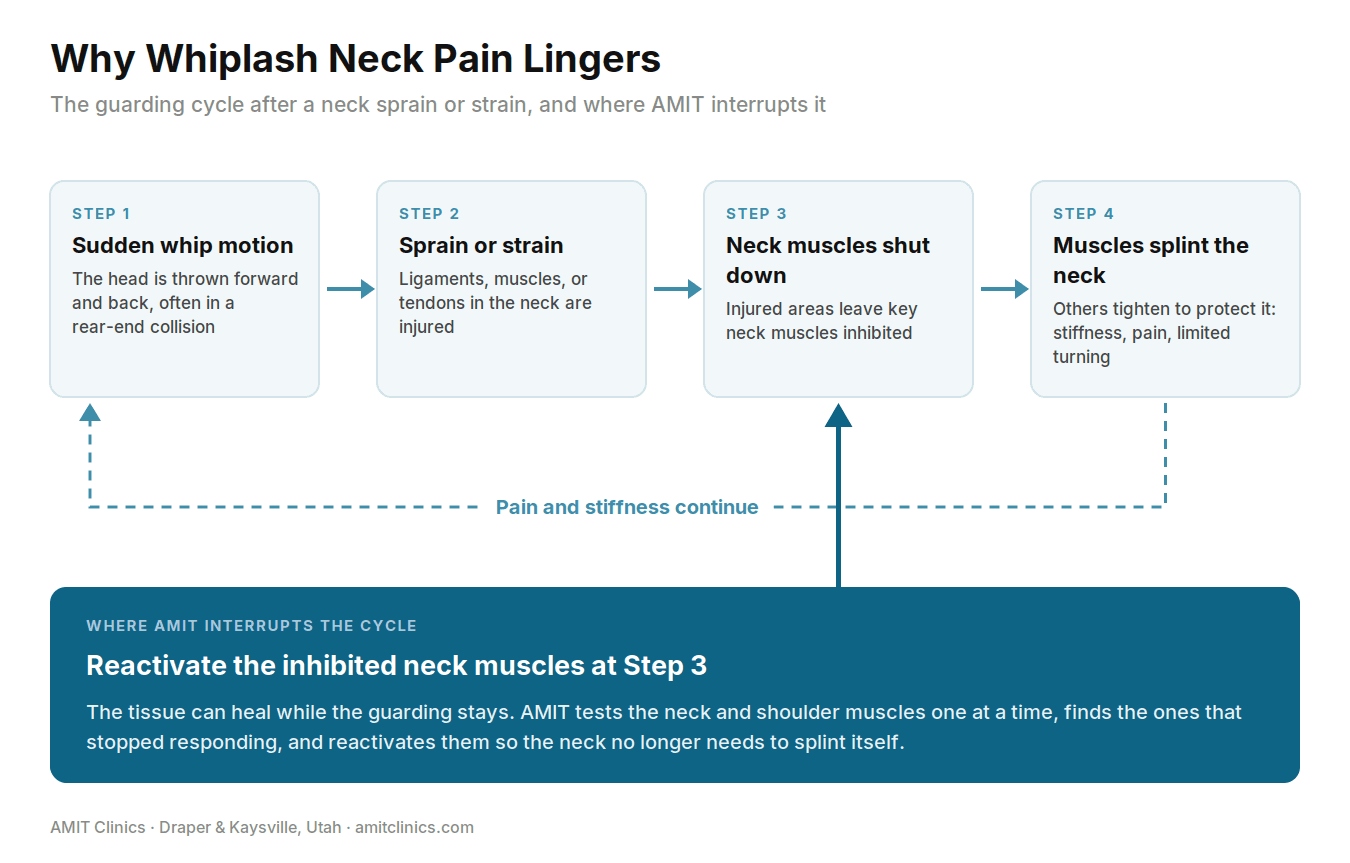
Most neck sprains and strains settle within four to six weeks. When pain, stiffness, or headaches are still there after that, the injured tissue has usually done most of its healing, and what keeps the neck guarded is often the muscles that stopped working properly at the moment of impact.
Cervical sprain or strain, commonly referred to as whiplash, occurs when the neck is suddenly hyperextended or hyperflexed, typically during rear-end or head-on collisions.
This trauma can result in injury to the muscles, ligaments, and nerves of the neck, leading to persistent pain and limited mobility. This is one of the head, neck & spine conditions AMIT addresses by restoring proper muscle activation instead of relying on surgery.
On This Page:
Causes of Cervical Sprain or Strain (Whiplash)
Symptoms of Whiplash
Why Whiplash Symptoms Can Start the Next Day
How Long Does Whiplash Take to Heal?
When Neck Pain After an Accident Needs Urgent Care
AMIT Explanation for Whiplash
Causes of Cervical Sprain or Strain (Whiplash)
Trauma from Vehicle Accidents: Sudden jerking motions during collisions.
Sports Injuries: Impacts during high-contact sports.
Falls: Rapid movement of the head due to falls.
Repetitive Stress: Repeated strain on the neck from poor posture or work habits.
Symptoms of Whiplash
Localized or Widespread Pain: Dull, aching pain in the neck or shoulders.
Sharp Pain at Impact: Pain felt immediately during the accident.
Swelling or Weakness: Muscle inflammation and reduced strength.
Radiating Pain: Pain spreading to the arm, elbow, or wrist that may worsen over time.
Headaches that start at the base of the skull, trouble turning the head to check a blind spot, and muscle spasm across the tops of the shoulders are also common after a whiplash injury. If the headaches are the main problem, our page on headache treatment covers the cervicogenic type, which starts in the neck.
Why Whiplash Symptoms Can Start the Next Day
Pain from a neck sprain does not always appear at the scene. Many people feel fine, or only shaken, and wake up the next morning with a stiff, sore neck. Adrenaline and the time it takes for swelling and muscle guarding to build both play a part.
That delay is one reason it is worth getting checked after a collision even if you walked away feeling normal. A sprain or strain does not show on an X-ray, because ligaments and muscles are soft tissue. An X-ray is used to rule out a fracture or dislocation, not to confirm whiplash. We cover this in more detail in why your neck can still hurt after a car accident with a normal X-ray).
How Long Does Whiplash Take to Heal?
The American Academy of Orthopaedic Surgeons reports that most symptoms of a neck sprain or strain go away in four to six weeks. Some people take two to three months, and a smaller group still has pain, stiffness, or headaches well beyond that.
The timeline mostly reflects tissue healing. It does not tell you whether the deep neck muscles and the muscles between the neck and shoulder blade are firing again. When they are not, the larger muscles stay tight to protect the joints, and that guarding is what people describe as a neck that "never went back to normal." Our article on neck pain after a car accident walks through this pattern.
When Neck Pain After an Accident Needs Urgent Care
Most whiplash is a soft-tissue injury, but some signs point to nerve, spinal cord, or brain involvement and need medical care first. Get urgent care if neck pain after an injury comes with:
Numbness, tingling, or weakness in the arms, hands, or legs, or on one or both sides of the body
Trouble walking or sitting upright
A sudden electric-shock feeling that runs down the neck and back into the arms or legs
Loss of consciousness, confusion, repeated vomiting, or a worsening headache, which can point to a concussion
Pain that travels down one arm with tingling in the fingers can come from a pinched nerve root, sometimes from a cervical disc herniation. Our post on pinched nerve in the neck symptoms explains how to tell the difference.

AMIT Explanation for Whiplash
The neck contains a complex network of muscles, discs, and joints filled with nerve centers that control movement. When injured, these areas cause the muscles to tighten or "splint" in an effort to prevent further damage. This results in restricted motion and persistent pain. The Advanced Muscle Integration Technique (AMIT) works by reactivating inhibited muscles and restoring normal joint function, addressing the root cause of pain and enabling full mobility.
A first visit takes about 40 minutes. We check how far your neck turns, bends, and tilts, then test the neck, upper back, and shoulder muscles one at a time to find which ones stopped responding after the injury. If your history or exam points to a fracture, nerve damage, or a head injury that needs medical evaluation first, we refer you before treating. You can read more about the AMIT Method and what to expect on your first visit, including why we ask you to skip pain medication and anti-inflammatories beforehand.
Steps to Take If You Have Whiplash
Consult a Certified AMIT Practitioner: Get a thorough, personalized evaluation of your neck injury.
Rehabilitation: Following treatment, our team will guide you through exercises to restore full function and prevent future issues.
If you’re experiencing pain from a cervical sprain or strain (whiplash), contact Advanced Muscle Integration Clinics in the Salt lake City Area today for effective treatment using Advanced Muscle Integration Technique.
Whiplash Treatment in Draper and Kaysville
AMIT Clinics treats neck injuries at both Utah locations: Draper, at 12371 S 900 E Unit 101, and Kaysville, at 447 North 300 West Ste 5. We see people after car accidents, falls, and sports collisions, and people whose neck has not felt right since an accident months or years ago. Whiplash can also lead to tingling in the arm and hand when it involves the space above the first rib, a pattern covered on our thoracic outlet syndrome page.
Frequently Asked Questions About Whiplash
How long does whiplash last?
Most neck sprains and strains improve within four to six weeks. Some people need two to three months, and a smaller group has symptoms longer than that, often because the neck muscles that shut down during the injury have not started working again.
Can whiplash symptoms show up days later?
Yes. Pain and stiffness often start hours after the injury or the next day rather than at the scene. That is why it is worth being examined after a collision even if you felt fine at first.
Will whiplash show up on an X-ray?
No. Whiplash affects ligaments and muscles, which are soft tissue. An X-ray is used to rule out a fracture or dislocation. A normal X-ray does not mean the neck is uninjured.
What are signs that whiplash is more serious?
Numbness, tingling, or weakness in the arms or legs, trouble walking, an electric-shock feeling down the spine, confusion, repeated vomiting, or a worsening headache. Any of these needs urgent medical care before treatment for the neck itself.
Can whiplash cause headaches?
Yes. Headaches that start at the base of the skull are a common whiplash symptom. When they come from the neck joints and muscles, they are called cervicogenic headaches.
Is whiplash a sprain or a strain?
It can be either or both. A sprain involves the ligaments that connect the neck bones; a strain involves the muscles or tendons. Most whiplash injuries include some of each.
Call 801.544.2355 to be seen. If your injury happened in the last few days, mention that when you call.
Schedule an Appointment
Call: 801.544.2355
Or, use the link below to get started:
Understanding Cervical Sprain or Strain (Whiplash) and the AMIT Solution
Whiplash is a sprain or strain of the neck caused by the head being thrown rapidly forward and back, most often in a rear-end collision. A sprain is damage to the ligaments that hold the neck bones together; a strain is damage to the muscles or tendons. Symptoms often do not show up right away and can start hours after the injury or the next day.
Most neck sprains and strains settle within four to six weeks. When pain, stiffness, or headaches are still there after that, the injured tissue has usually done most of its healing, and what keeps the neck guarded is often the muscles that stopped working properly at the moment of impact.
Cervical sprain or strain, commonly referred to as whiplash, occurs when the neck is suddenly hyperextended or hyperflexed, typically during rear-end or head-on collisions.
This trauma can result in injury to the muscles, ligaments, and nerves of the neck, leading to persistent pain and limited mobility. This is one of the head, neck & spine conditions AMIT addresses by restoring proper muscle activation instead of relying on surgery.
On This Page:
Causes of Cervical Sprain or Strain (Whiplash)
Symptoms of Whiplash
Why Whiplash Symptoms Can Start the Next Day
How Long Does Whiplash Take to Heal?
When Neck Pain After an Accident Needs Urgent Care
AMIT Explanation for Whiplash
Causes of Cervical Sprain or Strain (Whiplash)
Trauma from Vehicle Accidents: Sudden jerking motions during collisions.
Sports Injuries: Impacts during high-contact sports.
Falls: Rapid movement of the head due to falls.
Repetitive Stress: Repeated strain on the neck from poor posture or work habits.
Symptoms of Whiplash
Localized or Widespread Pain: Dull, aching pain in the neck or shoulders.
Sharp Pain at Impact: Pain felt immediately during the accident.
Swelling or Weakness: Muscle inflammation and reduced strength.
Radiating Pain: Pain spreading to the arm, elbow, or wrist that may worsen over time.
Headaches that start at the base of the skull, trouble turning the head to check a blind spot, and muscle spasm across the tops of the shoulders are also common after a whiplash injury. If the headaches are the main problem, our page on headache treatment covers the cervicogenic type, which starts in the neck.
Why Whiplash Symptoms Can Start the Next Day
Pain from a neck sprain does not always appear at the scene. Many people feel fine, or only shaken, and wake up the next morning with a stiff, sore neck. Adrenaline and the time it takes for swelling and muscle guarding to build both play a part.
That delay is one reason it is worth getting checked after a collision even if you walked away feeling normal. A sprain or strain does not show on an X-ray, because ligaments and muscles are soft tissue. An X-ray is used to rule out a fracture or dislocation, not to confirm whiplash. We cover this in more detail in why your neck can still hurt after a car accident with a normal X-ray).
How Long Does Whiplash Take to Heal?
The American Academy of Orthopaedic Surgeons reports that most symptoms of a neck sprain or strain go away in four to six weeks. Some people take two to three months, and a smaller group still has pain, stiffness, or headaches well beyond that.
The timeline mostly reflects tissue healing. It does not tell you whether the deep neck muscles and the muscles between the neck and shoulder blade are firing again. When they are not, the larger muscles stay tight to protect the joints, and that guarding is what people describe as a neck that "never went back to normal." Our article on neck pain after a car accident walks through this pattern.
When Neck Pain After an Accident Needs Urgent Care
Most whiplash is a soft-tissue injury, but some signs point to nerve, spinal cord, or brain involvement and need medical care first. Get urgent care if neck pain after an injury comes with:
Numbness, tingling, or weakness in the arms, hands, or legs, or on one or both sides of the body
Trouble walking or sitting upright
A sudden electric-shock feeling that runs down the neck and back into the arms or legs
Loss of consciousness, confusion, repeated vomiting, or a worsening headache, which can point to a concussion
Pain that travels down one arm with tingling in the fingers can come from a pinched nerve root, sometimes from a cervical disc herniation. Our post on pinched nerve in the neck symptoms explains how to tell the difference.
AMIT Explanation for Whiplash
The neck contains a complex network of muscles, discs, and joints filled with nerve centers that control movement. When injured, these areas cause the muscles to tighten or "splint" in an effort to prevent further damage. This results in restricted motion and persistent pain. The Advanced Muscle Integration Technique (AMIT) works by reactivating inhibited muscles and restoring normal joint function, addressing the root cause of pain and enabling full mobility.
A first visit takes about 40 minutes. We check how far your neck turns, bends, and tilts, then test the neck, upper back, and shoulder muscles one at a time to find which ones stopped responding after the injury. If your history or exam points to a fracture, nerve damage, or a head injury that needs medical evaluation first, we refer you before treating. You can read more about the AMIT Method and what to expect on your first visit, including why we ask you to skip pain medication and anti-inflammatories beforehand.
Steps to Take If You Have Whiplash
Consult a Certified AMIT Practitioner: Get a thorough, personalized evaluation of your neck injury.
Rehabilitation: Following treatment, our team will guide you through exercises to restore full function and prevent future issues.
If you’re experiencing pain from a cervical sprain or strain (whiplash), contact Advanced Muscle Integration Clinics in the Salt lake City Area today for effective treatment using Advanced Muscle Integration Technique.
Whiplash Treatment in Draper and Kaysville
AMIT Clinics treats neck injuries at both Utah locations: Draper, at 12371 S 900 E Unit 101, and Kaysville, at 447 North 300 West Ste 5. We see people after car accidents, falls, and sports collisions, and people whose neck has not felt right since an accident months or years ago. Whiplash can also lead to tingling in the arm and hand when it involves the space above the first rib, a pattern covered on our thoracic outlet syndrome page.
Frequently Asked Questions About Whiplash
How long does whiplash last?
Most neck sprains and strains improve within four to six weeks. Some people need two to three months, and a smaller group has symptoms longer than that, often because the neck muscles that shut down during the injury have not started working again.
Can whiplash symptoms show up days later?
Yes. Pain and stiffness often start hours after the injury or the next day rather than at the scene. That is why it is worth being examined after a collision even if you felt fine at first.
Will whiplash show up on an X-ray?
No. Whiplash affects ligaments and muscles, which are soft tissue. An X-ray is used to rule out a fracture or dislocation. A normal X-ray does not mean the neck is uninjured.
What are signs that whiplash is more serious?
Numbness, tingling, or weakness in the arms or legs, trouble walking, an electric-shock feeling down the spine, confusion, repeated vomiting, or a worsening headache. Any of these needs urgent medical care before treatment for the neck itself.
Can whiplash cause headaches?
Yes. Headaches that start at the base of the skull are a common whiplash symptom. When they come from the neck joints and muscles, they are called cervicogenic headaches.
Is whiplash a sprain or a strain?
It can be either or both. A sprain involves the ligaments that connect the neck bones; a strain involves the muscles or tendons. Most whiplash injuries include some of each.
Call 801.544.2355 to be seen. If your injury happened in the last few days, mention that when you call.
Schedule an Appointment
Call: 801.544.2355
Or, use the link below to get started:
Understanding Cervical Sprain or Strain (Whiplash) and the AMIT Solution
Whiplash is a sprain or strain of the neck caused by the head being thrown rapidly forward and back, most often in a rear-end collision. A sprain is damage to the ligaments that hold the neck bones together; a strain is damage to the muscles or tendons. Symptoms often do not show up right away and can start hours after the injury or the next day.
Most neck sprains and strains settle within four to six weeks. When pain, stiffness, or headaches are still there after that, the injured tissue has usually done most of its healing, and what keeps the neck guarded is often the muscles that stopped working properly at the moment of impact.
Cervical sprain or strain, commonly referred to as whiplash, occurs when the neck is suddenly hyperextended or hyperflexed, typically during rear-end or head-on collisions.
This trauma can result in injury to the muscles, ligaments, and nerves of the neck, leading to persistent pain and limited mobility. This is one of the head, neck & spine conditions AMIT addresses by restoring proper muscle activation instead of relying on surgery.
On This Page:
Causes of Cervical Sprain or Strain (Whiplash)
Symptoms of Whiplash
Why Whiplash Symptoms Can Start the Next Day
How Long Does Whiplash Take to Heal?
When Neck Pain After an Accident Needs Urgent Care
AMIT Explanation for Whiplash
Causes of Cervical Sprain or Strain (Whiplash)
Trauma from Vehicle Accidents: Sudden jerking motions during collisions.
Sports Injuries: Impacts during high-contact sports.
Falls: Rapid movement of the head due to falls.
Repetitive Stress: Repeated strain on the neck from poor posture or work habits.
Symptoms of Whiplash
Localized or Widespread Pain: Dull, aching pain in the neck or shoulders.
Sharp Pain at Impact: Pain felt immediately during the accident.
Swelling or Weakness: Muscle inflammation and reduced strength.
Radiating Pain: Pain spreading to the arm, elbow, or wrist that may worsen over time.
Headaches that start at the base of the skull, trouble turning the head to check a blind spot, and muscle spasm across the tops of the shoulders are also common after a whiplash injury. If the headaches are the main problem, our page on headache treatment covers the cervicogenic type, which starts in the neck.
Why Whiplash Symptoms Can Start the Next Day
Pain from a neck sprain does not always appear at the scene. Many people feel fine, or only shaken, and wake up the next morning with a stiff, sore neck. Adrenaline and the time it takes for swelling and muscle guarding to build both play a part.
That delay is one reason it is worth getting checked after a collision even if you walked away feeling normal. A sprain or strain does not show on an X-ray, because ligaments and muscles are soft tissue. An X-ray is used to rule out a fracture or dislocation, not to confirm whiplash. We cover this in more detail in why your neck can still hurt after a car accident with a normal X-ray).
How Long Does Whiplash Take to Heal?
The American Academy of Orthopaedic Surgeons reports that most symptoms of a neck sprain or strain go away in four to six weeks. Some people take two to three months, and a smaller group still has pain, stiffness, or headaches well beyond that.
The timeline mostly reflects tissue healing. It does not tell you whether the deep neck muscles and the muscles between the neck and shoulder blade are firing again. When they are not, the larger muscles stay tight to protect the joints, and that guarding is what people describe as a neck that "never went back to normal." Our article on neck pain after a car accident walks through this pattern.
When Neck Pain After an Accident Needs Urgent Care
Most whiplash is a soft-tissue injury, but some signs point to nerve, spinal cord, or brain involvement and need medical care first. Get urgent care if neck pain after an injury comes with:
Numbness, tingling, or weakness in the arms, hands, or legs, or on one or both sides of the body
Trouble walking or sitting upright
A sudden electric-shock feeling that runs down the neck and back into the arms or legs
Loss of consciousness, confusion, repeated vomiting, or a worsening headache, which can point to a concussion
Pain that travels down one arm with tingling in the fingers can come from a pinched nerve root, sometimes from a cervical disc herniation. Our post on pinched nerve in the neck symptoms explains how to tell the difference.
AMIT Explanation for Whiplash
The neck contains a complex network of muscles, discs, and joints filled with nerve centers that control movement. When injured, these areas cause the muscles to tighten or "splint" in an effort to prevent further damage. This results in restricted motion and persistent pain. The Advanced Muscle Integration Technique (AMIT) works by reactivating inhibited muscles and restoring normal joint function, addressing the root cause of pain and enabling full mobility.
A first visit takes about 40 minutes. We check how far your neck turns, bends, and tilts, then test the neck, upper back, and shoulder muscles one at a time to find which ones stopped responding after the injury. If your history or exam points to a fracture, nerve damage, or a head injury that needs medical evaluation first, we refer you before treating. You can read more about the AMIT Method and what to expect on your first visit, including why we ask you to skip pain medication and anti-inflammatories beforehand.
Steps to Take If You Have Whiplash
Consult a Certified AMIT Practitioner: Get a thorough, personalized evaluation of your neck injury.
Rehabilitation: Following treatment, our team will guide you through exercises to restore full function and prevent future issues.
If you’re experiencing pain from a cervical sprain or strain (whiplash), contact Advanced Muscle Integration Clinics in the Salt lake City Area today for effective treatment using Advanced Muscle Integration Technique.
Whiplash Treatment in Draper and Kaysville
AMIT Clinics treats neck injuries at both Utah locations: Draper, at 12371 S 900 E Unit 101, and Kaysville, at 447 North 300 West Ste 5. We see people after car accidents, falls, and sports collisions, and people whose neck has not felt right since an accident months or years ago. Whiplash can also lead to tingling in the arm and hand when it involves the space above the first rib, a pattern covered on our thoracic outlet syndrome page.
Frequently Asked Questions About Whiplash
How long does whiplash last?
Most neck sprains and strains improve within four to six weeks. Some people need two to three months, and a smaller group has symptoms longer than that, often because the neck muscles that shut down during the injury have not started working again.
Can whiplash symptoms show up days later?
Yes. Pain and stiffness often start hours after the injury or the next day rather than at the scene. That is why it is worth being examined after a collision even if you felt fine at first.
Will whiplash show up on an X-ray?
No. Whiplash affects ligaments and muscles, which are soft tissue. An X-ray is used to rule out a fracture or dislocation. A normal X-ray does not mean the neck is uninjured.
What are signs that whiplash is more serious?
Numbness, tingling, or weakness in the arms or legs, trouble walking, an electric-shock feeling down the spine, confusion, repeated vomiting, or a worsening headache. Any of these needs urgent medical care before treatment for the neck itself.
Can whiplash cause headaches?
Yes. Headaches that start at the base of the skull are a common whiplash symptom. When they come from the neck joints and muscles, they are called cervicogenic headaches.
Is whiplash a sprain or a strain?
It can be either or both. A sprain involves the ligaments that connect the neck bones; a strain involves the muscles or tendons. Most whiplash injuries include some of each.
Call 801.544.2355 to be seen. If your injury happened in the last few days, mention that when you call.
Schedule an Appointment
Call: 801.544.2355
Or, use the link below to get started: