Meniscus Tear
Treatment in Salt Lake City, UT Advanced Muscle Integration Technique (A.M.I.T.)
Meniscus Tear
Treatment in Salt Lake City, UT Advanced Muscle Integration Technique (A.M.I.T.)
Meniscus Tear
Treatment in Salt Lake City, UT Advanced Muscle Integration Technique (A.M.I.T.)
How to Identify Meniscus Tears and the AMIT Solution
A meniscus tear is a tear in one of the two wedge-shaped pieces of cartilage that cushion the knee between the thighbone and shinbone. It is among the most common knee injuries, and when people talk about "torn cartilage" in the knee they usually mean a torn meniscus. You may feel a pop when it happens, but most people can still walk, and many athletes keep playing. Over the next 2 to 3 days the knee gradually becomes stiffer and more swollen.
Whether a tear needs surgery depends on its type, size, and location. Many meniscus tears do not need immediate surgery, while locking or ongoing swelling are reasons to get a surgical opinion. In both cases, getting the muscles around the knee working again is a large part of recovery.
A meniscus tear is one of the most common knee injuries. Each knee contains two menisci-C-shaped pieces of cartilage that act as cushions between the shinbone and the thighbone.
These menisci play a crucial role in stabilizing and supporting the knee joint. This is one of the hip and knee care AMIT addresses by restoring proper muscle activation instead of relying on surgery.
On This Page:
Causes of Meniscus Tears
Symptoms of Meniscus Tears
Types of Meniscus Tears
Does a Meniscus Tear Need Surgery?
AMIT Treatment for Meniscus Tears
Causes of Meniscus Tears
Meniscus tears can occur during any activity that involves forcefully twisting or rotating the knee, especially under the pressure of full body weight. Common causes include:
Sudden Twists: Sharp changes in direction or pivoting, such as during sports like basketball or soccer.
Squatting or Heavy Lifting: Bending deeply at the knees or lifting heavy objects can stress the menisci.
Aging: The menisci can weaken over time, making them more susceptible to injury.
As people age they are more likely to have degenerative meniscus tears, because worn tissue tears more easily. Meniscus tears also often happen together with an ACL injury.
Symptoms of Meniscus Tears
Typical symptoms of a meniscus tear include:
Popping Sensation: A feeling or sound of a pop in the knee at the time of injury.
Swelling and Stiffness: The knee may become swollen and difficult to move.
Pain When Twisting or Rotating: Discomfort occurs with certain knee movements, such as twisting or pivoting.
Difficulty Straightening the Knee: The knee may feel like it's locked in place, limiting your range of motion.
Types of Meniscus Tears
Tears are described by their shape and by where they sit. Common types include bucket handle, flap, and radial tears. Location matters just as much as shape:
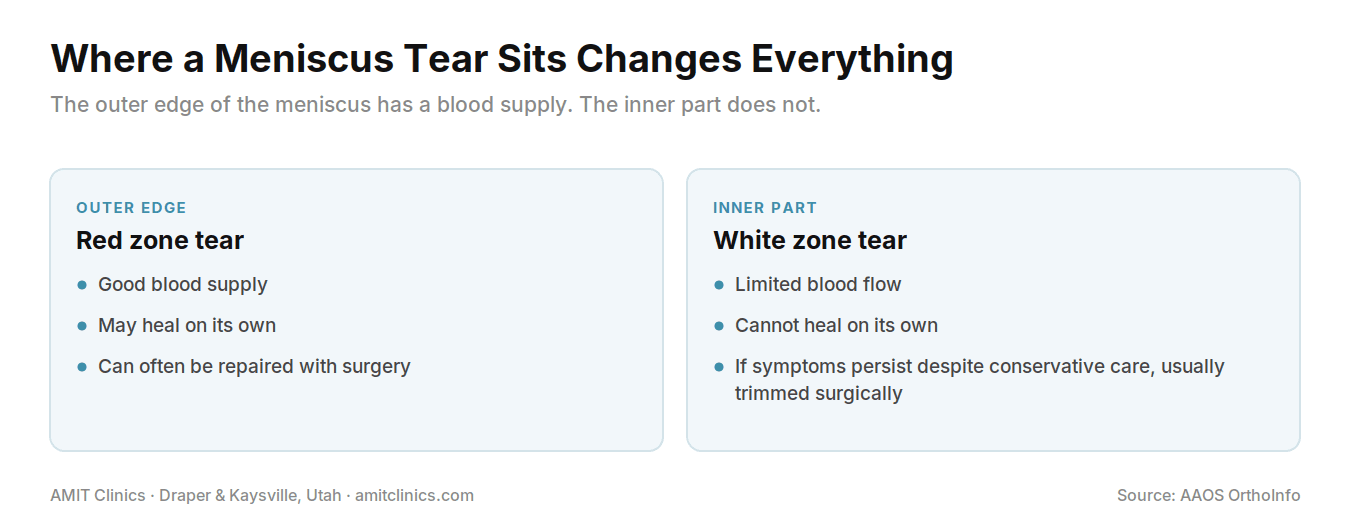
Outer "red zone": The outer edge of the meniscus has a good blood supply. Tears here may heal on their own or can often be repaired with surgery.
Inner "white zone": The inner part has limited blood flow, so tears here cannot heal. When they keep causing symptoms despite conservative care, they are usually trimmed surgically.
An MRI is used to see the meniscus; X-rays show bone and are used to rule out other problems.
Does a Meniscus Tear Need Surgery?
Not always. According to the American Academy of Orthopaedic Surgeons, many meniscus tears do not need immediate surgery. If symptoms do not persist and the knee is not locking or staying swollen, nonsurgical treatment may be recommended. Signs that point toward a surgical evaluation include:
The knee locks or catches and you cannot fully straighten it
Swelling keeps returning
Ask a physician to evaluate the knee first, as the steps below recommend. After that, whether you have surgery or not, the muscles around the knee are what protect it from here on.
AMIT Treatment for Meniscus Tears
What Happens During a Meniscus Tear?
A meniscus tear is a defect in one or both fibrocartilage menisci of the knee that affects their ability to properly position and support the knee. This can cause a small, painful click inside the knee, along with joint line tenderness. While surgical repair is often necessary to treat a torn meniscus, AMIT can play a crucial role in accelerating recovery.
How Does AMIT Help?
Advanced Muscle Integration Technique (AMIT) assists in the recovery process after surgical repair by reactivating the muscles surrounding the knee. When the knee experiences trauma, some muscles may become inhibited, slowing down recovery. AMIT helps restore proper muscle function, improving stability and accelerating the healing process after surgery.
On a first visit we review your imaging and the surgeon's notes if you have them, then test the quadriceps, hamstrings, and calf muscles one at a time to find the ones that shut down after the injury or surgery. The visit takes about 40 minutes; what to expect explains how to prepare, and our article on post-surgical rehabilitation explains how we work alongside your surgeon's plan.
Steps to Take If You Have a Meniscus Tear
Consult a Specialist: If you suspect a meniscus tear, consult a physician to evaluate whether surgical repair is needed.
Consider AMIT for Recovery: After surgery, AMIT can help restore muscle function, improving your recovery time. Contact a certified AMIT physician to schedule a consultation.
Why Choose AMIT for Meniscus Tear Recovery?
Supports Post-Surgery Recovery: AMIT can help improve muscle function after meniscus surgery, speeding up rehabilitation.
Restores Knee Stability: By reactivating inhibited muscles, AMIT helps restore proper knee function and support.
Prevents Future Injuries: Proper muscle balance around the knee joint reduces the risk of future knee injuries.
If you’ve experienced a meniscus tear and are recovering from surgery, contact Advanced Muscle Integration Clinics in the Salt lake City Area to learn how AMIT can assist your rehabilitation process. A certified AMIT physician can help you get back to your normal activities faster and with more confidence.
Call us today at 801.544.2355 or fill out our online form to schedule a consultation.
Meniscus Tear Care in Draper and Kaysville
AMIT Clinics works with knee injuries at both Utah locations: Draper, at 12371 S 900 E Unit 101, and Kaysville, at 447 North 300 West Ste 5. We see athletes after cutting and pivoting injuries, people recovering from meniscus surgery, and older adults with degenerative tears. Related knee injuries are covered on our MCL sprain page and in knee injury treatment without surgery.
Frequently Asked Questions About Meniscus Tears
What does a torn meniscus feel like?
Often a pop at the time of injury, then pain, especially when twisting or rotating the knee. Over 2 to 3 days the knee usually gets stiffer and more swollen, and it may catch or lock.
Can you walk on a torn meniscus?
Most people can, and many athletes keep playing right after the injury. That is one reason meniscus tears are often not recognized until the swelling and stiffness build.
Will a torn meniscus heal on its own?
It depends on where it is. Tears in the outer red zone, which has a blood supply, may heal on their own. Tears in the inner white zone cannot heal because they lack blood flow.
Does a meniscus tear always need surgery?
No. Many meniscus tears do not need immediate surgery. Locking, recurring swelling, or symptoms that persist despite conservative care are the usual reasons for a surgical evaluation.
Does a meniscus tear show on an X-ray?
No. The meniscus is cartilage and does not show on X-ray. An MRI is used to see it, while X-rays help rule out other problems.
How can AMIT help after meniscus surgery?
Knee trauma and surgery can leave the surrounding muscles inhibited, which slows recovery. AMIT reactivates those muscles to help restore stability and function alongside your rehabilitation plan.
Call 801.544.2355 to be seen.
Schedule an Appointment
Call: 801.544.2355
Or, use the link below to get started:
How to Identify Meniscus Tears and the AMIT Solution
A meniscus tear is a tear in one of the two wedge-shaped pieces of cartilage that cushion the knee between the thighbone and shinbone. It is among the most common knee injuries, and when people talk about "torn cartilage" in the knee they usually mean a torn meniscus. You may feel a pop when it happens, but most people can still walk, and many athletes keep playing. Over the next 2 to 3 days the knee gradually becomes stiffer and more swollen.
Whether a tear needs surgery depends on its type, size, and location. Many meniscus tears do not need immediate surgery, while locking or ongoing swelling are reasons to get a surgical opinion. In both cases, getting the muscles around the knee working again is a large part of recovery.
A meniscus tear is one of the most common knee injuries. Each knee contains two menisci-C-shaped pieces of cartilage that act as cushions between the shinbone and the thighbone.
These menisci play a crucial role in stabilizing and supporting the knee joint. This is one of the hip and knee care AMIT addresses by restoring proper muscle activation instead of relying on surgery.
On This Page:
Causes of Meniscus Tears
Symptoms of Meniscus Tears
Types of Meniscus Tears
Does a Meniscus Tear Need Surgery?
AMIT Treatment for Meniscus Tears
Causes of Meniscus Tears
Meniscus tears can occur during any activity that involves forcefully twisting or rotating the knee, especially under the pressure of full body weight. Common causes include:
Sudden Twists: Sharp changes in direction or pivoting, such as during sports like basketball or soccer.
Squatting or Heavy Lifting: Bending deeply at the knees or lifting heavy objects can stress the menisci.
Aging: The menisci can weaken over time, making them more susceptible to injury.
As people age they are more likely to have degenerative meniscus tears, because worn tissue tears more easily. Meniscus tears also often happen together with an ACL injury.
Symptoms of Meniscus Tears
Typical symptoms of a meniscus tear include:
Popping Sensation: A feeling or sound of a pop in the knee at the time of injury.
Swelling and Stiffness: The knee may become swollen and difficult to move.
Pain When Twisting or Rotating: Discomfort occurs with certain knee movements, such as twisting or pivoting.
Difficulty Straightening the Knee: The knee may feel like it's locked in place, limiting your range of motion.
Types of Meniscus Tears
Tears are described by their shape and by where they sit. Common types include bucket handle, flap, and radial tears. Location matters just as much as shape:
Outer "red zone": The outer edge of the meniscus has a good blood supply. Tears here may heal on their own or can often be repaired with surgery.
Inner "white zone": The inner part has limited blood flow, so tears here cannot heal. When they keep causing symptoms despite conservative care, they are usually trimmed surgically.
An MRI is used to see the meniscus; X-rays show bone and are used to rule out other problems.
Does a Meniscus Tear Need Surgery?
Not always. According to the American Academy of Orthopaedic Surgeons, many meniscus tears do not need immediate surgery. If symptoms do not persist and the knee is not locking or staying swollen, nonsurgical treatment may be recommended. Signs that point toward a surgical evaluation include:
The knee locks or catches and you cannot fully straighten it
Swelling keeps returning
Ask a physician to evaluate the knee first, as the steps below recommend. After that, whether you have surgery or not, the muscles around the knee are what protect it from here on.
AMIT Treatment for Meniscus Tears
What Happens During a Meniscus Tear?
A meniscus tear is a defect in one or both fibrocartilage menisci of the knee that affects their ability to properly position and support the knee. This can cause a small, painful click inside the knee, along with joint line tenderness. While surgical repair is often necessary to treat a torn meniscus, AMIT can play a crucial role in accelerating recovery.
How Does AMIT Help?
Advanced Muscle Integration Technique (AMIT) assists in the recovery process after surgical repair by reactivating the muscles surrounding the knee. When the knee experiences trauma, some muscles may become inhibited, slowing down recovery. AMIT helps restore proper muscle function, improving stability and accelerating the healing process after surgery.
On a first visit we review your imaging and the surgeon's notes if you have them, then test the quadriceps, hamstrings, and calf muscles one at a time to find the ones that shut down after the injury or surgery. The visit takes about 40 minutes; what to expect explains how to prepare, and our article on post-surgical rehabilitation explains how we work alongside your surgeon's plan.
Steps to Take If You Have a Meniscus Tear
Consult a Specialist: If you suspect a meniscus tear, consult a physician to evaluate whether surgical repair is needed.
Consider AMIT for Recovery: After surgery, AMIT can help restore muscle function, improving your recovery time. Contact a certified AMIT physician to schedule a consultation.
Why Choose AMIT for Meniscus Tear Recovery?
Supports Post-Surgery Recovery: AMIT can help improve muscle function after meniscus surgery, speeding up rehabilitation.
Restores Knee Stability: By reactivating inhibited muscles, AMIT helps restore proper knee function and support.
Prevents Future Injuries: Proper muscle balance around the knee joint reduces the risk of future knee injuries.
If you’ve experienced a meniscus tear and are recovering from surgery, contact Advanced Muscle Integration Clinics in the Salt lake City Area to learn how AMIT can assist your rehabilitation process. A certified AMIT physician can help you get back to your normal activities faster and with more confidence.
Call us today at 801.544.2355 or fill out our online form to schedule a consultation.
Meniscus Tear Care in Draper and Kaysville
AMIT Clinics works with knee injuries at both Utah locations: Draper, at 12371 S 900 E Unit 101, and Kaysville, at 447 North 300 West Ste 5. We see athletes after cutting and pivoting injuries, people recovering from meniscus surgery, and older adults with degenerative tears. Related knee injuries are covered on our MCL sprain page and in knee injury treatment without surgery.
Frequently Asked Questions About Meniscus Tears
What does a torn meniscus feel like?
Often a pop at the time of injury, then pain, especially when twisting or rotating the knee. Over 2 to 3 days the knee usually gets stiffer and more swollen, and it may catch or lock.
Can you walk on a torn meniscus?
Most people can, and many athletes keep playing right after the injury. That is one reason meniscus tears are often not recognized until the swelling and stiffness build.
Will a torn meniscus heal on its own?
It depends on where it is. Tears in the outer red zone, which has a blood supply, may heal on their own. Tears in the inner white zone cannot heal because they lack blood flow.
Does a meniscus tear always need surgery?
No. Many meniscus tears do not need immediate surgery. Locking, recurring swelling, or symptoms that persist despite conservative care are the usual reasons for a surgical evaluation.
Does a meniscus tear show on an X-ray?
No. The meniscus is cartilage and does not show on X-ray. An MRI is used to see it, while X-rays help rule out other problems.
How can AMIT help after meniscus surgery?
Knee trauma and surgery can leave the surrounding muscles inhibited, which slows recovery. AMIT reactivates those muscles to help restore stability and function alongside your rehabilitation plan.
Call 801.544.2355 to be seen.
Schedule an Appointment
Call: 801.544.2355
Or, use the link below to get started:
How to Identify Meniscus Tears and the AMIT Solution
A meniscus tear is a tear in one of the two wedge-shaped pieces of cartilage that cushion the knee between the thighbone and shinbone. It is among the most common knee injuries, and when people talk about "torn cartilage" in the knee they usually mean a torn meniscus. You may feel a pop when it happens, but most people can still walk, and many athletes keep playing. Over the next 2 to 3 days the knee gradually becomes stiffer and more swollen.
Whether a tear needs surgery depends on its type, size, and location. Many meniscus tears do not need immediate surgery, while locking or ongoing swelling are reasons to get a surgical opinion. In both cases, getting the muscles around the knee working again is a large part of recovery.
A meniscus tear is one of the most common knee injuries. Each knee contains two menisci-C-shaped pieces of cartilage that act as cushions between the shinbone and the thighbone.
These menisci play a crucial role in stabilizing and supporting the knee joint. This is one of the hip and knee care AMIT addresses by restoring proper muscle activation instead of relying on surgery.
On This Page:
Causes of Meniscus Tears
Symptoms of Meniscus Tears
Types of Meniscus Tears
Does a Meniscus Tear Need Surgery?
AMIT Treatment for Meniscus Tears
Causes of Meniscus Tears
Meniscus tears can occur during any activity that involves forcefully twisting or rotating the knee, especially under the pressure of full body weight. Common causes include:
Sudden Twists: Sharp changes in direction or pivoting, such as during sports like basketball or soccer.
Squatting or Heavy Lifting: Bending deeply at the knees or lifting heavy objects can stress the menisci.
Aging: The menisci can weaken over time, making them more susceptible to injury.
As people age they are more likely to have degenerative meniscus tears, because worn tissue tears more easily. Meniscus tears also often happen together with an ACL injury.
Symptoms of Meniscus Tears
Typical symptoms of a meniscus tear include:
Popping Sensation: A feeling or sound of a pop in the knee at the time of injury.
Swelling and Stiffness: The knee may become swollen and difficult to move.
Pain When Twisting or Rotating: Discomfort occurs with certain knee movements, such as twisting or pivoting.
Difficulty Straightening the Knee: The knee may feel like it's locked in place, limiting your range of motion.
Types of Meniscus Tears
Tears are described by their shape and by where they sit. Common types include bucket handle, flap, and radial tears. Location matters just as much as shape:
Outer "red zone": The outer edge of the meniscus has a good blood supply. Tears here may heal on their own or can often be repaired with surgery.
Inner "white zone": The inner part has limited blood flow, so tears here cannot heal. When they keep causing symptoms despite conservative care, they are usually trimmed surgically.
An MRI is used to see the meniscus; X-rays show bone and are used to rule out other problems.
Does a Meniscus Tear Need Surgery?
Not always. According to the American Academy of Orthopaedic Surgeons, many meniscus tears do not need immediate surgery. If symptoms do not persist and the knee is not locking or staying swollen, nonsurgical treatment may be recommended. Signs that point toward a surgical evaluation include:
The knee locks or catches and you cannot fully straighten it
Swelling keeps returning
Ask a physician to evaluate the knee first, as the steps below recommend. After that, whether you have surgery or not, the muscles around the knee are what protect it from here on.
AMIT Treatment for Meniscus Tears
What Happens During a Meniscus Tear?
A meniscus tear is a defect in one or both fibrocartilage menisci of the knee that affects their ability to properly position and support the knee. This can cause a small, painful click inside the knee, along with joint line tenderness. While surgical repair is often necessary to treat a torn meniscus, AMIT can play a crucial role in accelerating recovery.
How Does AMIT Help?
Advanced Muscle Integration Technique (AMIT) assists in the recovery process after surgical repair by reactivating the muscles surrounding the knee. When the knee experiences trauma, some muscles may become inhibited, slowing down recovery. AMIT helps restore proper muscle function, improving stability and accelerating the healing process after surgery.
On a first visit we review your imaging and the surgeon's notes if you have them, then test the quadriceps, hamstrings, and calf muscles one at a time to find the ones that shut down after the injury or surgery. The visit takes about 40 minutes; what to expect explains how to prepare, and our article on post-surgical rehabilitation explains how we work alongside your surgeon's plan.
Steps to Take If You Have a Meniscus Tear
Consult a Specialist: If you suspect a meniscus tear, consult a physician to evaluate whether surgical repair is needed.
Consider AMIT for Recovery: After surgery, AMIT can help restore muscle function, improving your recovery time. Contact a certified AMIT physician to schedule a consultation.
Why Choose AMIT for Meniscus Tear Recovery?
Supports Post-Surgery Recovery: AMIT can help improve muscle function after meniscus surgery, speeding up rehabilitation.
Restores Knee Stability: By reactivating inhibited muscles, AMIT helps restore proper knee function and support.
Prevents Future Injuries: Proper muscle balance around the knee joint reduces the risk of future knee injuries.
If you’ve experienced a meniscus tear and are recovering from surgery, contact Advanced Muscle Integration Clinics in the Salt lake City Area to learn how AMIT can assist your rehabilitation process. A certified AMIT physician can help you get back to your normal activities faster and with more confidence.
Call us today at 801.544.2355 or fill out our online form to schedule a consultation.
Meniscus Tear Care in Draper and Kaysville
AMIT Clinics works with knee injuries at both Utah locations: Draper, at 12371 S 900 E Unit 101, and Kaysville, at 447 North 300 West Ste 5. We see athletes after cutting and pivoting injuries, people recovering from meniscus surgery, and older adults with degenerative tears. Related knee injuries are covered on our MCL sprain page and in knee injury treatment without surgery.
Frequently Asked Questions About Meniscus Tears
What does a torn meniscus feel like?
Often a pop at the time of injury, then pain, especially when twisting or rotating the knee. Over 2 to 3 days the knee usually gets stiffer and more swollen, and it may catch or lock.
Can you walk on a torn meniscus?
Most people can, and many athletes keep playing right after the injury. That is one reason meniscus tears are often not recognized until the swelling and stiffness build.
Will a torn meniscus heal on its own?
It depends on where it is. Tears in the outer red zone, which has a blood supply, may heal on their own. Tears in the inner white zone cannot heal because they lack blood flow.
Does a meniscus tear always need surgery?
No. Many meniscus tears do not need immediate surgery. Locking, recurring swelling, or symptoms that persist despite conservative care are the usual reasons for a surgical evaluation.
Does a meniscus tear show on an X-ray?
No. The meniscus is cartilage and does not show on X-ray. An MRI is used to see it, while X-rays help rule out other problems.
How can AMIT help after meniscus surgery?
Knee trauma and surgery can leave the surrounding muscles inhibited, which slows recovery. AMIT reactivates those muscles to help restore stability and function alongside your rehabilitation plan.
Call 801.544.2355 to be seen.
Schedule an Appointment
Call: 801.544.2355
Or, use the link below to get started: