
If a doctor has mentioned surgery for your shoulder, you probably walked out of that appointment with one question: is there anything else I can try first? For most shoulder problems, the answer is yes. Impingement, frozen shoulder, tendinitis and many rotator cuff tears are treated without an operation first, and the American Academy of Orthopaedic Surgeons (AAOS) reports that nonsurgical treatment relieves pain and improves function in about 80 to 85% of patients with a rotator cuff tear.
An alternative to shoulder surgery is any treatment that aims to restore pain-free movement without operating on the joint. That includes physical therapy, activity changes, medication, injections, and hands-on care that changes how the shoulder muscles work together. Which option fits you depends on what is actually wrong, how long it has been going on, and whether anything is torn.
This guide covers the options condition by condition, explains how long a fair trial of non-surgical care should last, and lists the situations where surgery really is the better choice.
Key takeaways
• Unless you have a fracture, a dislocation or a sudden traumatic tear, most shoulder problems are treated without surgery first.
• According to the AAOS, nonsurgical care relieves pain and improves function in about 80 to 85% of people with a rotator cuff tear.
• The right alternative depends on the diagnosis. Frozen shoulder, impingement and rotator cuff problems do not respond to the same things.
• Give non-surgical care a defined trial with checkpoints, not an open-ended "wait and see."
• Some shoulders do need surgery. Sudden weakness after an injury is the clearest example.
In this guide
• Why surgery is rarely the first step for shoulder pain
• Alternatives to shoulder surgery, condition by condition
• The main non-surgical options compared
• How the AMIT approach fits in
• How long to try non-surgical treatment
• When surgery is the right call
• Questions to ask before you agree to shoulder surgery
• Alternative to shoulder surgery near Draper, Utah
• Frequently asked questions
Why surgery is rarely the first step for shoulder pain

The shoulder is the most mobile joint in the body, and it pays for that mobility with very little bony stability. A shallow ball sits against a small socket, and what keeps it centered is soft tissue: the four rotator cuff muscles, their tendons, the joint capsule, and the muscles that move and steady the shoulder blade. When one of those muscles stops doing its share, the others compensate, the ball drifts slightly out of its ideal track, and tissues start to get pinched or overloaded.
That is why so much shoulder pain is a movement and muscle problem rather than a structural one that needs to be cut and repaired. It is also why the AAOS states plainly for shoulder impingement that "in most cases, initial treatment is nonsurgical." Many patients improve gradually, although complete recovery can take several weeks to months.
Compare that with the surgical route for the same condition. After impingement surgery, the AAOS says it typically takes 2 to 4 months to reach complete pain relief and can take up to a year. Add the sling, the time off work or sport, the anesthesia, and the usual surgical risks such as infection and post-operative stiffness, and it is easy to see why surgeons themselves usually want a real attempt at conservative care before they operate.
Surgery is not the enemy. It is a tool for specific problems, and the goal of trying alternatives first is to make sure you only use it when you need it.
Alternatives to shoulder surgery, condition by condition
"Shoulder pain" covers very different problems. Here is how the non-surgical picture looks for the conditions we see most often.
Shoulder impingement
Shoulder impingement is pain that happens when the rotator cuff tendons and the bursa above them get pinched under the top of the shoulder blade (the acromion), usually when you lift your arm out to the side or overhead.
Because impingement is mostly about how the shoulder blade and upper arm move together, the first-line alternatives target mechanics: rest from the aggravating movement, physical therapy to strengthen the rotator cuff and shoulder blade muscles, anti-inflammatory medication for flare-ups, and sometimes a cortisone injection to calm an irritated bursa. At our clinic we also test each rotator cuff muscle one at a time and check the neck, because a muscle that is not activating properly or a stiff upper neck can keep the shoulder blade from moving the way it should. You can read how we assess and treat it on our shoulder impingement treatment in Utah page.
Surgery (usually an arthroscopic procedure to make more room under the acromion) is typically discussed only when pain persists after a solid trial of these options.
Frozen shoulder (adhesive capsulitis)
Frozen shoulder is a condition in which the capsule around the shoulder joint thickens and tightens, causing pain and a steady loss of motion in every direction. It is most common between ages 40 and 60, more common in women, and more likely in people with diabetes or thyroid conditions.
Frozen shoulder has a natural course. The AAOS describes a freezing stage that lasts from 6 weeks to 9 months, a frozen stage of 4 to 6 months, and a thawing stage in which a return to normal or near-normal motion typically takes 6 months to 2 years. It also notes that most people improve with relatively simple treatments to control pain and restore motion, although full recovery may take up to 3 years.
That timeline is the real problem. Few people want to wait two or three years, which is why they start hearing about manipulation under anesthesia or arthroscopic capsular release. Before that point, the usual alternatives are a gentle, progressive stretching program, anti-inflammatory medication, and a cortisone injection, which tends to help most in the painful early stage. Our frozen shoulder treatment adds muscle activation work and treatment of the upper neck, which we find often contributes to the guarding and stiffness.
For a real-world example, read how Mary's six-month frozen shoulder was treated without surgery. She had already tried cortisone, which helped for a few weeks, and had been told surgery was her next step. Her story shows what the process looks like from the patient's side, from the first exam to lifting her arm overhead again.
Rotator cuff strain, tendinitis and degenerative tears
The rotator cuff is the group of four muscles and tendons that hold the ball of the upper arm in the socket. Problems range from a strain or tendinitis, to a partial tear, to a full-thickness tear. The AAOS reports that almost 2 million people in the U.S. visit their doctors each year because of rotator cuff tears.
The key distinction is how the problem started. Acute tears happen suddenly, from a fall on an outstretched arm or lifting something heavy with a jerk. Degenerative tears develop slowly from wear, repetitive overhead work, or reduced blood supply to the tendon with age. Strains and degenerative tears are where non-surgical care tends to do best, and they make up a large share of the patients behind the AAOS figure of 80 to 85% improvement with nonsurgical treatment.
Standard alternatives include rest and activity modification, a strengthening program, anti-inflammatory medication and, in some cases, an injection. Our rotator cuff strain treatment focuses on reactivating the muscles that have shut down after the injury so the healthy parts of the cuff can share the load again.
Shoulder arthritis
If your surgeon is talking about a shoulder replacement, the cause is usually arthritis that has worn away the cartilage. Exercise, activity changes, anti-inflammatory medication and injections can reduce pain and delay a replacement, sometimes for years, but they cannot regrow lost cartilage. If you have advanced, bone-on-bone arthritis, ask your orthopedic surgeon directly what you can realistically expect from conservative care. The rest of this guide focuses on the soft-tissue problems above, where avoiding surgery altogether is often a realistic goal.
The main non-surgical options compared
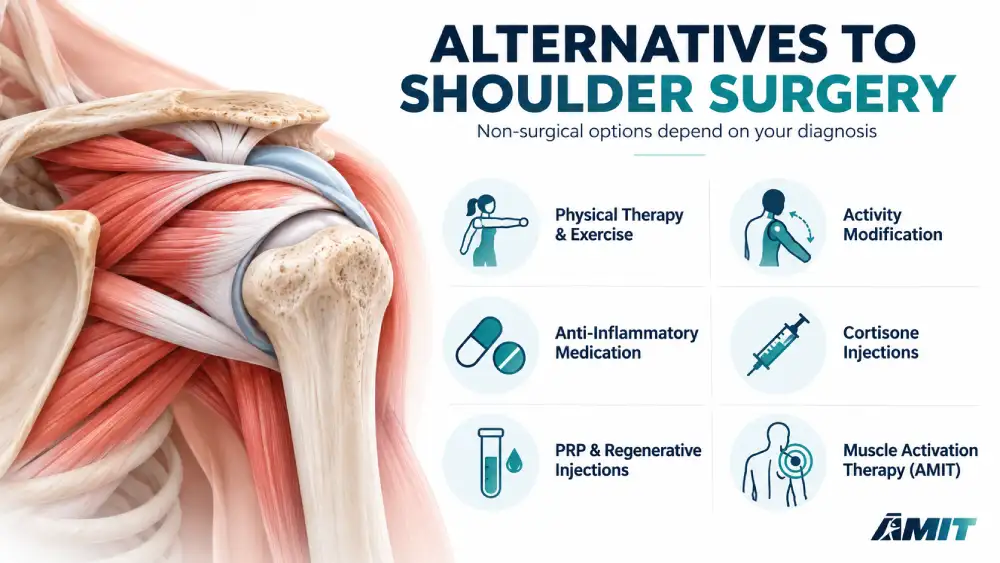
Most people end up using two or three of these together. This table shows what each one does and where it falls short.
Option | What it does | Best suited for | Limits |
Physical therapy and home exercise | Strengthens the rotator cuff and shoulder blade muscles, restores range of motion | Impingement, rotator cuff strain and degenerative tears, frozen shoulder | Takes consistent work over weeks; results depend on doing the exercises |
Activity modification | Removes the movement or load that keeps irritating the tissue | Early impingement, tendinitis, overuse | Calms symptoms but does not fix the underlying mechanics on its own |
Anti-inflammatory medication | Reduces pain and inflammation | Flare-ups in most conditions | Short-term relief; not suitable for everyone, so check with your doctor |
Cortisone injection | Strong anti-inflammatory placed in or near the joint | Painful early frozen shoulder, irritated bursa in impingement | Relief often fades; repeated injections are usually limited |
PRP and other regenerative injections | Uses concentrated components of your own blood to support tissue healing | Some tendon problems | Evidence is still developing and insurance often does not cover it |
Muscle activation therapy (AMIT) | Identifies muscles that are not firing properly and restores their activation | Shoulder pain linked to muscle inhibition, compensation patterns and neck involvement | Not a fix for complete traumatic tears, fractures or advanced arthritis |
A few practical notes from our experience. Cortisone is often the first thing a primary care doctor offers, and it can be very useful for getting through a painful stretch. The trouble is that pain relief can let you return to the same movement pattern that caused the problem, so the pain comes back when the injection wears off. That was Mary's experience. Whatever you choose, pair pain relief with something that changes how the shoulder moves.
How the AMIT approach fits in

The Advanced Muscle Integration Technique (A.M.I.T.) was developed by Dr. Buhler, a chiropractor with 47 years of experience who spent 24 years as a chiropractor for the NBA's Utah Jazz. It starts from a simple observation: after an injury, some muscles become inhibited, meaning they stop activating properly even though they are not torn. The muscles around them pick up the slack, and those compensations are what keep the joint irritated.
In the shoulder, that often means one or more rotator cuff muscles, such as the infraspinatus, teres minor or subscapularis, have stopped doing their job. A first visit includes a full muscle exam: we watch how the shoulder blade and arm move together, test the rotator cuff muscles one at a time, and check the neck, because in our experience restricted motion in the upper neck often goes hand in hand with shoulder muscles that will not switch on. If we suspect a tendon tear, we refer you for imaging before treating. Follow-up visits reactivate the inhibited muscles in sequence.
What we value most about this approach for people weighing surgery is that it gives a fast, honest answer. Our own guideline for rotator cuff problems is that if a patient does not respond to AMIT within two to three visits, that can indicate the cuff is torn and needs surgical attention. You are not left guessing for months.
How long to try non-surgical treatment
None of the top-ranking articles on this topic tell you how long to try conservative care, and an open-ended trial is exactly how people end up stuck for a year. The right timeline depends on the condition and the treatment, but you can set clear checkpoints.
Ask for a timeline at the first visit. Any provider offering an alternative to shoulder surgery should be able to tell you what change to expect and by when. If they cannot, that is useful information.
Track a few specific things. Pain scores are vague. These are easier to judge:
• How high can you lift your arm before it hurts, and can you reach behind your back?
• Can you sleep on the painful side? Does pain wake you up at night?
• Can you do the specific task that bothers you most, such as reaching a high shelf, fastening a bra, or throwing?
Use the condition as a guide. For impingement, the AAOS says recovery with nonsurgical care can take several weeks to months, so steady progress over that period is a good sign even if you are not pain-free yet. For a suspected rotator cuff problem treated with AMIT, look for clear change within two to three visits. Frozen shoulder is slower by nature, so the question is whether motion is improving from month to month, not whether it is back to normal in a few weeks.
Reassess if you plateau. If nothing has changed by your checkpoint, go back to your doctor for imaging or a surgical opinion. Trying an alternative is not a commitment to avoid surgery at all costs.
When surgery is the right call
A good conservative-care provider will tell you when you need a surgeon. These situations usually call for a prompt orthopedic evaluation rather than a long trial of alternatives:
• Sudden weakness after an injury. If you fell or felt a pop and now cannot lift your arm, an acute full-thickness rotator cuff tear is possible, and surgeons often recommend early repair for these, especially in younger and active people.
• A dislocation or suspected fracture. Visible deformity, severe pain after a fall, or a shoulder that keeps slipping out needs imaging and specialist care.
• No progress after a fair trial. When well-run conservative care has not helped by your checkpoint, surgery may be the most direct route back to function.
• Heavy overhead demands. The AAOS notes surgery may be recommended for very active people who use their arms for overhead work or sports.
• Advanced arthritis with severe pain and lost function that no longer responds to conservative care.
• Warning signs that are not mechanical, such as fever, a hot and swollen joint, numbness or tingling down the arm, or pain with unexplained weight loss. See a doctor right away.
Questions to ask before you agree to shoulder surgery
If surgery is on the table, these questions help you make the decision with full information:
1. What exactly is the diagnosis, and does my imaging match my symptoms?
2. What non-surgical options have we tried, and for how long?
3. What happens if I wait three months? Does the delay make the outcome worse?
4. What does recovery look like: time in a sling, time off work, and how long until I am back to full activity?
5. What results do patients like me usually get from this procedure?
6. Would a second opinion, or a trial of a different conservative approach, change your recommendation?
A surgeon who is confident in a recommendation will welcome these questions. And if the answers show you have not yet had a real trial of conservative care, you have a clear next step.
Alternative to shoulder surgery near Draper, Utah
If you are looking for an alternative to shoulder surgery near you in the Salt Lake Valley, AMIT Clinics treats shoulder impingement, frozen shoulder and rotator cuff problems at our Draper clinic (12371 S 900 E, Unit 101, Draper, UT 84020), with a second location in Kaysville (447 North 300 West, Suite 5). Your first visit includes a full muscle exam and a frank conversation about whether your shoulder is a good fit for non-surgical care or needs a surgeon. Patients come to us from across the south end of the valley, and if we think your shoulder needs a surgeon, we will tell you.
Frequently asked questions
Is it possible to repair a shoulder without surgery?
Yes, for many shoulder problems. Strains, tendinitis, impingement, frozen shoulder and many degenerative rotator cuff tears improve with non-surgical care, and the AAOS reports that about 80 to 85% of rotator cuff tear patients improve with nonsurgical treatment. A torn tendon does not knit back together on its own, but the surrounding muscles can often be retrained to restore pain-free function.
Is there a way to avoid shoulder replacement surgery?
Sometimes, or at least for a while. Exercise, activity changes, medication and injections can reduce arthritis pain and delay a replacement, sometimes for years. They cannot rebuild worn cartilage, so for advanced bone-on-bone arthritis a replacement may eventually be the best option.
Can you live with shoulder arthritis without surgery?
Many people do. With strengthening, sensible activity changes and occasional injections, people with mild to moderate shoulder arthritis often keep a good level of function. Surgery becomes more likely when pain disturbs sleep, daily tasks become hard, and conservative care stops working.
What is the best alternative to rotator cuff surgery?
There is no single best option, but a structured program that restores how the rotator cuff muscles work is the foundation, often combined with short-term pain relief. At AMIT Clinics we focus on reactivating inhibited cuff muscles and expect to see clear change within two to three visits. If that does not happen, a tear may need surgical repair.
How long should I try non-surgical treatment before shoulder surgery?
It depends on the condition. For impingement, the AAOS says nonsurgical recovery can take several weeks to months, while frozen shoulder can take much longer to resolve. Agree on specific checkpoints with your provider at the start, and get a surgical opinion if you have not improved by then.
Where can I find an alternative to shoulder surgery near me in Draper?
AMIT Clinics in Draper, Utah, offers non-surgical treatment for shoulder impingement, frozen shoulder and rotator cuff problems. Call 801.544.2355 to schedule an initial exam or a free consultation call with an AMIT doctor.
Most shoulder problems give you time to try something other than surgery, and in many cases that something works. The key is matching the treatment to the diagnosis, setting a clear timeline, and being honest about the situations where surgery is the better path. If you have been told surgery is your next step and you have not had a real trial of conservative care, it is worth a second look.
Related reading: Frozen Shoulder vs Shoulder Impingement: How to Tell the Difference and Shoulder Pain That Won't Heal: A Guide for Athletes and Active Adults.
Not sure if your shoulder is a candidate? Get a free consultation call from a real AMIT doctor at 801.544.2355. We will listen to your history and tell you plainly whether non-surgical care makes sense for you.