
Key Takeaways
A sports chiropractor focuses on injuries from training and competition, and on getting you back to your sport, not just out of pain.
Adult athletes heal differently than teenagers: slower recovery between sessions, old injuries that left compensations, and desk jobs between workouts.
At AMIT Clinics in Draper and Kaysville, the first visit tests how individual muscles are firing, so treatment targets the reason the injury happened.
See a medical doctor first for a suspected fracture, dislocation, spreading numbness, a head injury, or a joint that won't bear weight.
No referral is needed to book.
If you searched "sports chiropractor near me," you probably have a specific problem in mind. A hamstring that grabs every time you open your stride. A shoulder that complains on the third set. A knee that hasn't felt right since the end of ski season. You want someone who understands training, not just pain.
A sports chiropractor is a chiropractor who focuses on injuries caused or aggravated by sport and exercise, and on returning athletes to full training. For adults in Draper, Kaysville, and the rest of the Wasatch Front, good sports chiropractic care comes down to finding out why the injury happened, treating both the sore tissue and the movement pattern behind it, and building a realistic plan back to the trail, the court, or the slopes.
This guide is written for adult athletes: weekend warriors, masters competitors, and lifelong runners, skiers, and lifters. If you're a parent of a high school athlete, our guide to preventing youth sports injuries is the better read, since growing bodies and a fall sports schedule change the picture quite a bit.
What Does a Sports Chiropractor Actually Do?
A sports chiropractor assesses, treats, and helps prevent injuries that come from training and competition. The goal is to calm the pain and also get you back to full training without the injury returning. In practice, that means a detailed history of how you train, a hands-on movement and muscle assessment, treatment such as adjustments, soft tissue work, and muscle activation, and a plan for returning to your sport.
Sports chiropractic is a focus within chiropractic care built around athletes and active people. In the United States, some chiropractors hold formal sports credentials, such as the Certified Chiropractic Sports Physician (CCSP) or the Diplomate of the American Chiropractic Board of Sports Physicians (DACBSP). Others build the focus through years of hands-on work with teams and competitive athletes. Either way, it's fair to ask a clinic what its sports experience actually looks like.
Athletes use this kind of care more often than most people realize. In a survey of 309 Division I college athletes published in the Clinical Journal of Sport Medicine (Nichols and Harrigan, 2006), 29 percent reported seeing a chiropractor in the previous 12 months.
At AMIT Clinics, the sports background goes back decades. Our founder, Dr. Craig Buhler, spent more than 20 years as team chiropractor for the Utah Jazz and two decades caring for the US Ski Team. Dr. Alec Russell holds a degree in exercise science and treats sports injuries as a primary focus of his practice. That experience shapes how we look at a weekend runner's sore knee just as much as a professional's.
Why Adult Athletes Need a Different Approach

Most sports injury content online is written for teenagers or for professionals. Adult recreational athletes sit somewhere else entirely, and the treatment plan should reflect that.
You recover slower, but you still train like you're 25
Muscles, tendons, and ligaments keep adapting to training as you age, but they adapt more slowly, and recovery between hard sessions takes longer. The trouble is that motivated adults rarely adjust their schedule to match. They add a long run, a second ski day, or a heavier lift on the same weekly plan they used a decade ago. A lot of overuse injuries in adults come from that gap between what the body can recover from and what the calendar asks of it. A good sports chiropractor looks at your training load, not just the sore spot.
Old injuries leave compensations behind
By your thirties or forties, you have a history. A sprained ankle from college basketball. A shoulder that "went out" once. A knee scope years ago. Even when the original injury healed, the way your body moves around it often didn't reset. In our clinics, we regularly trace a current problem, like hip pain on long runs, back to an older injury that changed how certain muscles fire. Treating only the hip in that case tends to produce a short-lived result.
Your sport is only part of your day
A teenager goes from class to practice. An adult athlete often sits through eight hours of meetings and a commute, then tries to sprint, cut, or carry a pack up a canyon trail. Long hours of sitting change how the hips and upper back move, and that carries straight into the workout. That's why we ask about your workday, not just your sport.
Common Athletic Injuries We Treat in Adult Athletes
Utah adults stay active year-round, and the injuries tend to follow the seasons. Here's what we see most often at our Draper and Kaysville clinics, grouped by activity:
Runners and trail runners: knee pain, IT band irritation, shin splints, plantar fasciitis, and Achilles tendinitis. If you're trying to decide whether to keep running on a sore knee, our post on knee pain while running and when to stop lays out the warning signs.
Skiers and snowboarders: knee sprains, including MCL sprains, shoulder injuries from falls, and low back strain after long days on the mountain.
Golfers, pickleball and tennis players, climbers, and lifters: shoulder impingement, rotator cuff irritation, and elbow problems such as golfer's elbow. For a shoulder that keeps flaring up, read our guide to shoulder pain that won't heal in athletes and active adults.
Recreational basketball and soccer players: ankle sprains, hamstring strains, and knee irritation from cutting and landing.
Cyclists: low back and neck pain, tight hip flexors, and knee pain from thousands of repeated pedal strokes.
You can see the full list on our conditions we treat page.
How the AMIT Method Fits Into Sports Chiropractic
Most sports injury care focuses on the tissue that hurts. We start one step earlier and ask why that tissue got overloaded in the first place.
Muscle inhibition is when a muscle stops contracting fully after an injury, strain, or repeated overload, even though it isn't torn. When one muscle switches off, neighboring muscles and joints pick up the extra load, and that extra load is often where the next injury shows up.
The A.M.I.T. method (Advanced Muscle Integration Technique), developed by Dr. Buhler, tests individual muscles for how well they're firing, then uses targeted muscle reactivation treatment to restore that activation. Chiropractic adjustments and other therapies support the process when they're useful. For an athlete, the result we look for is simple: the movement that hurt feels normal again, and the strength test that failed now holds.
The approach has a long history in professional sport. One well-known example is how AMIT helped John Stockton return from an ankle sprain during the 1997 NBA Finals. Most of our patients aren't in the NBA, of course. They're people who want to finish a half marathon, ski the whole season, or play pickleball without icing afterward.
We're also straightforward about limits. Some injuries need imaging, a sports medicine physician, or an orthopedic surgeon, and we'll tell you when we think that's the case.
What to Expect at Your First Visit

No referral is needed. You can book directly at either clinic.
A new patient visit takes about 40 minutes. Wear loose athletic clothing, because you'll move, stretch, and contract muscles throughout the exam. Your doctor will ask about your sport, your training volume, any recent jumps in load, and old injuries, then test how specific muscles respond. You'll leave with an explanation of what we found and a treatment plan with an expected number of visits.
Bring anything that helps tell the story: imaging reports, notes from a physical therapist, or your training log. If your watch tracks mileage or training load, that's useful too. Athletes usually remember the day it started hurting, but not the three weeks of extra volume that came before it.
You can read more on our what to expect page and see current rates on our pricing page.
Sports Chiropractor, Physical Therapist, or Doctor?
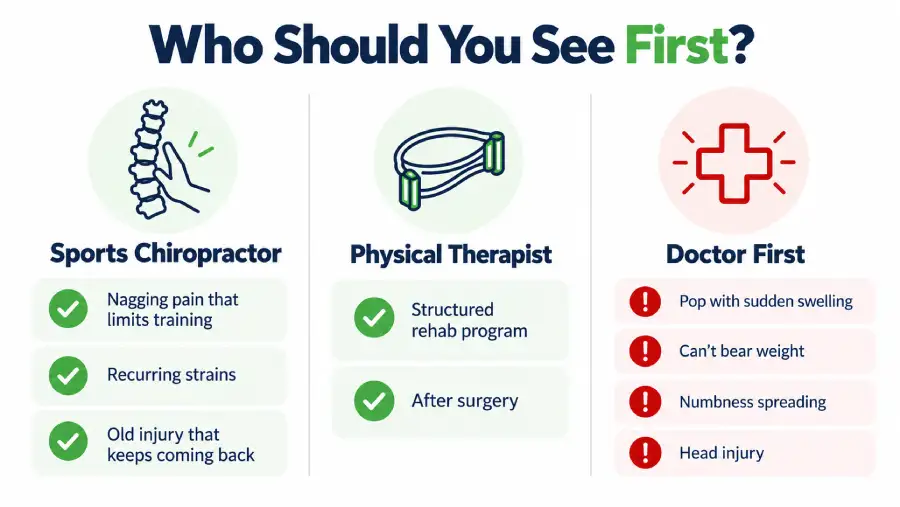
These aren't competing options. Plenty of athletes use more than one, and the right first stop depends on the injury.
See a sports chiropractor when pain limits your training but there are no signs of a serious structural injury: recurring tightness, a nagging joint, a strain that isn't improving, or an old injury that keeps coming back.
See a physical therapist when you need a structured, supervised rehab program, especially after surgery. We often work alongside PT, and our post on rehabilitation after surgery explains how that works.
See a medical doctor or urgent care first if you heard a pop followed by immediate swelling, can't bear weight, see a visible deformity, have numbness or weakness spreading down an arm or leg, or took a hit to the head.
If you're not sure which applies, call us and describe what happened. If it sounds like something that needs a physician or imaging first, we'll say so.
Questions to Ask Any Sports Chiropractor Before You Book
Whether you choose us or another clinic, these questions will tell you a lot in a short phone call:
Do you regularly treat athletes in my sport?
How do you find out why the injury happened, not just where it hurts?
What does the return to training look like, and can I keep training during treatment?
How many visits do you expect, and how will we measure progress?
Will you coordinate with my physical therapist or doctor if I have one?
Vague answers to the second and fourth questions are a red flag. You should hear a specific method and a specific way of measuring whether it's working.
Frequently Asked Questions
What does a sports chiropractor do?
A sports chiropractor assesses and treats injuries related to exercise and sport, then helps you return to training safely. Treatment can include adjustments, soft tissue work, muscle activation techniques, and guidance on training load. At AMIT Clinics, we also test individual muscles to find out what caused the injury.
Is a sports chiropractor different from a regular chiropractor?
Yes, mainly in focus and experience. A sports chiropractor spends most of their time on athletic injuries and performance, and some hold formal sports credentials like the CCSP or DACBSP. A general chiropractor may see more posture, back, and neck complaints that have nothing to do with sport.
Can a chiropractor help with athletic injuries?
Yes, for many of them. Strains, overuse injuries, joint irritation, and problems that keep returning after an old injury often respond well to sports chiropractic care. Fractures, dislocations, complete tears, and head injuries need a medical evaluation first.
Do I need a referral to see a sports chiropractor at AMIT Clinics?
No. You can book a new patient exam directly at our Draper or Kaysville clinic, and the first visit includes a full evaluation before any treatment starts.
How many visits will I need for a sports injury?
It depends on how long the problem has been there and how many muscles are involved. A recent strain may improve in a few visits, while an injury that keeps coming back usually takes longer because the older compensations need treatment too. You'll get an estimate after your first evaluation.
Can I keep training while I'm being treated?
Often, yes, with some changes. We usually adjust your volume or intensity rather than stop you completely, unless the injury needs full rest. The goal is to keep you moving while the underlying problem gets fixed.
Get Back to Your Sport in Draper or Kaysville
If an injury is cutting your runs short, keeping you off the slopes, or making you think twice before the next pickup game, it's worth getting it properly assessed. Book a new patient exam at our Draper clinic or our Kaysville clinic, and bring your training history with you. We'll find out what's driving the problem and lay out a plan to get you back to full training.
Not ready to book yet? Browse more injury and recovery articles for active adults on our blog.